
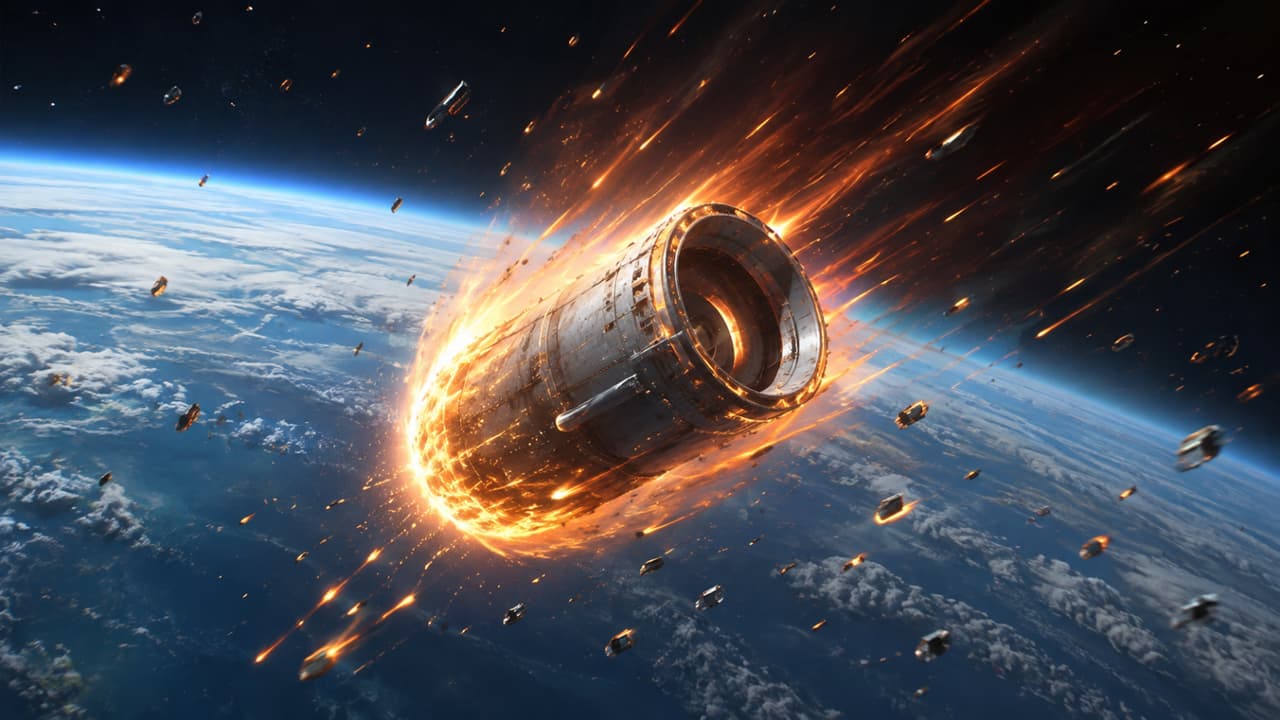
A Falcon 9 rocket stage is set to strike the lunar surface, creating a new crater. Scientists say the impact poses no danger to Earth.
A four-tonne chunk of a SpaceX rocket is set to crash into the Moon on Wednesday, creating a fresh crater but posing no risk to Earth. The unplanned impact is expected to offer scientists a valuable opportunity to study how artificial objects behave when they strike the lunar surface.
The object is the second stage of a Falcon 9 rocket that launched a Firefly Aerospace lunar lander in January 2025, according to a report by The Guardian. After completing its mission, the stage remained in space and drifted for months before being pulled onto a collision course with the Moon.
The rocket debris is expected to hit the lunar surface at approximately 12:00 PM Indian Standard Time (IST), travelling at a speed of nearly 8,690 kilometres per hour. Scientists estimate the impact will carve out a crater roughly 60 feet wide and 12 feet deep, while sending dust and rock flying outward.
Impact expected near Einstein crater on Moon's western edge
The collision site is believed to be near the Einstein crater on the Moon's western edge, a region that is difficult to observe clearly from Earth. NASA has said it will attempt to capture images of the impact zone before and after the collision. Researchers hope the data will help refine methods used to track space debris and understand the effects of such impacts.
"The impact poses no danger to Earth and NASA scientists are planning to collect lunar data from the event and refine techniques for tracking objects in space," said NASA's Jimi Russell.
Astronomers only confirmed earlier this year that the rocket stage, now uncontrollable after exhausting its fuel, would eventually strike the Moon. Its path was altered over time due to gravitational forces and solar activity.
"What has happened is essentially a mixture of solar activity and gravity forces have put it on a path toward the moon," Julianna Scheiman of SpaceX said.
Rocket stages are usually designed to fall back into Earth's atmosphere and burn up or land in the ocean. However, missions heading deeper into space often leave such debris drifting in orbit. This piece remained in space because the lunar mission required greater thrust.
Experts say accidental impacts on the Moon are uncommon but not unprecedented. A Chinese rocket stage crashed into the Moon in 2022, while NASA deliberately smashed a rocket into the lunar surface in 2009 to study the debris plume.
"This may be of some – probably minor — scientific interest, and we may learn some things from it," said astronomer Bill Gray, as quoted in the report. "It doesn't present any danger to anyone, though it does highlight a certain carelessness about how leftover space hardware [space junk] is disposed of."
Space debris has become an increasing concern for space agencies worldwide. The growing number of satellites and rocket stages left in orbit raises the risk of accidental collisions. While this particular impact is on the Moon and poses no threat to Earth, it underscores the broader issue of managing space junk.
The Falcon 9 rocket stage had been in a chaotic orbit since its launch. Without fuel to steer it, it drifted uncontrollably until gravitational forces from the Sun and the Moon nudged it onto a collision path.
NASA's Lunar Reconnaissance Orbiter and other spacecraft may attempt to observe the impact and analyse the resulting crater. This data could provide insights into the Moon's surface composition and how spacecraft behave upon impact.
The crash is expected to take place as scheduled, and scientists are awaiting the results with interest. However, because the impact site is on the far western edge of the Moon, real-time observation from Earth remains challenging.
