IS Bindra Passes Away: How Did Former BCCI President Change Indian Cricket Forever
Former BCCI president IS Bindra, an architect of modern Indian cricket, transformed the sport and the board, leaving a lasting legacy that reshaped Indian cricket on and off the field.
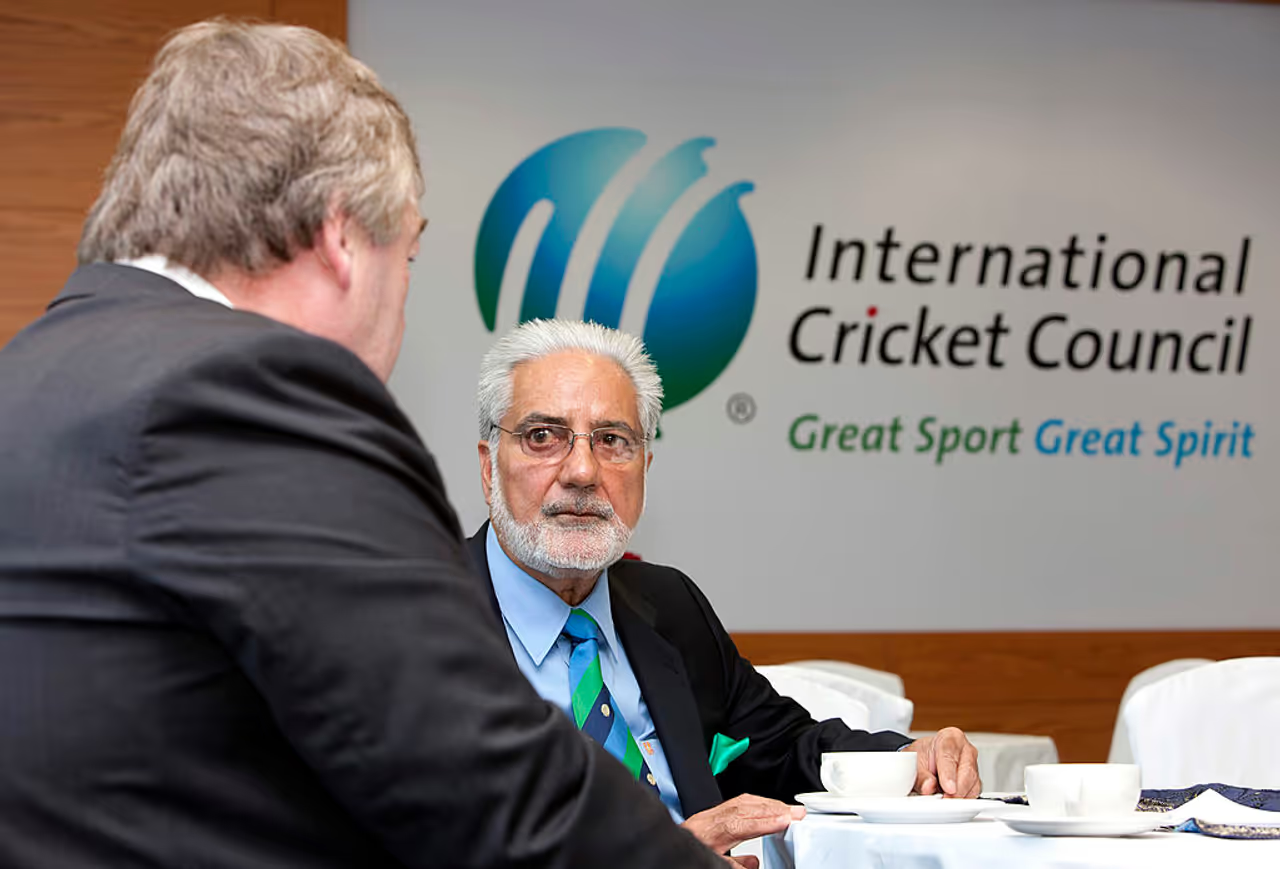
The Man Behind Indian Cricket Revolution
The former BCCI and Punjab Cricket Association (PCA) president, Inderjit Singh Bindra, breathed his last in New Delhi on Sunday, January 26. He was 84 at the time of his demise. Bindra was immediately taken to the hospital after a sudden health deterioration in the afternoon and passed away in the evening.
His demise left the Indian cricket fraternity mourning as he was one of the true architects of modern Indian cricket. IS Bindra left behind a legacy that could not only be everlasting but also transformative, shaping the way the sport is governed, commercialized, and promoted in India.
As IS Bindra left for the heavenly abode, let’s take a look back at his legacy as BCCI president, who served from 1993 to 1996, during which he laid the foundation for the revolutionization of Indian cricket.


Broadcasting Rights to Private Networks
Inderjit Singh Bindra, or IS Bindra, will be remembered for playing a pivotal role in breaking the monopoly of Doordarshan in telecasting Indian cricket matches. India’s home matches were telecast on the Indian government-run Doordarshan until the early 1990s, limiting the revenue and global reach. As BCCI president, late. Bindra decided to open the broadcasting rights to private and satellite networks for telecasting Indian matches.
IS Bindra, alongside the late. Jagmohan Dalmiya went to the Supreme Court in 1994 to challenge the monopolization of cricket broadcasting rights by Doordarshan. The landmark legal battle witnessed a historic verdict, allowing private broadcasters to telecast matches in India.
This enabled BCCI to generate significant revenues, expanding Indian cricket’s global outreach, and ensuring financial security and stability for the players, marking the beginning of Indian cricket’s commercial revolution.
Securing 1996 World Cup Hosting Rights
India was awarded co-hosting rights for the 1996 ODI World Cup alongside Sri Lanka and Pakistan, a move that uplifted the country’s stature in world cricket. As a BCCI President, late. IS Bindra played an instrumental role in ensuring that India got to host the marquee event, which turned out to be a watershed moment for Indian cricket, drawing massive crowds, generating massive revenues, and commercial interest.
Bindra, alongside ex-BCCI president Dalmiya, also played a crucial role in India getting the hosting rights for the 1987 World Cup, marking the first time that prestigious tournament was staged outside England.
The successful hosting of both events laid the foundation for the country’s influence in world cricket, which eventually translated into greater power within the ICC.
Turned BCCI into a Money Machine
We would often say that if something made Indian cricket rich and powerful, the root lies in certain decisions taken in the late 1990s, and the heart of the revolution was IS Bindra. The late. Bindra’s crucial role in providing Indian cricket broadcasting rights to private networks and securing the hosting rights for the 1987 and 1996 World Cups opened multiple streams of revenue for the BCCI.
The commercialization of television rights, sponsorships, and international fixtures for Indian cricket transformed the Board of Control for Cricket in India (BCCI) from a conventional governing body into a financial powerhouse.
Today, the BCCI is the richest cricket board in the world, with a valuation of INR 18,700 crore as of 2025, a legacy that traces back to the foundation laid by IS Bindra
Professionalization of BCCI
Before IS Bindra became the BCCI president, the Indian cricket board was running largely as a conventional administrative body, with limited structure and professional management. However, the late Bindra completely changed the way the board operated at the administrative level. As president, Bindra decided to introduce administrative practices, strategic planning, and transparent financial management.
Under Bindra’s leadership, the BCCI became more of a professionally run administration with clear hierarchies, accountability, and streamlined processes. The decisions regarding the major tournaments, like World Cups, sponsorships, and player management, were handled systematically.
Today, the BCCI operates as one of the most professionally and efficiently run cricket boards in the world, capable of handling major tournaments and international series with efficiency and transparency.
Infrastructure-Focused and Grassroots Development
Alongside serving as a BCCI president, IS Bindra served as the president of the Punjab Cricket Association. As the head of the state administration, the late. Bindra spearheaded the development of the Mohali cricket stadium, with world-class infrastructure and facilities. Before the construction of the Mohali stadium, the PCA lacked modern facilities for players and international-standard grounds.
The Mohali cricket stadium was renamed as IS Bindra Stadium in 2015, a year after he retired from administrative duties following 36 years of dedicated service to cricket. Additionally, IS Bindra played a pivotal role in the grassroots development of Punjab cricket, ensuring that the young players had proper access to training facilities and competitive opportunities.
Over the years, Punjab cricket produced several national and international cricketers, including the likes of Yuvraj Singh, Harbhajan Singh, Arshdeep Singh, and Shubman Gill.
Stay on top of all the latest Sports News, including Cricket News, Football News, WWE News, and updates from Other Sports around the world. Get live scores, match highlights, player stats, and expert analysis of every major tournament. Download the Asianet News Official App from the Android Play Store and iPhone App Store to never miss a sporting moment and stay connected to the action anytime, anywhere.