Delhi Gets A Breather From Pollution: What Helped Improve AQI And Why It May Not Last
Delhi recorded cleanest air quality of November so far on Tuesday, with daily AQI improving to 204 in 'poor' category. Favourable northwesterly winds and mixing depth of 1,500 metres helped disperse pollutants. However, the relief may be short-lived.
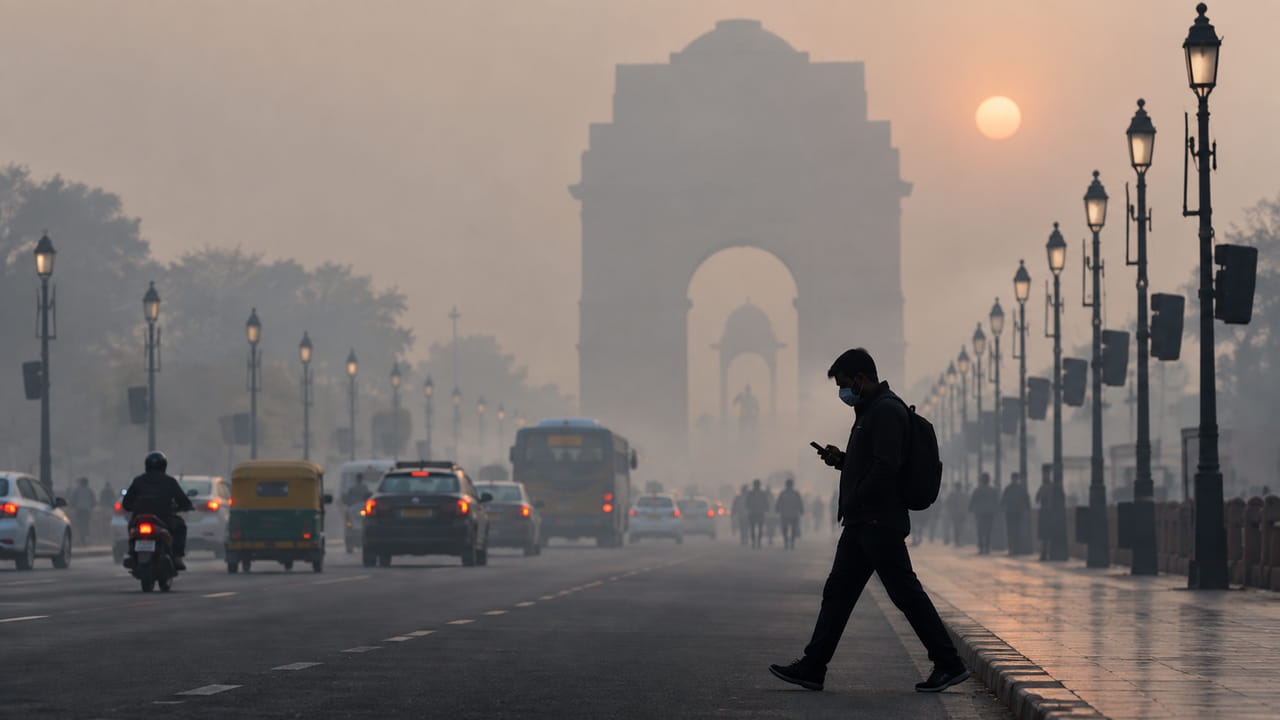
Delhi records November's cleanest air as AQI improves to 204
Delhi recorded its cleanest air quality of November so far on Tuesday, with the daily Air Quality Index (AQI) improving to 204. Although the reading remained in the 'poor' category, it offered some relief to residents after days of high pollution and persistent haze across the national capital.
The improvement was supported by favourable weather conditions, including northwesterly winds and a greater mixing height, which helped disperse pollutants. However, the relief may not last long. The Air Quality Early Warning System has forecast a return to the 'very poor' category on Wednesday and Thursday.
#AQI of #Delhi on 17.11.2026 at 4:00 PM (पिछले 24 घंटों का औसत) |
https://t.co/VRPIm3tAYW
#GoGreenBreatheClean https://t.co/i0kTKGZzgj
— Commission for Air Quality Management (@CAQM_Official) November 17, 2026
Tuesday's AQI of 204 was the lowest recorded in Delhi this month. The last time the city recorded a lower reading was on October 31, when the AQI stood at 117, placing it in the 'moderate' category.


Why did Delhi's air quality improve?
Favourable meteorological conditions played an important role in Tuesday's improvement, according to the Air Quality Early Warning System.
Northwesterly winds reaching speeds of up to 15 kmph helped move polluted air away from the city. The mixing depth was around 1,500 metres, allowing pollutants to disperse higher into the atmosphere instead of remaining concentrated near the ground.
Mixing depth is the height up to which air and pollutants can mix vertically. When this height is greater, pollutants have more room to disperse. A lower mixing depth, on the other hand, can trap pollution closer to the surface and worsen air quality.
These conditions helped Delhi record its lowest AQI of November so far. However, the improvement does not mean that the city's pollution problem has been resolved.
Most monitoring stations record poor air quality
The improvement was visible across several parts of Delhi, although pollution levels continued to vary between monitoring stations.
Of the 58 stations that recorded data for Tuesday's daily reading, 31 reported 'poor' air quality and 26 recorded 'moderate' levels. Sirifort was the only station in the 'very poor' category, with an AQI of 303.
The Central Pollution Control Board (CPCB) had recorded an AQI of 238 at 8 am on Tuesday, also in the 'poor' category. At that time, 32 stations were in the 'poor' category, 16 were in the 'moderate' category and 10 were in the 'very poor' category. Sirifort recorded the highest reading, at 333.
The morning reading and the later daily figure reflect measurements taken at different times. The daily AQI of 204 therefore represents an improvement from the morning level.
What is contributing to Delhi's pollution?
Fine particulate matter, known as PM2.5, remained the dominant pollutant in Delhi. These particles measure 2.5 micrometres or less in diameter. Because they are extremely small, they can travel deep into the lungs and even enter the bloodstream, posing health risks.
Estimates from the Air Quality Early Warning System showed that secondary organic aerosols were the largest contributor to the city's real-time PM2.5 concentration on Tuesday, accounting for 32.2 per cent.
Biomass burning, which includes stubble burning and the use of solid fuels such as wood and dung cakes, contributed 18 per cent. Waste burning accounted for 15.7 per cent, while vehicular emissions contributed 14.5 per cent.
Other sources included secondary inorganic aerosols at 11.9 per cent, coal combustion at 2.9 per cent, firecrackers at 2.3 per cent, industrial sources at 1.7 per cent, and road dust and soil at 0.7 per cent.
The figures show that Delhi's pollution comes from several sources, rather than a single activity. The relative contribution of these sources can also change with weather conditions.
Delhi AQI forecast: Why could pollution rise again?
Despite Tuesday's improvement, the Air Quality Early Warning System has warned that Delhi's air may deteriorate to the 'very poor' category on Wednesday and remain there on Thursday.
The forecast points to less favourable conditions for the dispersal of pollutants. The maximum mixing depth is expected to be around 1,500 metres on November 17 and 1,400 metres on November 18.
The ventilation index is also expected to fall from around 6,200 square metres per second on Tuesday to 4,000 square metres per second on Wednesday.
The ventilation index indicates how effectively the atmosphere can disperse pollution. A reading below 6,000 square metres per second, combined with average wind speeds of less than 10 kmph, is considered unfavourable for pollutant dispersion.
When winds are weaker and the atmosphere has a lower capacity to clear polluted air, pollutants can accumulate near the surface. This could push Delhi's AQI back into the 'very poor' category.
What do the different AQI categories mean?
According to the CPCB, an AQI between zero and 50 is classified as 'good', while 51 to 100 is 'satisfactory'. A reading between 101 and 200 falls in the 'moderate' category, and 201 to 300 is considered 'poor'.
An AQI between 301 and 400 is classified as 'very poor', while readings between 401 and 500 fall in the 'severe' category.
Tuesday's reading of 204 placed Delhi just inside the 'poor' category. While it was a welcome improvement and the city's best reading this month, the forecast suggests that residents may have to contend with higher pollution levels again in the coming days.
(With inputs from agencies)
Stay updated with the Breaking News Today and Latest News from across India and around the world. Get real-time updates, in-depth analysis, and comprehensive coverage of India News, World News, Indian Defence News, Kerala News, and Karnataka News. From politics to current affairs, follow every major story as it unfolds. Get real-time updates from IMD on major cities weather forecasts, including Rain alerts, Cyclone warnings, and temperature trends. Download the Asianet News Official App from the Android Play Store and iPhone App Store for accurate and timely news updates anytime, anywhere.