Bike Braking System: Drum Brake vs Disc Brake - Which One Should You Pick?
Are you confused between drum brakes and disc brakes while buying a bike? Let's check out their performance, pros and cons, and which one actually works best for daily use.
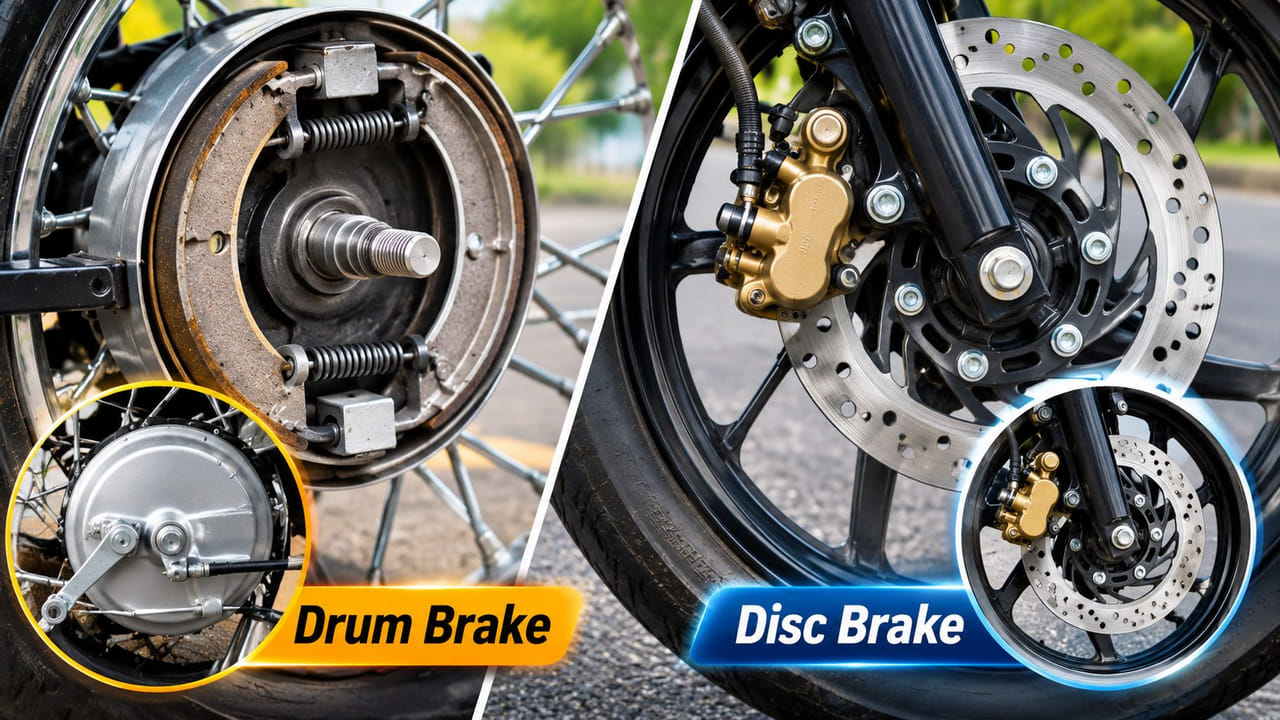
Drum Brake vs Disc Brake: What fits your bike better?
Brakes are one of the most critical safety features on any bike. They help riders control speed, safely stop the bike, and avoid accidents. However, not all bikes come with the same braking system.
Most bikes feature either drum brakes or disc brakes, while some models use a combination of both. So what exactly is the difference between these two braking setups? And which one is better for everyday riding?


What is a drum brake and how does it work?
A drum brake is an older, traditional braking system. You will typically find it in affordable bikes and scooters. It consists of a round metal drum attached to the wheel, with brake shoes fitted inside. When the rider hits the brake, the brake shoes inside expand and press against the rotating drum's inner surface. The friction this creates slows down the wheel and stops the bike.
They cost less to manufacture and maintain. Since their internal parts are fully enclosed, they stay protected from dust, mud, and water. However, they don't dissipate heat quickly. During hard, repeated braking, they can overheat, which reduces their braking efficiency.
What makes disc brakes special?
Disc brakes are a modern braking setup. You mostly see them on bikes, scooters, and high-performance motorcycles. They feature a metal disc mounted to the wheel and a brake caliper holding the brake pads. When the rider pulls the brake lever, hydraulic pressure pushes the brake pads against both sides of the rotating disc. This creates instant friction and stops the wheel immediately.
Disc brakes deliver very strong and consistent braking performance. Because the disc is exposed to the air, it sheds heat quickly. You get great control during sudden braking. But compared to drum brakes, their cost and maintenance are slightly higher.
Key differences between the two
When it comes to performance, drum brakes operate the brake shoes using mechanical cables or rods, requiring a bit more force on the lever. But since disc brakes use hydraulic fluid, they offer sharp action with less effort. If water gets inside a drum brake during the rains, its grip drops until it dries out. With disc brakes, water sheds quickly from the spinning disc, so it maintains a strong grip even on wet roads.
Since a bike's weight shifts forward during braking, the front tire handles about 70 percent of the stopping power. That is why most bikes come equipped with disc brakes on the front wheel and drum brakes on the rear. Disc brakes are also essential for an Anti-lock Braking System (ABS) to work properly.
Which one is best for daily use?
For daily city commutes at lower speeds on 100cc to 125cc bikes and scooters, drum brakes work fine, especially for the rear wheel. On muddy and dusty rural roads, drum brakes also don't wear out easily.
But for riders hitting the highway, traveling long distances, or riding on uneven terrain, a bike with a front disc brake is the best choice. Sports bikes, cruisers, and heavy motorcycles come with dual disc brakes for added safety.
What to look for when buying a bike?
Overall, drum brakes are cheaper and simpler to use. Disc brakes offer better heat management and high-performance braking. Industry experts say instead of picking a bike based solely on the brake type, it is best to make the right call based on the overall braking system, ABS availability, tire quality, and your daily riding needs.
Get all the latest Automobile News, including updates on Electric Vehicles, new car and bike launches, reviews, and auto industry trends. Stay informed about mileage comparisons, performance insights, and expert opinions to guide your next vehicle choice. Download the Asianet News Official App for all the latest updates from the world of automobiles.