
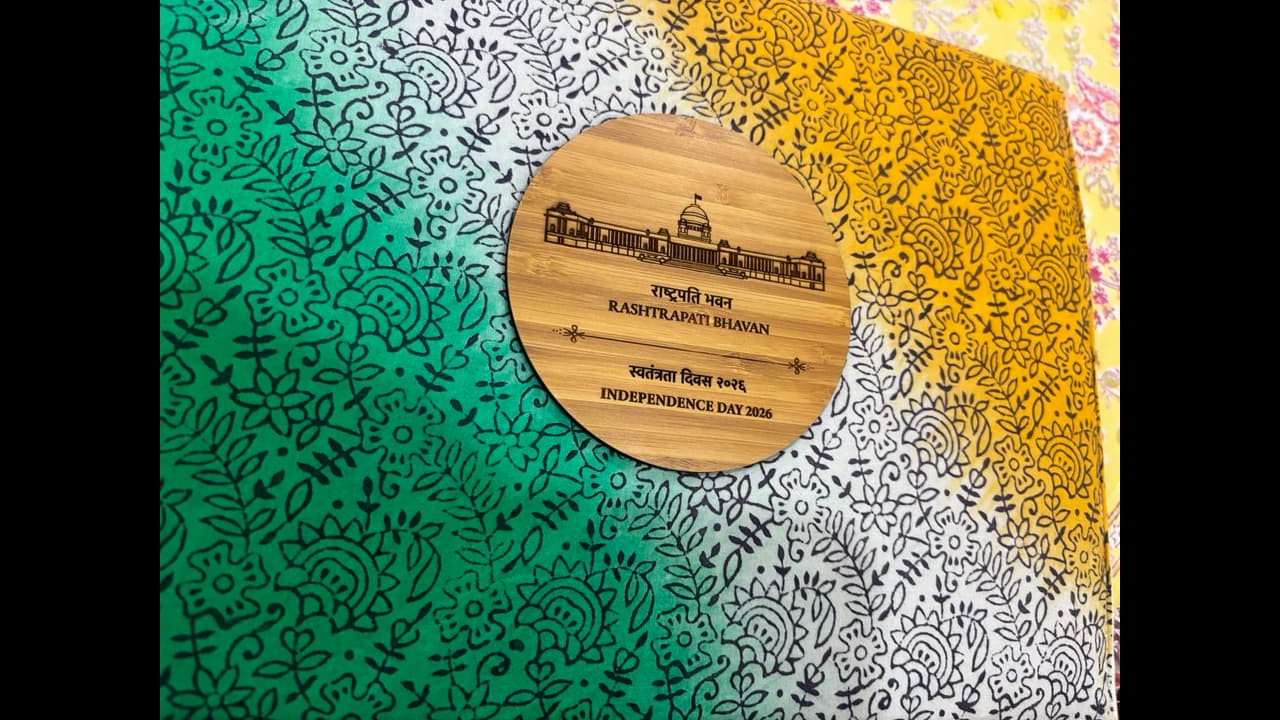
The invitation for the Independence Day 'At Home' reception at Rashtrapati Bhavan, hosted by President Droupadi Murmu, celebrates India's cultural diversity. It features keepsakes and cards showcasing indigenous crafts, weaving, and folk art.
A celebration of India's cultural diversity begins even before guests arrive at Rashtrapati Bhavan for the annual 'At Home' reception on Independence Day. The invitation card for this year's reception, hosted by the President Droupadi Murmu on August 15, reflects the country's rich artistic traditions through thoughtfully curated keepsakes and information cards showcasing indigenous crafts, weaving traditions and folk art from across the country.
The invitation features tricolour-themed fabric sleeve featuring an illustration of Rashtrapati Bhavan. It depicts a bamboo coaster engraved with the iconic presidential estate and "Independence Day 2026," along with a set of illustrated cards introducing guests to traditional Indian crafts. As per the information on the invitation card "the guests will be welcomed upon their arrival at the reception by traditional draping of a specially designed stole".
A Handwoven Tribute to Textile Traditions
The stole has been handwoven in Maheshwar using the traditional dual silk and cotton weave of Maheshwari weaving tradition of Madhya Pradesh. The stole celebrates textile tradition of Chhattisgarh, Goa, Madhya Pradesh and Maharashtra. One of the centrepieces of the invitation is the Handwoven Maheshwari Stole, specially designed in the Maheshwari weaving tradition of Madhya Pradesh. According to the information card, the silk-and-cotton stole blends motifs from four regions--the 'karwat kathi' saree of Maharashtra, Goa's Kunbi saree border, 'kangra' motif of Maheshwari weaving of Madhya Pradesh, and Chhattisgarh's Chinta Chowk motif. It brings together diverse textile vocabularies in a single expression.
Goa's Azulejo Tile Tradition
Another card celebrates Goa's Azulejo tile tradition, tracing its origins to crafts introduced centuries ago before being adapted by Goan artisans using Indian techniques and vibrant local themes. The hand-painted blue-and-white tiles depict everyday Goan life, fishing communities, rural landscapes, local flora and fauna, and continue to adorn homes and public spaces across the state.
Conservation and Culture: Sacred Groves
The invitation also highlights community-led conservation of sacred forest groves, describing them as biodiversity hotspots preserved through generations of traditional knowledge. The accompanying note highlights the ecological and cultural significance of trees such as the Mahua, revered locally as the "tree of life" for providing food, oil, timber and supporting traditional livelihoods.
Bastar's Wrought Iron Craft
Guests are also introduced to the wrought iron craft of Bastar in Chhattisgarh, where skilled tribal artisans transform iron into decorative and functional works inspired by nature, mythology and daily life. The illustrated cards feature traditional Bastar ironwork alongside photographs celebrating the region's artistic heritage.
The invitation card blends craftsmanship with sustainability and Indian traditions. (ANI)
(Except for the headline, this story has not been edited by Asianetnews Editorial staff and is published from a syndicated feed.)