
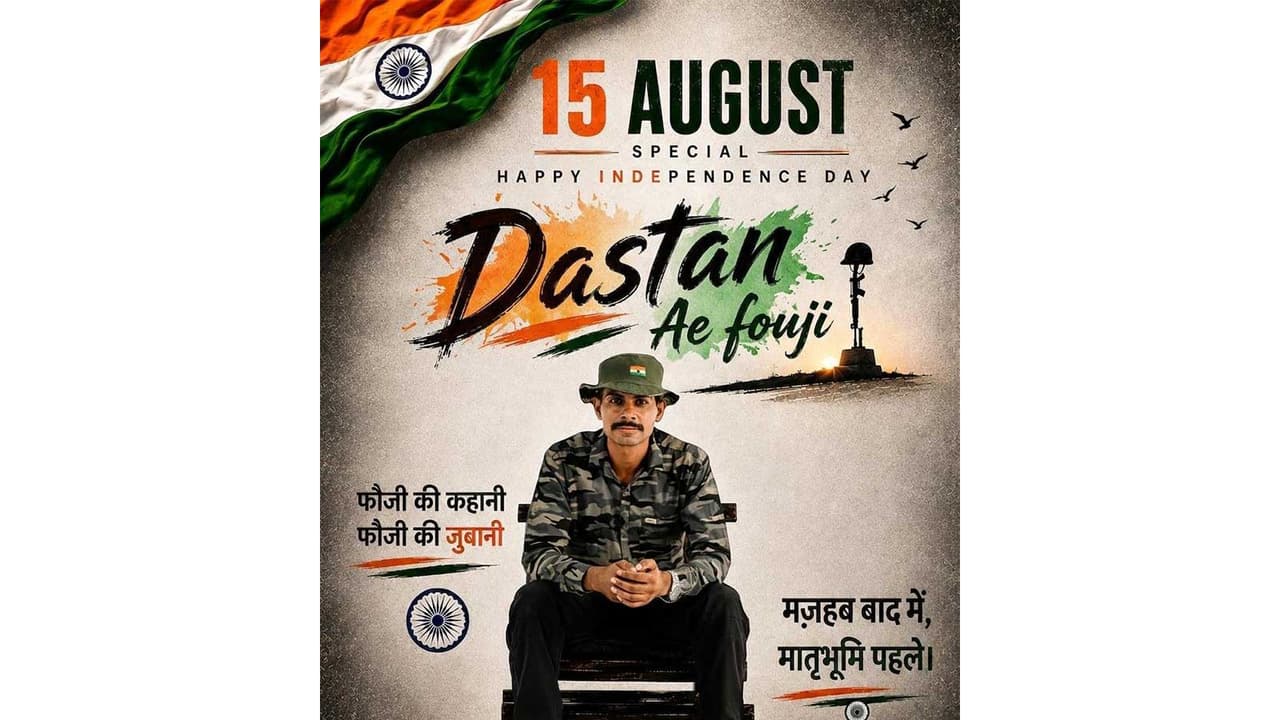
On Independence Day, ex-IAF soldier Ajay Kumar explores true freedom through poetry. His work 'Dastan-e-Fouji' and Huemanity Studios champion human dignity over mere symbolism, questioning what it means to be free beyond sovereign borders.
Every Independence Day, India awakens dressed for remembrance. Flags flower from balconies. Patriotic songs pour from schoolyards. Saffron, white and green ripple through streets where, for one morning, difference surrenders to a shared sky. We remember the freedom fighters who refused to remain subjects. We remember the soldiers who ensure that we remain citizens.
But between the flag being raised and folded away lies a larger, less ceremonial question: what is real independence? Is a nation free merely because its borders are its own? Or does freedom remain unfinished while poverty imprisons possibility, prejudice polices identity, corruption corrodes confidence and religion is made larger than the human beings it was meant to guide?
There are men who wear a uniform, and there are men whom the uniform wears. It stiffens their spine, sharpens their salute, shortens their speech. It teaches the body to stand still even when the soul is shaking. And then there is Ajay Kumar. He wore the uniform for fifteen years, but refused to let it imprison the person inside it. The Air Force gave him discipline, danger, duty and distance. Life gave him a wife who became his wisest influence, a daughter who became his dearest destination, and words that would not remain locked behind his teeth.
Between command and confession, cantonment and camera, soldiering and storytelling, he discovered his truest terrain: humanity. It is the word he returns to repeatedly. Humanity as impulse. Humanity as inheritance. Humanity as protest, prayer and production house. When I suggested the name Huemanity Studios, the altered spelling held a proposition: before colour, caste, creed, costume or country, there is the human hue. The blood beneath the badge. The being before the branding. Ajay understood. Perhaps he had been preparing to understand it all his life.
From Jammu to Humanity
Born in Jammu on September 24, 1992, he grew up in a home shaped by service. His father was an Army veteran; his mother, a housewife, belonged to that vast and insufficiently honoured regiment of women whose campaigns are conducted in kitchens, corridors and crises. His brother, Vijay, shared the landscape of his growing years. The boy they knew was shy, naughty and responsible--a marvellous trinity. Shyness gave him observation. Naughtiness gave him nerve. Responsibility gave both a railing.
Jammu was his first geography, but humanity became his first homeland. Even as a child, he dreamed of becoming a Nobel Peace Prize winner. Today, he says he is still trying to achieve "the whole universe." Ajay does not dream in teaspoons. He dreams in thunderclaps. A private jet appears in those dreams too; idealism need not pretend that pleasure is sinful or success shameful. Why must aspiration arrive apologetically, barefoot and badly tailored? He contains seriousness, but also sparkle. Guts. Humanity. Romance. Those are the three words he chooses for himself, and together they sound like a three-act declaration of intent. Punjabi folk gives him pulse, motorcycles motion, rajma chawal home. Irrfan Khan gives him the grammar of silence; Bhagat Singh, the courage to question. He admires courage, not cruelty; success, not swagger; power, not pomposity.
Dastan-e-Fouji: A Soldier's Testimony
His own room was once lonely. He began writing poetry in 2013 because shyness made speech difficult and solitude made silence crowded. Writing became the door through which his inner self walked out. Some write because they have mastered language. Others because language rescues them from what they cannot say. Ajay belongs to that vulnerable tribe. He has written seven poems, about ninety shers and ten songs; created and led a web series; and performed on stage. He is also pursuing a master's degree in economics, as if art, fatherhood and a former military life were not enough for one calendar.
But numbers cannot measure the urgency of his work. For that, one must enter Dastan-e-Fouji. Registered with the Screenwriters Association in January 2022, the work is part poem, part song, part dramatic testimony. It does not observe the soldier through a ceremonial telescope. It enters his tent, his trembling hand, his homesickness, his horror and his half-swallowed questions. Its refrain declares, "Main hoon ek fauji"--I am a soldier--and insists that no religion stands higher than the nation. Yet the work's deepest patriotism lies in its refusal to forget that a soldier is also a son, husband, father, frightened body and fallible heart.
This is Ajay's contribution to our understanding of independence: the nation must be sovereign, certainly, but the person serving it must not disappear inside the symbol. The roots reach back to the 2016 Uri attack. Ajay was guarding a vital installation under conditions he remembers as punishing. He also carries the searing memory of indignity shown to a martyred soldier's body, including stone-pelting in Kashmir. Such an image can calcify a person, turning grief into permanent rage. Ajay turned it into art.
In Dastan-e-Fouji, we encounter the old mother whose eyes remain open in expectation of her son; the father who once placed his boy proudly on a train and now fears what may happen even to his body; the wife whose vermilion and bangles hold both marriage and mortality; the child who says in baby English, "My papa is great," and wants to be recruited too. Around the soldier stand all those who serve without salary, salute or uniform. This is where Ajay's writing becomes meaningful. He does not offer patriotism as a polished parade-ground product. His soldier tires. He doubts. For a moment, he wants to abandon tent-life, sit in an air-conditioned office and be addressed as "Mr Ajay." That admission is not weakness. It is witness. Courage is not the absence of escape fantasies; it is returning to duty after imagining the door.
From Page to Screen
The filmed performance extends that testimony from page to screen. Ajay is its writer, performer and voice. Presented by Huemanity Studios, with music, direction, camera, editing and production carrying the labour of collaborators, it retains the rawness of one man's memory. A visual rendition is collective creation: many crafts carrying one testimony into the final frame. The complete filmed performance of Dastan-e-Fouji can be watched on Ajay's official YouTube platform. There, the words leave the registered page and acquire voice, expression, music and movement--allowing us not merely to read the soldier's testimony, but to encounter the man breathing beneath it.
The Philosophy of Freedom
Ajay wants his audience to connect with its inner soul. The phrase may sound impossibly large, but he means something intimate: he wants feeling to puncture our practised indifference. He wants us to look at a uniform and see skin; at a martyr and see a mother's child; at patriotism and see responsibility rather than performance. His definition of success is startlingly social: no one in his vicinity should be poor. Not merely his family or payroll. No one in his vicinity. Success, then, is not a pedestal but a perimeter of care.
This, too, is real independence. Freedom cannot survive only as history; it must become a daily atmosphere. The hungry must be free from hunger, the child free to learn, the woman free to choose. The believer must be free to pray, the atheist free to question, and both free from fear. The soldier must be free to feel, the artist to speak, and the citizen to disagree without being declared disloyal. Independence is not merely release from foreign rule. It is release from our smaller tyrannies: hatred, humiliation, hopelessness. A flag is truly honoured when the weakest person beneath it can stand without fear.
His belief that no religion is greater than humanity must be tested in daily life--in how we speak to strangers, spouses and opponents; in whether dignity survives disagreement. Ajay admits people misunderstand his directness. He trusts too easily. These may be flaws, but they are also the bruises left by openness. Suspicion protects, but it can pickle the spirit. Ajay would rather risk believing than perfect perpetual doubt.
Personal Influences: Family and Conviction
At the centre of his expansive universe stand two people who make it personal. His wife, Meena Verma, has influenced him more than anyone. Men trained by masculine institutions often credit commanders and celebrated heroes before acknowledging the woman who has quietly rearranged their thinking. Ajay does not hesitate. Meena is influence, intimacy and intellectual weather--the presence that altered his inner climate. And then there is Avvy, their four-year-old daughter, the person to whom he feels closest in his family. One imagines the former serviceman disarmed by four-year-old logic, military precision defeated by a small voice and sudden cuddle. Children are commandants of chaos. They turn schedules into confetti and make grand words accountable. It is easy to pronounce humanity before an audience; harder and holier to practise it at bedtime.
Soldier, Storyteller, and Humanist
There is glee in Ajay's restlessness. He is not merely a solemn soldier writing sad songs beside a sunset. He sings, rides and romances possibility. He dreams of a private jet without abandoning rajma chawal. He admires Rowan Atkinson and, with a mischievous emoji, Narendra Modi as an actor--proof that reverence and irreverence can share a sofa without starting a civil war. We have made public life painfully binary: patriot or protester, believer or atheist, warrior or poet. Ajay occupies the fertile "and." Soldier and storyteller. Romantic and revolutionary. A man who can salute the flag while questioning the society gathered beneath it.
His work is young. Mansha and Huemanity Studios are beginnings, not monuments. His task is to deepen craft until conviction finds control--until anger acquires architecture, emotion earns editing, and every rhyme arrives because it must. Yet beginnings have their own beauty. A seed is not diminished because it is not yet a tree. It carries the tree in secrecy. Ajay carries many futures: writer, actor, screen storyteller, producer, student, husband, father, former airman. Why not Nobel Peace Prize winner too? The world has enough cynics clipping wings. What it lacks are grounded dreamers building runways.
Ajay Kumar has known the sky through service. He now approaches it through story. The uniform taught him how to stand at attention. Poetry taught him what deserves attention. Family taught him where attention must return. And humanity--that overused word he is determined to make useful again--gave all three a home. This Independence Day, Dastan-e-Fouji asks us to honour service by expanding freedom. Not fireworks, but fairness. Not pride without purpose, but participation with principle. Not a country intoxicated by power, but a civilisation attentive to its people.
The work is not only a soldier's tale. It is Ajay's declaration that beneath every institution stands an individual; beneath every slogan, a soul; beneath every victory, a cost; beneath every country, countless kitchens where someone waits for a key to turn, a telephone to ring, a beloved body to return. The soldier in him knows borders. The writer in him crosses them. The father in him dreams beyond them. And the human being in him--gutsy, guileless, romantic, restless--asks us to remember that the highest service is not merely to die for a nation, but to help its people live with dignity. That is when political independence becomes personal independence; when liberty leaves the textbook and enters life. That is his mission. That is his message. That is his unfinished, unafraid, deeply human song. (ANI/Suvir Saran)
Disclaimer: Suvir Saran is a Masterchef, Author, Hospitality Consultant And Educator. The views expressed in this article are his own.
(Except for the headline, this story has not been edited by Asianet Newsable English staff and is published from a syndicated feed.)