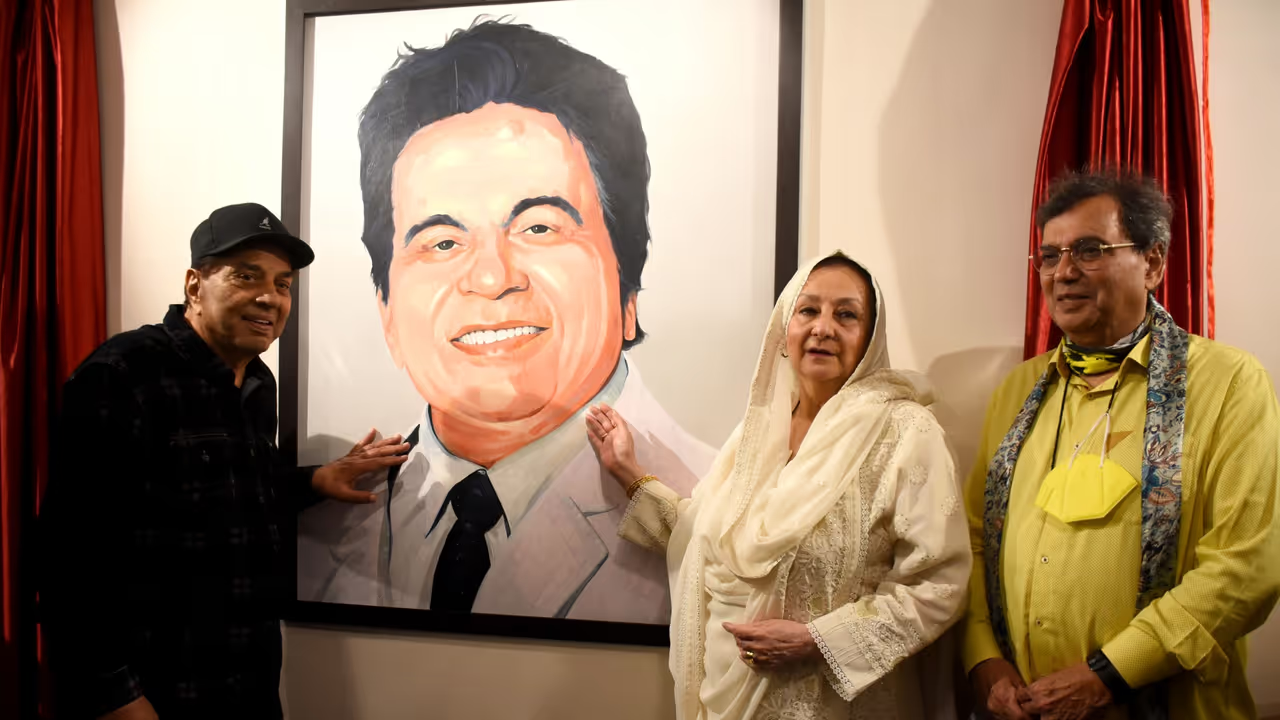
Dharmendra once boldly walked into Dilip Kumar’s Bandra home in 1952, standing at the entrance of his bedroom before running away in surprise. Years later, he met his idol properly, receiving guidance & a warm hug that inspired his legendary career.
Long before Dharmendra became the He-Man of Hindi cinema, known for his action, charm, and romantic screen presence, he was just a young boy from a small town in Punjab, dreaming of films and stars he admired. One such idol, Dilip Kumar, became a defining figure in the early journey of a boy who would later star in over 300 films across 65 years.
A Bold Step Into the World of Dreams
Sometime in 1952, a young Dharam Singh Deol, then in his second year of college in Ludhiana, Punjab, made a daring trip to Bombay. “I had no definite plans of becoming an actor back then but I definitely wanted to meet Dilip Kumar whose acting in ‘Shaheed’ had touched a deep emotional chord within me. For some inexplicable reason I began to fancy that Dilip Kumar and I were siblings,” Dharmendra recalled in the ‘Reminiscences’ section of Dilip Kumar’s autobiography The Substance and the Shadow.
Without hesitation, he made his way to Dilip Kumar’s house in Bandra’s Pali Mala locality. “I wasn't stopped at the gate by anybody, and so I walked right into the house through the main door. There was a wooden staircase leading to a bedroom upstairs. Again, nobody stopped me, so I climbed up the stairs and stood at the entrance to one of the rooms,” he said.
Related Articles

An Awkward Encounter With His Idol
Standing at the bedroom door, Dharmendra saw a young, fair, slim, handsome youth asleep on the couch. “I stood still not knowing what to do. He sat up on the couch and stared at me, quite taken aback to see a total stranger standing gingerly at his bedroom door gazing admiringly at him,” Dharmendra remembered.
Startled, Dilip Kumar called out to a servant, and the young boy bolted down the stairs and out of the house. Sitting in a nearby cafeteria with a cold lassi in hand, Dharmendra reflected on his reckless boldness: “As I sat in the cafeteria and thought back to what I had done, I realized how reckless I had been by intruding into the privacy of a star. So what if there was no watchman at the gate and no family member in the house to stop me?”
He remembered the open, welcoming nature of homes in his village: “In the villages of Punjab the houses were always open to anybody who cared to drop in… I was very happy to see my idol living just the way we lived in Punjab. But then, I had blundered by taking it for granted that I did not need an introduction. This was Bombay, the big city, and the house belonged to the star Dilip Kumar!”
The Filmfare Talent Contest and a Second Meeting
Six years later, Dharmendra returned to Bombay with a more focused ambition — to act in films. He participated in the United Producers and Filmfare Talent Contest, which would mark the real start of his career. “I was truly keen on becoming an actor now and I had convinced my father who had yielded to let me join films. I was declared a winner and, following that, I was asked to report at the Filmfare office for a photo shoot,” he said.
At the shoot, a young woman came to touch up his face. “The then editor of Filmfare, L P Rao, asked me softly whether I knew who the girl was. On saying I didn't, he told me she was Farida, Dilip Sahab's sister, who was working with Femina. I saw her leaving and I ran after her requesting her to arrange to meet Dilip Sahab. I told her I firmly believed that he was my brother too. She was amused but she agreed to call L P Rao if her brother agreed,” Dharmendra recalled.
The following evening, he was invited to Dilip Kumar’s bungalow at 48 Pali Hill. “Time stood still for me when ‘Dilip Sahab’ came out and welcomed me and gave me a chair to sit beside him on the lawns,” Dharmendra said.
Guidance From a Mentor and a Brotherly Hug
During this meeting, Dilip Kumar spoke with warmth and patience, recounting his own struggles and journey into cinema. “He talked to me like an elder brother, full of love and concern and narrated how he became an actor and how difficult was for him in the beginning to understand the demands of the profession since he came from a non-filmi background,” Dharmendra recalled.
The actor remembered being spellbound, listening to Dilip Kumar speak in English, Punjabi, and Urdu. As he prepared to leave, Dilip Kumar took him upstairs and gave him a sweater, noticing that Dharmendra was wearing only a thin cotton shirt. “He hugged me and saw me off at the gate. I can still feel the warmth of that hug because it was genuine,” he said.
From a Dreamer to a Superstar
This early encounter, years before Dharmendra’s first film, encapsulates the curiosity, boldness, and humility of a young boy destined for stardom. Within a few years, he would rise from the streets of Bombay to the film sets that would make him a legend, eventually starring in over 300 films spanning classics like Satyakam, Sholay, Chupke Chupke, and Phool Aur Patthar.
Dharmendra passed away on Monday in Mumbai at the age of 89, leaving behind a legacy that began with a daring childhood trip to meet his idol and blossomed into one of the most extraordinary careers in Indian cinema.