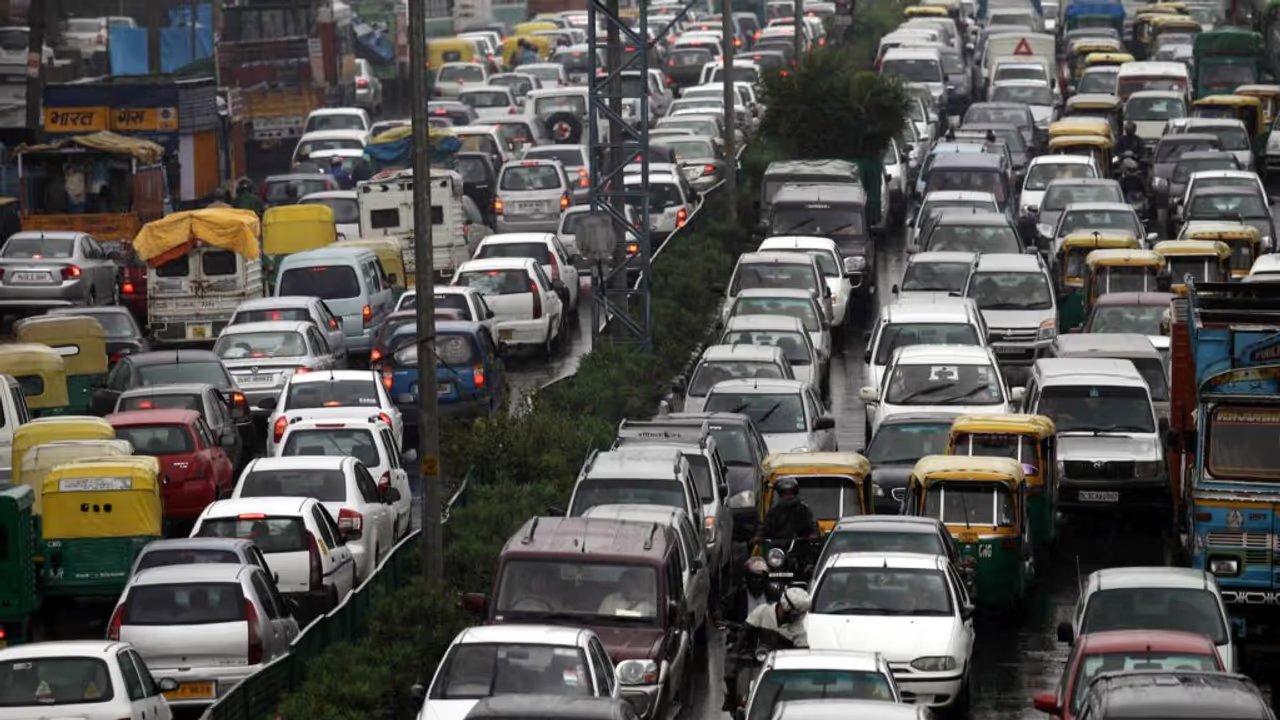
India's urban parking crisis contributes to 30% of city traffic. A new study proposes a smart solution using AI and the Internet of Things (IoT). Sensors in parking lots would detect occupancy, sending real-time data to the cloud.
If you have ever driven through an Indian city, you already know the frustration. You circle the block again. And again. The clock is ticking, your fuel is burning, and every possible spot is either occupied, "reserved," or blocked by double-parked vehicles. Parking in India isn't just a daily inconvenience, it's a full-blown urban crisis.
But a new study by Pranav Sunil Upasani from SNJB's Kantabai Bhavarlalji Jain College of Engineering, Maharashtra, suggests that the answer might already be here, in Artificial Intelligence (AI) and the Internet of Things (IoT).
The Parking Struggle Every City Knows
India adds millions of vehicles to its roads every year. Yet, parking spaces haven't grown at even a fraction of that pace.
Related Articles

From hospitals to malls and residential colonies, the story is the same, not enough space, not enough order, and no real-time information. According to mobility experts, 30% of India's city traffic at any given time comes from cars simply looking for a place to park.
That means we are literally fueling congestion.
The Smart Fix: AI Meets Parking
Upasani's research, published in the International Journal for Research in Applied Science & Engineering Technology (IJRASET), proposes a smart parking system powered by AI and IoT.
Here's the idea:
Tiny sensors in parking lots detect whether a slot is occupied. That data goes to the cloud, where an AI system predicts when and where a slot will be free. A simple app then shows you available parking in real time, or even lets you book a spot before you arrive.
It's like using Google Maps, but for parking.
The study found that such a system could cut parking search time by up to 40%, save fuel, and ease traffic jams across Indian metros.
Predictive Parking: A Peek Into the Future
Imagine leaving your office in Gurugram, opening an app, and seeing exactly which spot will be vacant at the mall you're driving to in Delhi. No honking, no circling, no frustration.
That's the promise of predictive parking, where AI learns from data, weekdays vs weekends, festive rush, or weather patterns, to forecast parking availability ahead of time.
As Upasani explains, "We already use technology to navigate, pay, and plan. Parking should be no different."
How It Works
- IoT sensors monitor each slot.
- Data is stored on a cloud server for real-time updates.
- AI algorithms like Linear Regression and Random Forest predict future availability.
- Users can access everything through a mobile dashboard.
This doesn't just improve convenience but it helps optimize underused parking zones, reduces illegal roadside parking, and supports EV charging and automated billing systems.
Why It Matters for Smart Cities
India's Smart City Mission has invested heavily in digital infrastructure. But, parking remains an overlooked pain point. A connected network of parking spaces, integrated through AI and IoT, could transform urban mobility.
It would mean:
- Less traffic chaos
- Cleaner air from reduced idling
- Better space utilization
- Happier commuters
It's not just about convenience, it's about reclaiming our cities from chaos.
The Road Ahead
The research calls for collaboration between government bodies, private tech companies, and city planners to turn this idea into reality. It also highlights the need to include Tier-II and Tier-III cities, where vehicle ownership is rising fast but infrastructure is still catching up.
"Technology must be part of everyday governance," says Upasani. "It's not just a luxury, it's essential for the quality of life."