
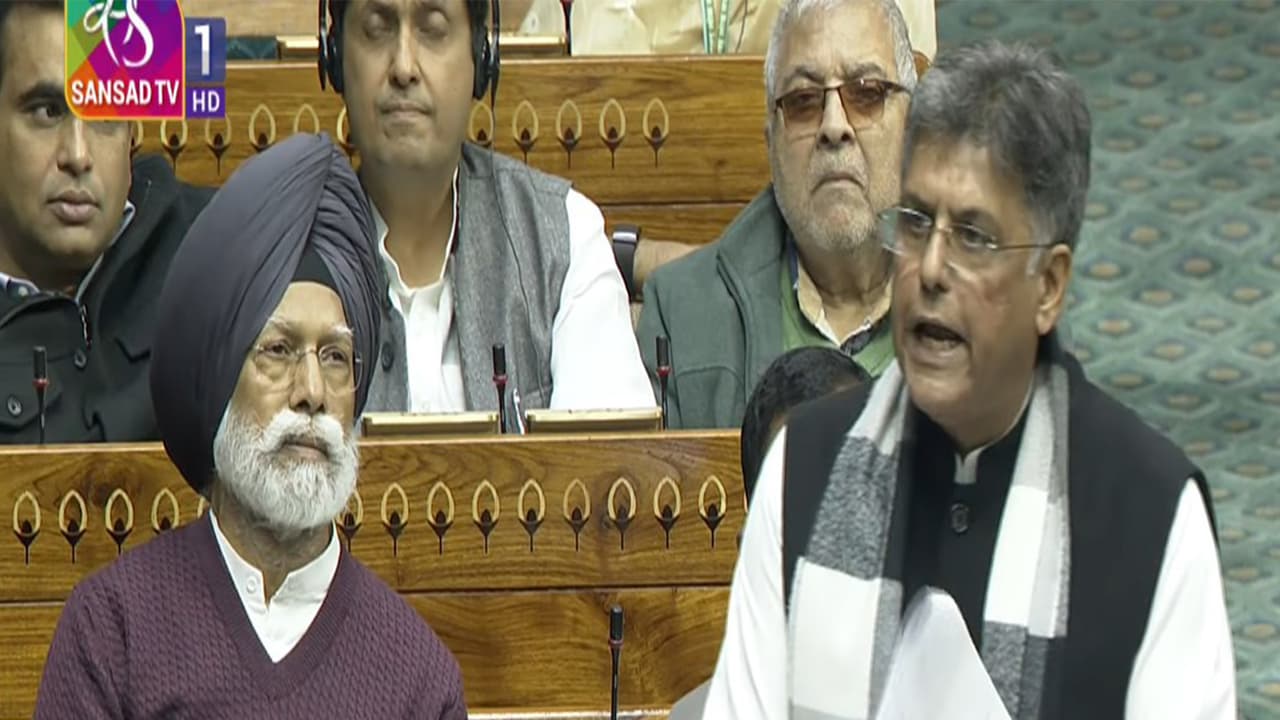
Congress MP Manish Tewari voiced concern in the Lok Sabha over pre-election cash transfers by indebted governments. He proposed a constitutional amendment to bar governments with a debt-to-GDP ratio over 20% from making such transfers.
Concerns over 'Misuse of Democracy'
"This growing trend of distributing money, that as elections approach the government starts transferring cash directly into people's accounts, what kind of democracy is this?" he said. "Is this what democracy has become, that 15 days before elections, 20 days before, a month, or even two months earlier, you start depositing money into people's accounts? And this is why I am concerned, there is a serious misuse of democracy, and a major manipulation of India's revenues," he added.
Highlighting National and State Debt
The Congress MP stated that he had earlier raised inquiries in Parliament regarding the scale of borrowings by governments. "As of 24 March 2025, the combined liability of the central and state governments--their total debt--is Rs 2.67 lakh crore," he said. Highlighting the rising debt levels among states, Tewari said that in the financial year 2023-24, 18 out of 28 states have a debt-to-GDP ratio of more than 30 per cent.
Proposal for Constitutional Amendment
Tewari noted that under Articles 292 and 293 of the Constitution, the Parliament has the authority to fix borrowing limits for the central and state governments. Article 292 deals with borrowing by the Government of India, while Article 293 governs borrowing powers of state governments. He suggested that the Constitution requires one more provision. "There is a need to add one more Article -- Article 293A -- and it should specifically state that if the debt-to-GDP ratio of the central government or any state government is more than 20 per cent, ideally it should be 10 per cent--then that state government or the central government should not be allowed to make any cash transfers. You cannot win elections at the cost of the national exchequer or the state exchequer," Tewari said.
He warned that allowing cash transfers by heavily indebted governments will "absolutely bankrupt our democracy and bankrupt our country."
Calling it a "very important proposal," he cautioned that if this proposal is not implemented, "No state government will ever change. Elections come, and someone transfers Rs 20,000, someone Rs 15,000, someone Rs 35,000 into people's accounts, and they get elected again. Meanwhile, the debt of your state keeps rising, and there are several states in this country that take additional loans just to pay the interest on their existing debt," he cautioned.
Research Supports Election Spending Trend
According to a report by Emkay Research, "The last 20 years have seen states' spending usually picking up post-elections.... Almost each of these states introduced new freebie schemes (especially for women), regardless of party lines, as such schemes have proven to be an election-winning strategy." The report observed that expenditure on welfare schemes and freebies tends to be "sticky," making it difficult to reduce once introduced, while new programs further increase the burden.
Looking at the most recent cycle, the report pointed out that 10 major states went to polls in the last two years--five in FY24 and five in FY25. On average, these states saw the fiscal deficit-to-GDP rise by 1 percentage point in the election year compared to the previous year, and then remain flat in the following year. (ANI)
(Except for the headline, this story has not been edited by Asianet Newsable English staff and is published from a syndicated feed.)