
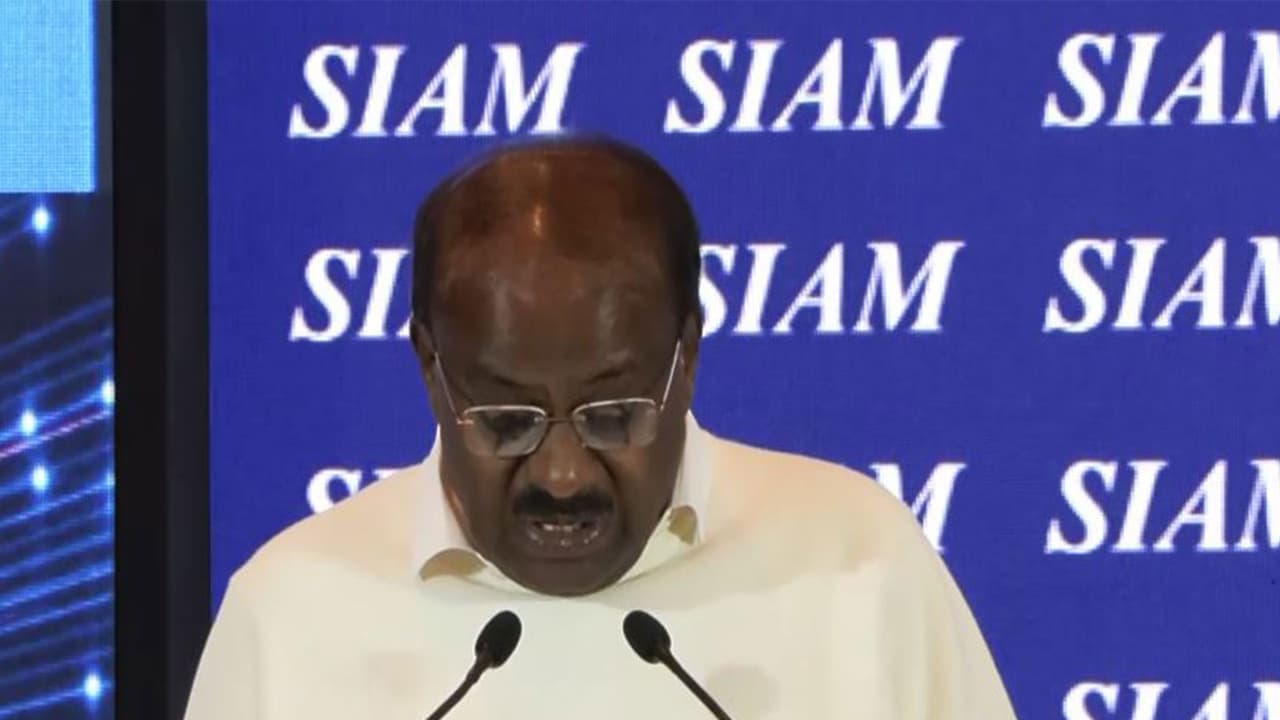
Heavy Industries Minister HD Kumaraswamy said India's trade deals with the US and EU are set to boost auto component exports and its battery ecosystem. These engagements aim to improve market access and enhance competitiveness for Indian manufacturers.
India's calibrated trade engagement with the United States and the European Union is set to strengthen the country's auto component exports and support its emerging battery and advanced manufacturing ecosystem, Heavy Industries Minister HD Kumaraswamy said on Wednesday.
"On the trade front, India has adopted a calibrated and strategic engagement with key global partners," Kumaraswamy said while addressing the 60th ACMA Excellence Awards and Technology Summit 2026.
Focus on US and EU Trade Engagements
Referring to recent developments under the India-US trade agreement, he said there are "commitments towards preferential access for select automotive components and the easing of trade restrictive measures."
He added that negotiations with the European Union -- which he described as a major strategic engagement -- are focused on addressing non-tariff barriers, strengthening regulatory cooperation and aligning standards, particularly in areas such as efficiency, sustainability and advanced automotive technologies. "These engagements are designed to improve market access and enhance global competitiveness for Indian manufacturers," he said.
Auto Sector's Growing Importance and Performance
Kumaraswamy said the auto component industry will play a central role in shaping next-generation global supply chains as India advances toward its long-term development vision.
Innovation in electronics, power electronics, lightweight materials and intelligent systems will be key to maintaining competitiveness in global markets, he said.
Highlighting the sector's recent performance, Kumaraswamy noted that India's vehicle production rose from 28.4 million units in the financial year 2023-24 to nearly 31 million units in 2024-25. Exports increased from 4.5 million units to over 5.3 million units during the same period. "This reflects the scale, resilience and global relevance of India's automotive sector," he said.
Policy Initiatives to Boost Manufacturing
The minister said the government is reinforcing domestic manufacturing capabilities through policy support and targeted incentives. The Production Linked Incentive (PLI) scheme for automobiles and auto components, with an outlay of nearly Rs 26,000 crore, is aimed at strengthening localisation and advanced manufacturing.
In parallel, the PLI scheme for Advanced Chemistry Cell (ACC) batteries, with an outlay of Rs 18,100 crore, seeks to establish 50 gigawatt hours (GWh) of domestic battery manufacturing capacity. "Battery manufacturing lies at the core of energy security and future mobility," Kumaraswamy said, underlining the importance of building domestic capacity in storage technologies to support electric vehicles and clean energy systems.
He also referred to the government's decision to develop rare earth corridors as part of the permanent magnet manufacturing initiative, aimed at securing critical materials for next-generation mobility technologies.
Additionally, the Budget has announced an approximately Rs 13,000 crore scheme for construction and infrastructure equipment to reinforce the heavy engineering and capital goods sectors.
A Vision for Global Leadership
"The government remains committed to providing a stable policy environment, encouraging technology adoption and working closely with industry stakeholders," Kumaraswamy said. "Our objective is clear -- to enable Indian manufacturers not only to participate in global value chains, but to lead them." (ANI)
(Except for the headline, this story has not been edited by Asianet Newsable English staff and is published from a syndicated feed.)