
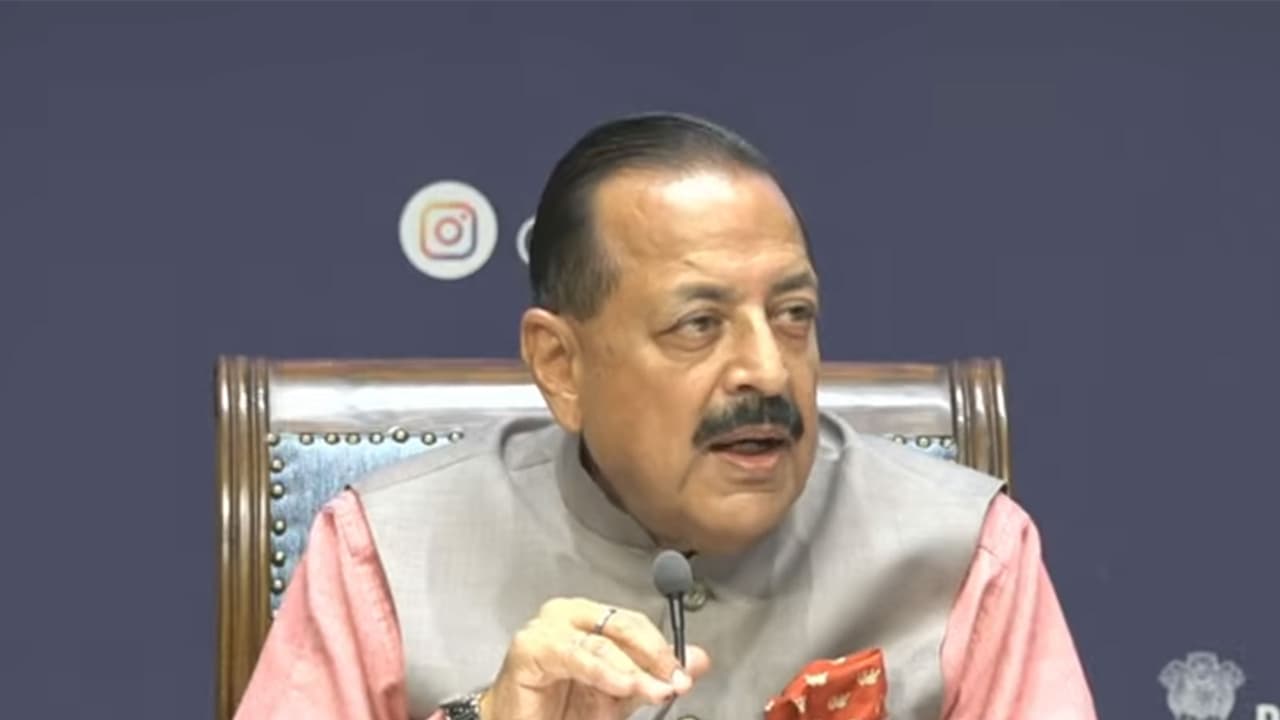
NITI Aayog's new roadmap projects India's bioeconomy to grow to USD 691 billion by 2035, creating 30 million jobs. Union Minister Jitendra Singh says India is ready to lead the biotech-driven fourth industrial revolution.
India's bioeconomy can expand to USD 691 billion by 2035, create over 30 million high-value jobs and position the country among the world's top three biotechnology powers, according to a roadmap unveiled by NITI Aayog on Thursday, as Union Minister Dr Jitendra Singh said India is ready to take a leadership role in the next wave of biotechnology-driven growth.
Launching the Roadmap for Building India as a Leading Bioeconomy Powerhouse by 2035, Singh said the "fourth industrial revolution is being driven by biotechnology" and noted that the global bioeconomy market is currently valued at USD 1.4-1.8 trillion, while India already has more than 11,000 biotechnology startups. "We are among the very few countries that have come out with a dedicated biotechnology policy," the minister said. Highlighting India's ambitions in the sector, Singh added, "We are no longer waiting for others to experiment. We are ready to take risks and take risks with a certain amount of confidence."
Future Projections and Strategy
The roadmap projects India's bioeconomy to grow further to USD 2.6 trillion by 2047, contributing 8-10 per cent of GDP, through a mission-driven strategy focused on biomanufacturing, AI-enabled biotechnology, regulatory reforms and stronger industry participation. It states that with decisive execution, India can emerge as one of the world's leading biotechnology hubs.
Key Proposals and Funding
To support this transformation, the roadmap proposes six National BioMissions covering gene and cell therapies, climate-resilient agriculture, synthetic biology, disease surveillance, marine biotechnology and next-generation biopharmaceuticals. It also recommends creating a Rs 50,000-crore BioEconomy Growth Fund for 2026-2035 to help bridge the gap between laboratory research and commercial-scale manufacturing, alongside PLI-style incentives, faster regulatory approvals and stronger intellectual property protection.
Developing Domestic Capabilities
Stressing the importance of developing domestic capabilities, Singh said talent development would be critical for building a sovereign biotechnology ecosystem. "We are introducing a course in engineering biology, which will be the first of its kind in India... which could be the key to bioeconomy," he said.
The roadmap notes that India's bioeconomy has already grown 16-fold, from USD 10 billion in 2014 to USD 195.3 billion in 2025, contributing 4.8 per cent to GDP.
Summing up the broader vision, Singh said, "Once we have a thriving bioeconomy, we will be addressing more than one national goal... there will be health security, food security, Vocal for Local and also global, there will be high-skill jobs in millions and above all the geopolitical stature of India."
(ANI)
(Except for the headline, this story has not been edited by Asianet Newsable English staff and is published from a syndicated feed.)