
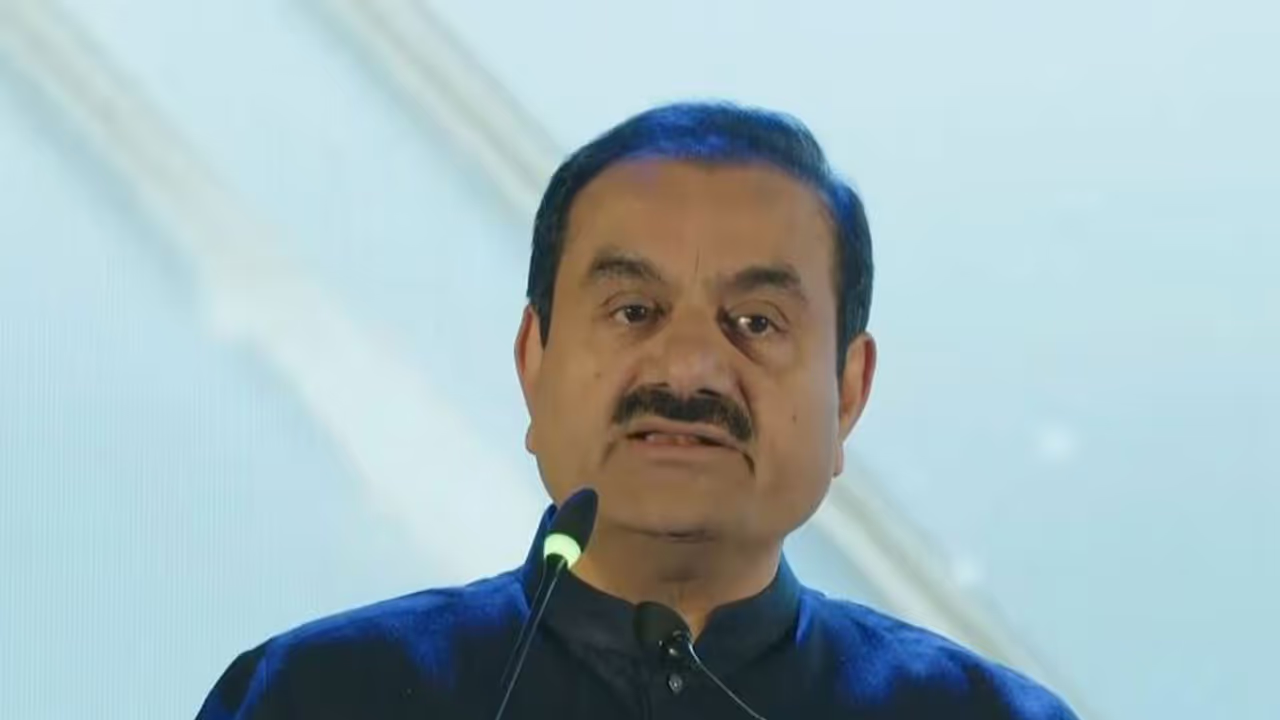
Gautam Adani lauded Vishakha Group's integrated ecosystem as a new model for Indian manufacturing, setting global benchmarks in renewable energy. He stressed their 35-year partnership was built on trust and character, not just business contracts.
Adani Group Chairman Gautam Adani on Saturday said that Vishakha Group's coordinated industrial ecosystem spanning solar glass, aluminium, polymer films and advanced materials represents a new model of Indian manufacturing capable of strengthening the country's renewable energy future while setting international benchmarks.
Speaking on the 25-year journey of Vishakha Group, he stressed that the success was not the result of legal agreements alone, but of shared conscience and mutual respect. He also acknowledged broader contributions of Jigish Doshi, Chairman, Vishakha Group, to the society, including leadership roles in community and charitable organisations.
A New Model of Indian Manufacturing
Adani pointed to the commissioning of India's largest solar glass furnace, a 660-tonne-per-day facility, completed within just 24 months, as evidence of this shift. "This was not an Indian timeline trying to catch up with global standards. It was an Indian benchmark setting a global benchmark," he said.
Adani added that the upcoming second phase would scale capacity to 1,260 tonnes per day, making it the largest solar glass furnace ever built in India, with an ambitious execution target of 20 months. He further highlighted one of the country's largest integrated aluminium complexes at Vishakha Group, anchored by India's largest fully automated anodizing line. "What makes the enterprise distinctive is not any single asset, but the integration of glass, aluminium and films into a single, 12-gigawatt solar manufacturing ecosystem an industrial configuration he described as unique globally," he mentioned.
Foundation of a 35-Year Partnership
Addressing the next generation of leaders, he urged them to look beyond balance sheets and safeguard the trust and family integrity that made growth possible.
Referring to the period during the Gulf War, when India faced severe import disruptions and factories were close to shutting down, he said many traders saw the shortage as a profit opportunity. "....Unfortunately, in that challenging period, many traders saw the shortage as an opportunity to profit. Contracts were broken, prices skyrocketed, and what should have been a crisis to address collaboratively transformed into an opportunity to exploit. It was in this situation that I first met Jigish, who had come to see me and had brought along many of his small customers. He had not come to complain, to ask for favours, to negotiate a better deal. He had come so I could truly understand the pain of those customers affected by this crisis..." he said.
"While the temptations of profits made others focus on themselves, Jigish was focused on his customers, his principles and the promises he had made. So, I made a simple decision. Instead of forcing Jigish through layers of distributors who made their cuts, we decided to supply to him directly. We extended him credit; we placed our trust in him. I did so because I realised that Jigish had come not to ask any favours, he was asking me for fairness..." he added.
Trust: The Most Valuable Form of Capital
Adani said that the moment of trust became the foundation of a 35-year partnership that later grew into multiple world-class manufacturing businesses. "Vishakha was not built by contracts. It was built by conviction. In a world obsessed with smart deals, this was a reminder that character revealed in crisis is the most valuable capital of all," he said.
"For Jigish and me, Vishakha is a living proof of how faith and friendship can shape a future where trust becomes the most valuable form of capital. It is a reminder of profound impact in guiding the incredible journey of Vishakha," he added. (ANI)
(Except for the headline, this story has not been edited by Asianet Newsable English staff and is published from a syndicated feed.)