
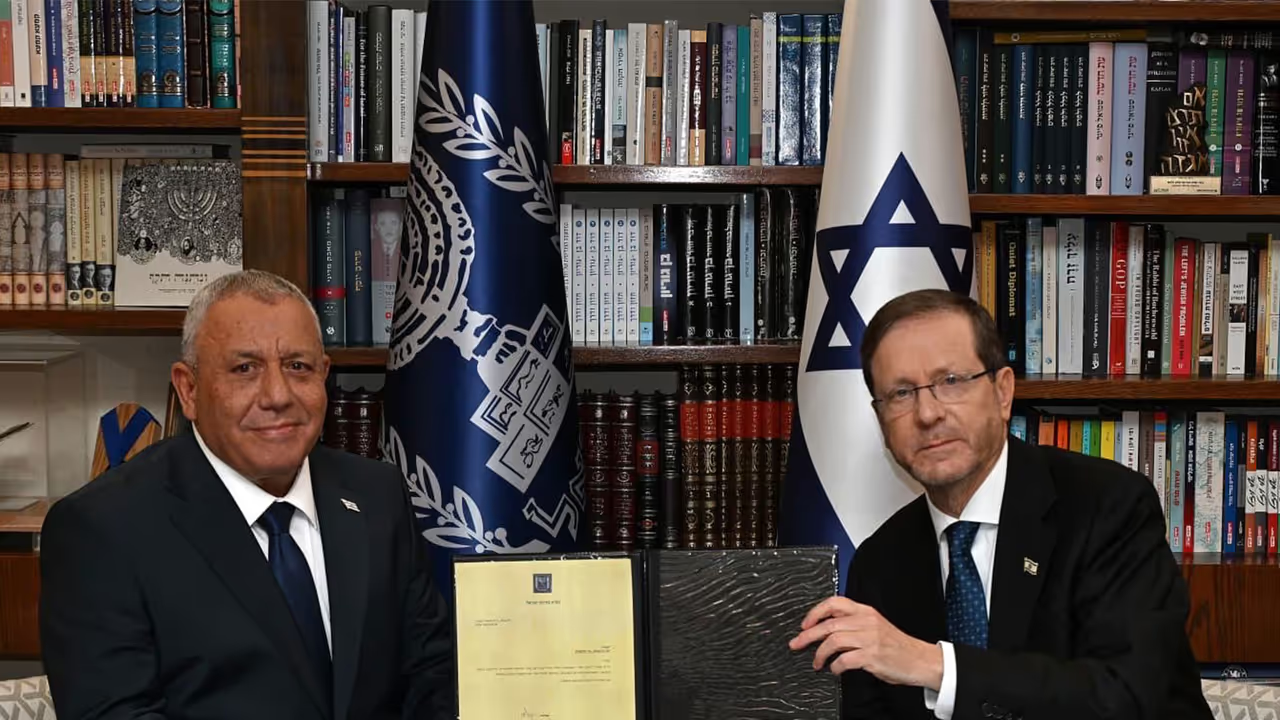
Yashar party leader Gadi Eisenkot has received the presidential mandate to form Israel's next government, pledging to unite the nation and address urgent security, diplomatic, and domestic challenges through a broad emergency administration.
Eisenkot Receives Mandate to Lead
Yashar party chairman Gadi Eisenkot on Sunday called for a new era of "Zionism, solidarity, and friendship" in Israel after formally receiving the mandate from President Isaac Herzog to form the country's next government, pledging to establish a national emergency government amid mounting security, diplomatic and domestic challenges. In a post on X following the mandate-conferral ceremony at the President's Residence, Eisenkot said Israel needed new leadership that could bring together different sections of society and overcome political divisions. "Israel needs a new government. Israel needs leadership that champions what unites us and paves the way for a new era—an era of Zionism, solidarity, and friendship. The task is difficult and there is much work ahead, but I believe success is within reach. Israel must win. And I will do everything to make that happen. With God's help, we will act and succeed!" Eisenkot wrote.
Presidential Mandate and Political Outlook
Eisenkot formally received the mandate from Herzog during an official ceremony at the President's Residence, following consultations with representatives of political factions in the 120-member Knesset. Addressing the ceremony, Herzog said Eisenkot had received the "clear and unequivocal support" of a majority of Knesset members on the question of who had the best chance of forming the next government, while acknowledging that current Prime Minister Benjamin Netanyahu's Likud remained the largest party. The Israeli President urged Eisenkot to form an administration that would represent all sections of Israeli society, including those who had supported the outgoing government and those who had voted for the opposition bloc. Expressing hope that the next government would help bridge political divisions, Herzog said, "I wish with all my heart that whatever government is formed will lead to unity, connection, and healing among all parts of the nation."
Urgent Challenges Facing the State
In his address, Eisenkot described the situation facing Israel as a "challenging and fateful state of emergency", pointing to ongoing wars, military objectives that remained unfulfilled and what he termed a "devastating diplomatic crisis". He also warned that Israel's international standing was facing difficulties, claiming that "even some of Israel's closest allies" were reconsidering their relations with the country. Highlighting domestic political challenges, the Yashar leader said Israel was experiencing "one of the most vulnerable moments Israeli democracy has ever known". He expressed concern over efforts to delegitimise democracy and growing distrust of state institutions, warning that the country had reached an "extremely dangerous point".
Outlining his immediate priorities after receiving the presidential mandate, Eisenkot declared that he would work towards establishing a broad-based government to address the country's challenges. "With the mandate entrusted to me here today, I will lead the establishment of a national emergency government," he said, adding that "this will require creative and unconventional political moves." Stressing the urgency of the government formation process, Eisenkot said Israel could not afford prolonged political uncertainty or repeated elections. "Israel does not have the privilege of wasting time or repeating endless election rounds," he said.
Coalition Building Efforts
The Yashar chairman also extended an invitation to all parliamentary factions and elected representatives to participate in the government formation process, irrespective of their existing political affiliations. "To all parliamentary factions and elected representatives: my door is open and my hand is extended, wholeheartedly and willingly, to anyone who understands the gravity of this moment and is prepared to take courageous action for the State of Israel," he said.
In a notable appeal to members of Netanyahu's political bloc, Eisenkot said lawmakers from Likud and Religious Zionism could support his proposed government if they agreed with the principles he had outlined. Emphasising that national unity should not be treated as a political bargaining instrument, he said, "For me, unity is neither a political bargaining chip nor an empty gimmick, but a supreme value that embodies genuine partnership." He further challenged members of the two parties to demonstrate their commitment to national unity by extending support to a government under his leadership. "If members of Likud and Religious Zionism truly believe that this is a time for unity, as they declared before the president, I cannot imagine any reason why they would not come forward and support a government under my leadership and the principles I have laid out," Eisenkot said.
However, amid disagreements within the opposition bloc over the composition of the proposed government, Eisenkot also cautioned political partners against allowing personal considerations to obstruct the formation process. "Anyone who tries to thwart the formation of a government for personal rather than substantive reasons will be remembered by history as someone who failed to save Israel at a time of emergency," he said. He acknowledged that the coalition-building exercise would require compromises from all participating parties, indicating that no political faction would be able to fulfil all its election promises. Eisenkot pledged to approach the negotiations with patience, humility and composure, while maintaining what he described as a "deep commitment to a Jewish, democratic, egalitarian, liberal and secure Israel."
Political Math and Hurdles
Meanwhile, Eisenkot faces the challenge of bringing together different political factions to secure the parliamentary backing required to establish the next government. Under the mandate, he has 28 days to form a government, with Herzog having the authority to grant an additional extension of up to 14 days if necessary. During the presidential consultations, factions representing 67 Members of the Knesset recommended Eisenkot, while 46 lawmakers backed Netanyahu. A faction comprising seven lawmakers chose not to recommend either candidate. The 67-seat backing for Eisenkot includes 48 seats from the Jewish-led opposition bloc, comprising Yashar, Together, The Democrats and Yisrael Beiteinu, along with eight seats from the Arab Ra'am party and 11 seats from the Joint List. The Joint List's unanimous decision to recommend Eisenkot, alongside the endorsement from Ra'am, contributed to his securing majority support during the consultations.
Meanwhile, differences have emerged between Eisenkot and Yisrael Beytenu chairman Avigdor Liberman over the proposed government's composition and the possibility of relying on Arab-led parties for parliamentary support. According to The Times of Israel, Eisenkot and Liberman are scheduled to meet on Monday to discuss their disagreements and coordinate the change bloc's parliamentary agenda, a day before the new Knesset is sworn in. The report further stated that Eisenkot is expected to meet B'Yachad chairman Naftali Bennett, who has remained silent amid the exchanges between Eisenkot and Liberman. Liberman has ruled out supporting a minority government or an administration dependent on Arab-led parties, narrowing Eisenkot's options for securing parliamentary backing, according to The Times of Israel. The report also said Liberman had indicated a willingness to negotiate with ultra-Orthodox parties, despite his longstanding opposition to cooperating with them, while suggesting that Likud lawmakers could defect from Netanyahu's bloc. His apparent shift has drawn criticism and accusations that he is obstructing Eisenkot's efforts because of personal ambitions to become Prime Minister, allegations that Liberman has denied. With the mandate formally conferred, Eisenkot now faces the task of reconciling differences among potential coalition partners and translating the parliamentary support received during the presidential consultations into a functioning government. (ANI)
(Except for the headline, this story has not been edited by Asianetnews Editorial staff and is published from a syndicated feed.)









