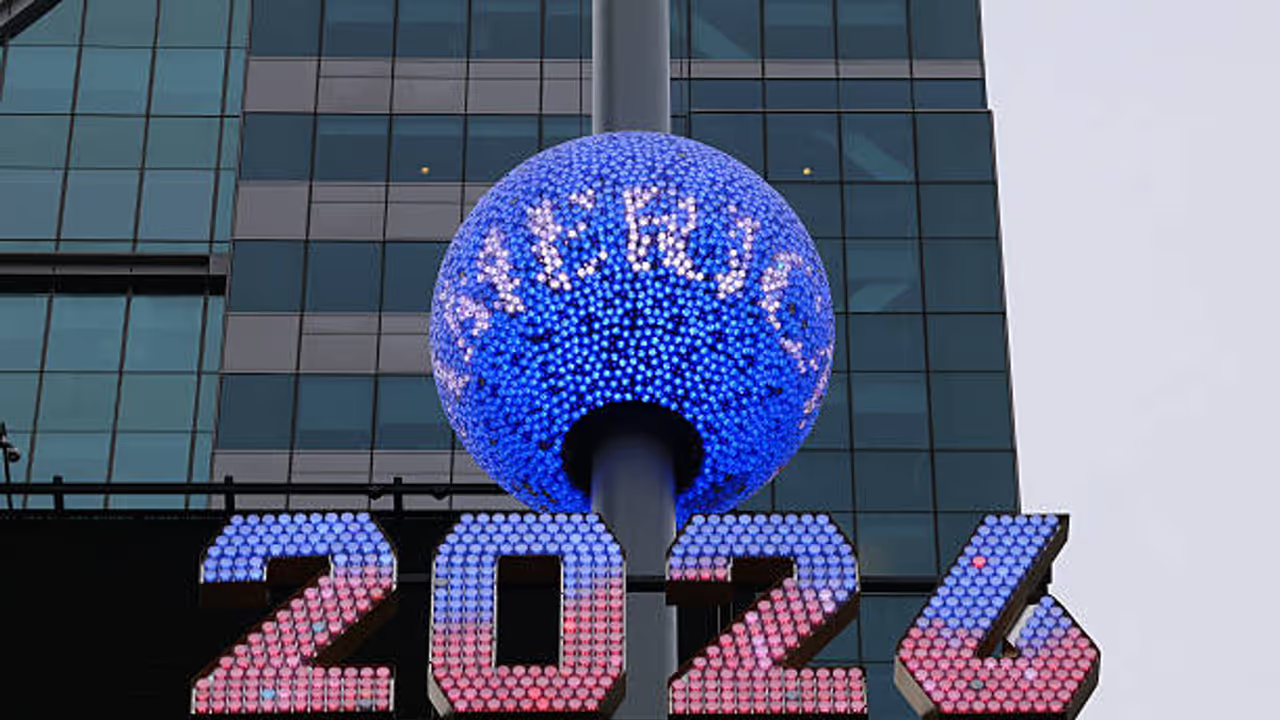
New Year's Eve revellers toasted the end of 2025 on Wednesday, waving goodbye to 12 months packed with Trump tariffs, a Gaza truce and vain hopes for peace in Ukraine.
New Year's Eve revellers toasted the end of 2025 on Wednesday, waving goodbye to 12 months packed with Trump tariffs, a Gaza truce and vain hopes for peace in Ukraine. It was one of the warmest years on record, the stifling heat stoking wildfires in Europe, droughts in Africa and deadly rains across Southeast Asia.
There was a sombre tinge to party preparations in Australia's harbour city Sydney, the self-proclaimed "New Year's capital of the world".
Barely two weeks have passed since a father and son allegedly opened fire on a Jewish festival at Bondi Beach, killing 15 people in the nation's deadliest mass shooting for almost 30 years.
Related Articles

Parties will pause for a minute of silence at 11:00 pm (1200 GMT) as the famed Sydney Harbour Bridge is bathed in white light to symbolise peace.
"It has been a difficult year for so many people," said Steph Grant, a 32-year-old Sydney resident.
"Here's hoping the world looks like a brighter place in 2026," said Grant, who works in advertising.
Hundreds of thousands of spectators are expected to line Sydney's foreshore as nine tonnes of fireworks explode on the stroke of midnight.
Security will be tighter than usual, with squads of heavily armed police patrolling the crowds.
Sydney kicks off a chain of celebrations stretching from glitzy New York to the Hogmanay festival on the chilly streets of Scotland.
More than two million people are expected to pack Brazil's lively Copacabana Beach for what authorities have billed as the world's biggest New Year's Eve party.
Truce and tariffs
Labubu dolls became a worldwide craze in 2025, thieves plundered the Louvre in a daring heist, and K-pop heartthrobs BTS made their long-awaited return.
The world lost pioneering zoologist Jane Goodall, the Vatican chose a new pope, and the assassination of right-wing activist Charlie Kirk laid bare America's deep political divisions.
Donald Trump returned to the White House in January, launching a tariff blitz that sent global markets into meltdown.
The US president used his Truth Social platform to lash out at his sliding approval ratings ahead of midterm elections in 2026.
"The polls are rigged," he wrote, without providing evidence.
"Our Country is 'hotter' than ever before. Isn't it nice to have a STRONG BORDER, No Inflation, a powerful Military, and great Economy??? Happy New Year!"
But many expect tough times to continue in 2026.
"The economic situation is also very dire, and I'm afraid I'll be left without income," said Ines Rodriguez, 50, a merchant in Mexico City.
"All our colleagues are in the same situation: very little work and not very profitable," said Buenos Aires business owner Fernando Selvaggi, 61.
After two years of war that left much of the Gaza Strip in ruins, US pressure helped land a fragile ceasefire between Israel and Hamas in October.
But with each side already accusing the other of flagrant violations, no one is sure how long the break in hostilities will hold.
Hamas militants stormed into southern Israel on October 7, 2023, resulting in the deaths of more than 1,200 people, most of them civilians.
Israel's retaliatory assault on Gaza has killed more than 70,000, also mostly civilians, according to the health ministry in the Hamas-run territory, a figure the UN deems credible.
World leaders including China's Xi Jinping and Russian counterpart Vladimir Putin began exchanging New Year greetings.
Both countries have made much of their presidents' supposedly close friendship, and Putin was an honoured guest at a spectacular Chinese military parade in September.
Xi said he was "ready to maintain close exchanges with Putin to jointly push for continuous new progress in bilateral ties", Chinese state news agency Xinhua reported Wednesday.
The war in Ukraine -- sparked by Russia's full-scale invasion in 2022 -- meanwhile grinds towards its four-year anniversary in February.
There were hopes a renewed burst of diplomacy might produce a breakthrough this year.
But Russia shot down any notion of a temporary ceasefire in the final days of 2025.
As envoys shuttle between Moscow, Washington and Kyiv, one major obstacle remains: Ukraine is reluctant to give up land, and Russia is unwilling to give it back.
Sports, ,space, and AI
The coming 12 months promise to be full of sports, space travel and serious questions over artificial intelligence.
More than 50 years since the last Apollo lunar mission, 2026 looks to be the year that humankind once again sets its sights towards the moon.
NASA's Artemis II mission, backed by Elon Musk, plans to launch a crewed spacecraft that will circle that moon during a 10-day test flight.
After years of unbridled enthusiasm, artificial intelligence is starting to face mounting scrutiny.
Nervous investors are already questioning whether the years-long AI boom might be starting to resemble something more like a market bubble.
Athletes will gather on Italy's famed Dolomites to hit the slopes for the Winter Olympics.
And for a brief few weeks between June and July, nations will come together for the biggest football World Cup in history.
For the first time, 48 teams will compete in the world's most-watched sports event, playing in venues across the United States, Mexico and Canada.
From the beaches of Brazil to the far-flung reaches of New Zealand, the tournament is expected to draw millions of fans.
(Except for the headline, this story has not been edited by Asianet Newsable English staff and is published from a syndicated feed)