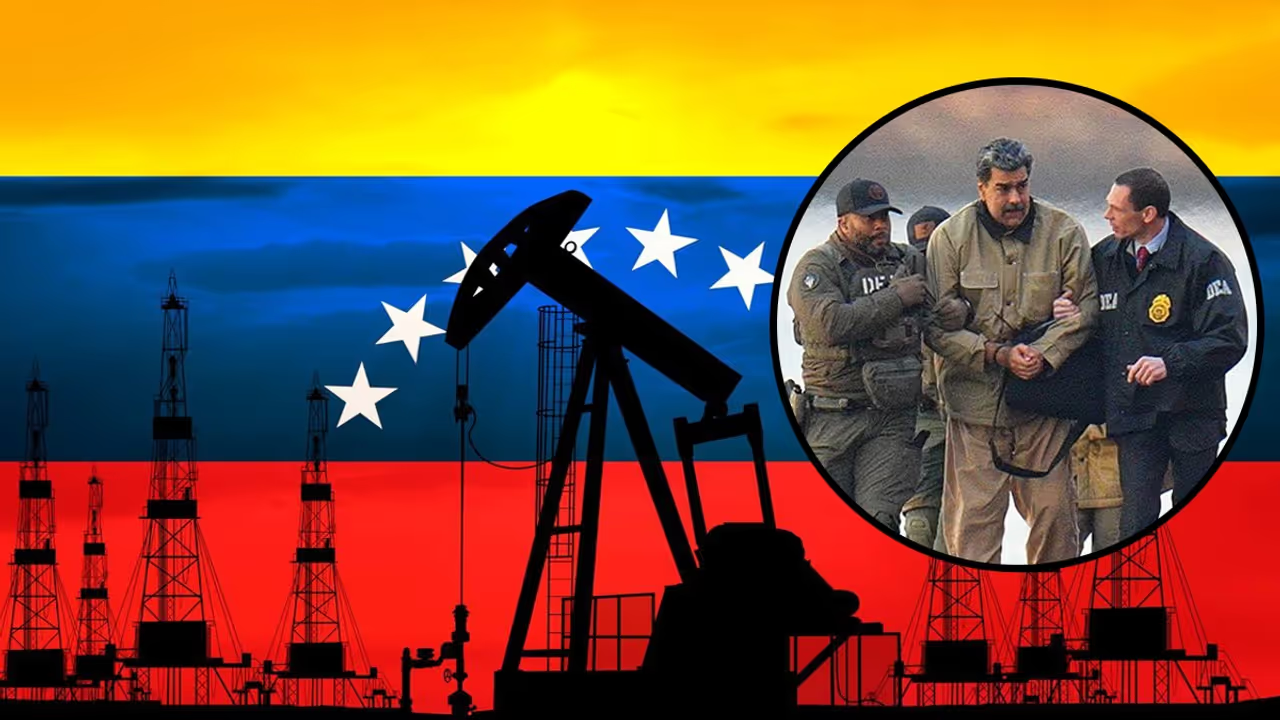
The US strike that removed Nicolas Maduro sparked claims it was about oil. But Venezuela’s crude is costly, complex and risky. The real motive may lie in power, perception and US political timing.
When US forces struck deep into Venezuela and removed Nicolas Maduro, the images were dramatic and the message unmistakable: strength and decisiveness. Almost immediately, a familiar question followed. Was this about oil? After all, Venezuela holds the world’s largest proven crude oil reserves. But a closer look at energy economics, industry behavior, and political timing shows that oil alone cannot explain this operation. In fact, it likely was not the primary motive at all.
On paper, Venezuela’s reserves are staggering. Roughly 300 billion barrels account for close to one fifth of global proven reserves. But reserves are not production, and production is not profitability. Today, Venezuela contributes less than 1 percent of global oil output, a gap that undermines the argument that its oil is strategically indispensable.
The Harsh Economics of Heavy Crude
The core issue lies in the nature of Venezuelan crude. Much of it is heavy and extra heavy oil, thick, viscous, and high in sulfur and metal content. Unlike lighter sweet crudes such as West Texas Intermediate or Brent, Venezuelan oil is expensive to extract, transport, and refine. It cannot be processed without extensive upgrading.
Related Articles

Refining heavy crude requires complex facilities equipped with cokers, hydrocrackers, and desulfurization units to break down dense hydrocarbons into usable fuels. Only a limited number of U.S. refineries have this capability, and even they face higher operating costs and thinner margins. This is why Venezuelan oil has historically traded at a discount to global benchmarks.
Why Big Oil Walked Away from Venezuela
Chevron is the only major US oil company still involved in Venezuela’s oil sector. Even that involvement is limited and cautious, shaped by sanctions, licensing restrictions, and political uncertainty. Other American oil majors such as ExxonMobil and ConocoPhillips exited Venezuela years ago after writing off billions of dollars in losses and have shown little interest in returning.
The economics explain their reluctance. Developing Venezuelan heavy crude requires massive capital investment, specialized refining capacity, and years of rebuilding degraded infrastructure. Estimates suggest that even doubling Venezuela’s current production would require at least 30 billion dollars, along with sustained political stability and regulatory clarity. Those conditions remain uncertain.
America Already Has Easier Oil Options
At the same time, the United States produces nearly 14 million barrels per day of high quality crude domestically and has reliable access to Canadian heavy oil under far more predictable legal and political frameworks. From a corporate perspective, there is little incentive to assume Venezuelan risk when safer and more profitable options exist closer to home.
If American oil companies themselves are unwilling to invest, the idea that Washington launched a risky geopolitical operation primarily to secure Venezuelan oil becomes implausible. Energy economics do not justify the timing, scale, or political cost of such an intervention.
If Not Oil — Then What Was This Really About?
This leads to a broader conclusion. This operation may not be about oil at all. Oil serves more as a convenient talking point than a genuine strategic driver.
To understand the real motive, one must look inward. With the November 2026 midterm elections approaching, Donald Trump faces persistent domestic pressures, including political polarization and governance criticism. When domestic challenges intensify, leaders often look outward, using foreign confrontation to project strength and regain control of the narrative.
The operation delivered what modern politics rewards: clarity and spectacle. A villain was identified. A mission was executed. Victory was declared. For domestic audiences, especially core supporters, the message was simple. America acts and America wins.
Power, Optics and Political Timing
Beyond domestic politics, the move also sends strategic signals, reinforcing unilateral decisiveness and reshaping regional power calculations. But it carries risks, including diplomatic backlash, legal challenges, and long term instability in a region wary of US intervention.
In the end, this was not a scramble for oil barrels or refinery margins. Venezuelan crude is costly, complex, slow to monetize, and strategically unnecessary for the United States today.
This was about power, perception, and politics. And in modern governance, controlling the narrative may be more valuable than controlling oil.