The negotiations, involving various stages and parties, could take several months to complete. Until a new government is sworn in, the outgoing cabinet will continue to run The Netherlands.
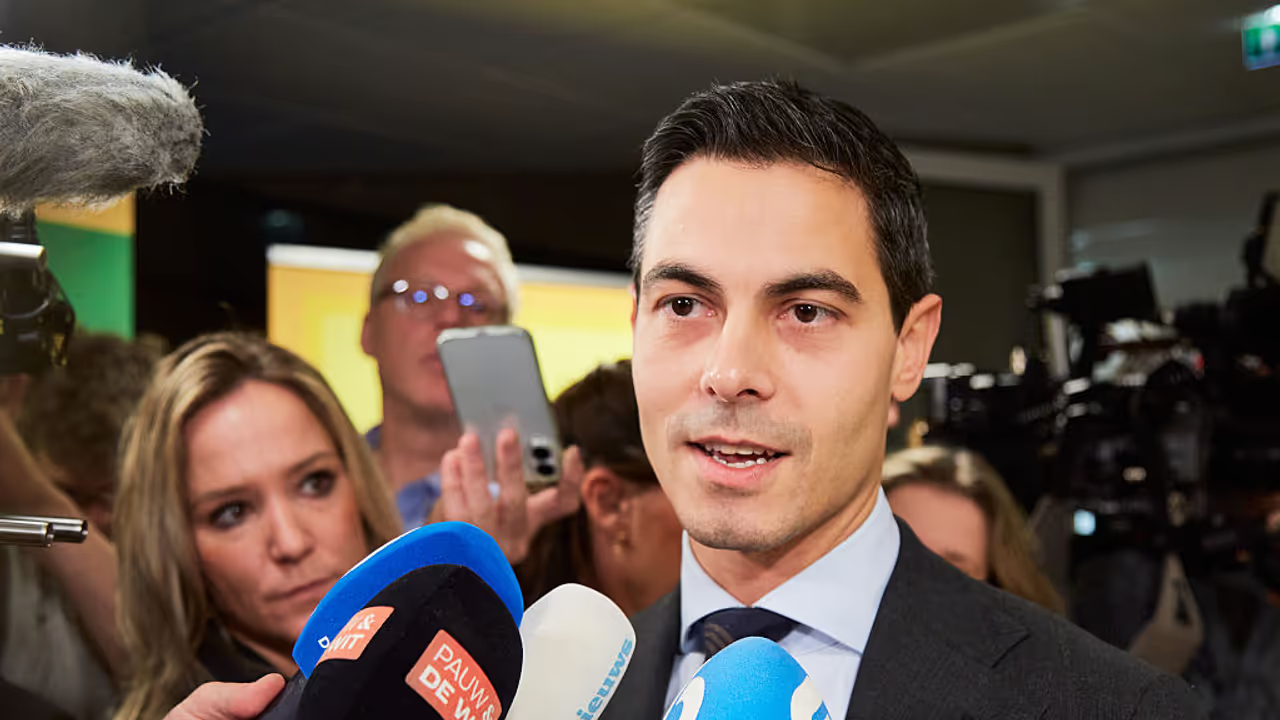
Photo finish, cliffhanger, nailbiter: Rob Jetten has claimed victory in Dutch elections after local news agency ANP said far-right head Geert Wilders could not overhaul his slender lead. "I am incredibly happy... At the same time, I feel a great responsibility," Jetten told reporters. So what happens next in Dutch politics, roiled by months of Wilders-inspired chaos? In short: months of talking, as party leaders try to form a workable coalition and haggle over a government programme palatable to all sides. Here's what you need to know.
What's Still Left To Count?
With ballots counted from all but one of 342 constituencies and the three Dutch overseas Caribbean islands, Jetten holds a lead of 15,155 votes over Wilders. Venray, a small constituency in the southeast of the Netherlands, is expected to declare later Friday after delays following a fire on election night. Voters there have historically supported Wilders and his far-right Party for Freedom. But the postal votes of some 90,000 expatriates are expected to be decisive. They will not be tallied until Monday evening at the earliest but are predicted to benefit Jetten. The Electoral Council will declare the official result next Friday.
How Do Negotiations Work?
The magic number is 76. That's how many seats in the 150-seat parliament any coalition needs to govern. As soon as the final results are in, the calculators will be out to see what combination of the many competing parties can get to that number. ANP puts the D66 and the Wilders's PVV both on 26 seats. If Jetten does edge the election as projected, he gets the first chance to form a coalition -- "a complex and exciting process", as the parliament's own website describes it.
Related Articles

First, he will appoint a "scout" to kick off talks. This person scouts around to see which parties are willing to work with each other. Then parliament appoints an "informateur" to scope out the possible contours of a coalition agreement. Before 2012, this person was appointed by the monarch. When it looks like a group of parties can work together, in comes a "formateur", who is almost always the person who won the election. That person starts building a potential cabinet. If all is agreed, the parties sign a coalition agreement and the new government sets out its plans in parliament, followed by a vote of confidence.
How Long Does This Take?
Ages. Parties compete to get as much of their manifesto into the coalition agreement as possible, and that's even before the jockeying for ministerial jobs. The last government of Prime Minister Dick Schoof took 223 days to form. All parties have said however that they want the process finished as quickly as possible. "You can imagine that compromising between four parties with different ideologies will be very challenging," Sarah de Lange, professor of Dutch politics at Leiden University, told AFP. “So it's very likely that the coalition formation will take a long period, say, anywhere between six months and a year.” Schoof has said he expects to still be premier at Christmas. Jetten himself admitted it would be "complicated" but said the Dutch voters could not afford to wait.
What Are The Possibilities?
With virtually all votes counted, a four-way coalition between the D66 (26 seats), the liberal VVD (22), the left-wing Green/Labour bloc (20), and the centre-right CDA (18) could form a government. Other smaller parties could play a crucial part, such as the hard-right JA21 (nine seats). And then there's the possibility of a minority cabinet, but this seems less likely given the desire for stability.
Who's In Charge Then?
Until a new government is officially sworn in, the outgoing cabinet and prime minister run the country, in this case Schoof. Things tend to run pretty smoothly in the interim period. This is a tried-and-tested process, as never in Dutch history has one party gained more than 50 percent of the vote. The caretaker government can still pass a budget and enact legislation, said De Lange. "So the Netherlands is not entirely on hold until a new coalition has been formed after these elections."
(Except for the headline, this story has not been edited by Asianet Newsable English staff and is published from a syndicated feed)