
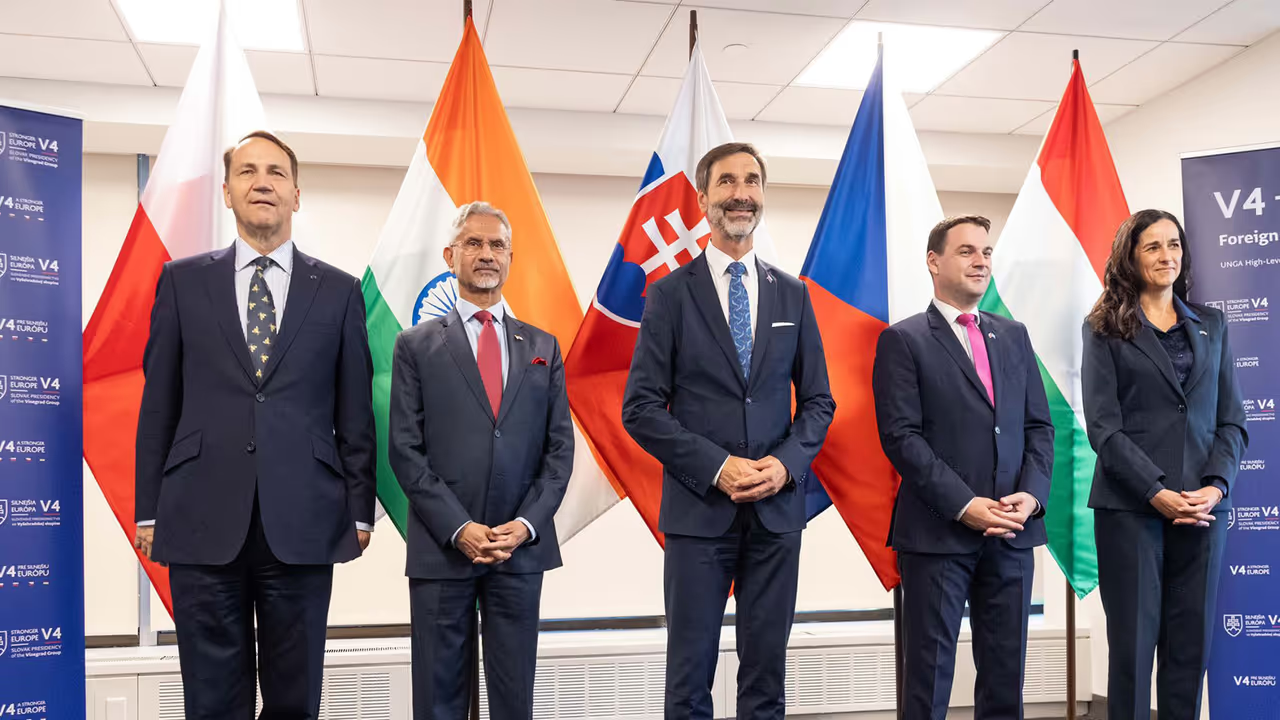
The Visegrád Group (V4) countries—Poland, Hungary, Slovakia, and the Czech Republic—have backed India for a permanent UN Security Council seat. Slovakia's FM Juraj Blanár stated India 'must be at the table' as a permanent member.
The Visegrád Group (V4) countries, comprising Poland, Hungary, Slovakia and the Czech Republic, have backed India's inclusion as a permanent member of the United Nations Security Council, with Slovakia's Foreign Minister Juraj Blanár saying that India "must be at the table" as a permanent member of the UN's top decision-making body.
During a press interaction following the first Visegrad Group (V4)+India Foreign Ministers' Meeting, Blanár, speaking alongside External Affairs Minister S Jaishankar, said, "We all agree as V4 countries that India, as a part of the Global South country, an upcoming superpower in the Indo-Pacific region, must be at the table as the permanent member of the UN Security Council."
Bilateral and Global Discussions
The remarks were made after the meeting, held on the sidelines of the 81st Session of the United Nations General Assembly in New York on Monday. The meeting brought together EAM Jaishankar and foreign ministers from the four V4 countries under Slovakia's presidency of the group. EAM Jaishankar participated in the meeting along with Slovakia's Foreign and European Affairs Minister Juraj Blanár, Poland's Deputy Prime Minister and Foreign Minister Radosław Sikorski, Czech Republic Deputy Prime Minister and Foreign Minister Petr Macinka, and Hungary's Deputy Prime Minister and Foreign Minister Anita Orbán.
According to a statement issued by the Ministry of External Affairs, the ministers discussed ways to strengthen engagement between India and the Visegrad Group and acknowledged the strong bilateral relations between India and each of the V4 countries. They also noted that the V4+India format could complement existing bilateral ties and provide further momentum to cooperation.
The discussions covered trade and investment, technology and innovation, resilient supply chains, defence and security, connectivity, education, mobility and people-to-people exchanges. The ministers also discussed greater interaction among businesses, academic and research institutions and other stakeholders from India and the V4 member states.
On the global front, the ministers exchanged perspectives on regional and international developments, peace and security and cooperation in multilateral forums. They also discussed the need for reformed multilateralism and ways to address contemporary global challenges, including those affecting the Global South.
Future of V4+India Cooperation
In a post on X after the meeting, Jaishankar outlined the areas where the V4+India format agreed to deepen cooperation. "Delighted to join the Visegrád Group DPM & FM Radek Sikorski of Poland, DPM & FM Anita Orban of Hungary, FM Juraj Blanár of Slovakia and FM Petr Macinka of Czechia on the sidelines of UNGA81. Our first meeting in the V4+India format agreed to: Closer political cooperation including annual meetings of Foreign Ministers, Deeper economic cooperation including Annual Business Forum, Strengthen technology, innovation, research and education partnerships, Reinvigorating our defence cooperation, Further development of our cultural cooperation and people to people relations, Working together to support multilateralism," the post read.
The MEA said the inaugural meeting marked an important step in establishing engagement between India and the Visegrad Group at the Foreign Ministers' level. It said the V4+India format offers an additional platform for dialogue and cooperation, building upon India's longstanding and substantive relations with V4 countries. (ANI)
(Except for the headline, this story has not been edited by Asianet Newsable English staff and is published from a syndicated feed.)