
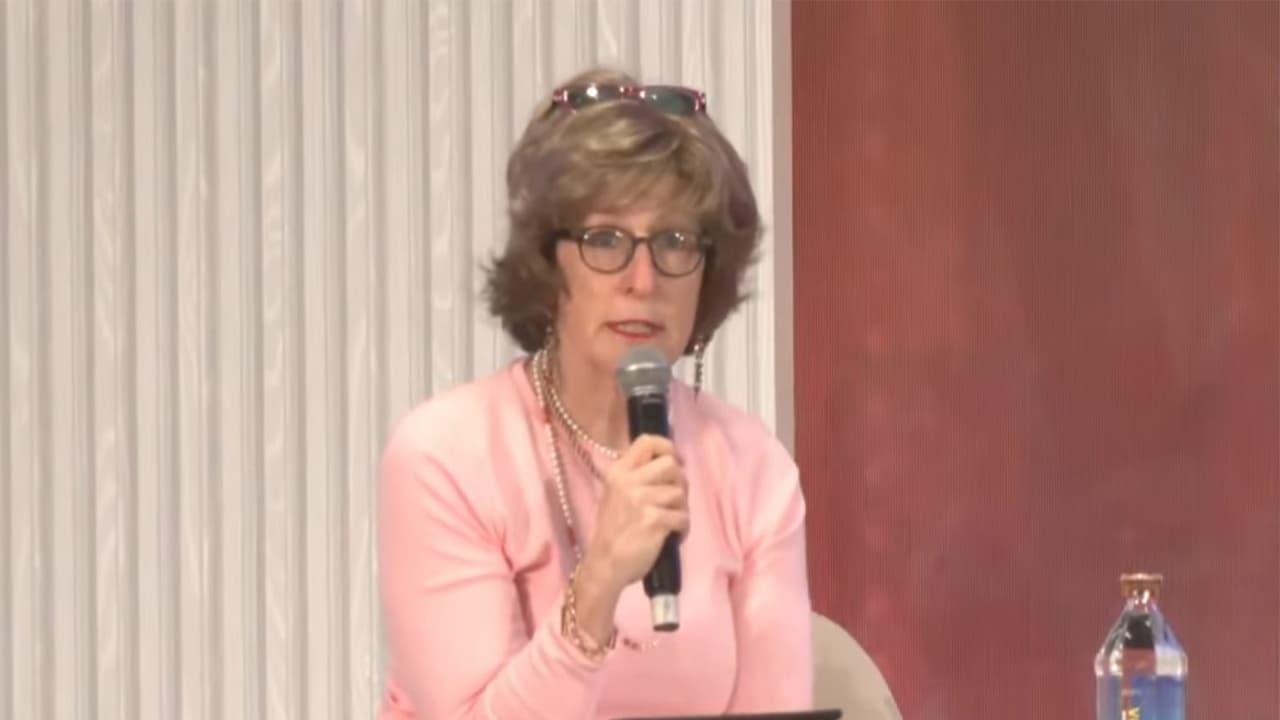
Bonnie Glick stated at Raisina Dialogue 2026 that the US can handle multiple global crises simultaneously, deterring China over Taiwan despite the Iran conflict. She contrasted the US-India partnership with China's 'miscalculated' WTO entry.
Highlighting the state of the current global security landscape, Bonnie Glick, Adjunct Senior Fellow at the Foundation for Defence of Democracies, stated that the United States remains focused on its ability to manage multiple international crises simultaneously while giving due attention to each individual conflict.
Rethinking Deterrence in the Taiwan Strait
Speaking at the Raisina Dialogue 2026 during a session titled 'Beyond Strategic Ambiguity: Rethinking Deterrence in the Taiwan Strait', Glick addressed the shift of American military resources from East Asia to West Asia amid the ongoing Iran conflict. "I think one of the things that we focus on in the United States is addressing conflicts individually, while also simultaneously having access to an ability to respond elsewhere in the world," Glick remarked.
The session explored how the "increasingly ad-hoc use of American power" and skepticism toward long-standing commitments, paired with the Chinese Communist Party's "vehement restatement of its desire for 'reunification'", has intensified regional tensions. Glick noted that there are "so many restive parts of the world" currently, leading to significant concern regarding how China might "use the opportunity vis-a-vis Taiwan." Despite the shift in resources, she maintained that the messaging from Washington remains "pretty clear" regarding its position.
"I think China views bottom-line American intervention in Iran right now as a moment for consideration of Taiwan, but also as a moment of this probably does not make sense right now, because we know that the United States will be able to respond if needed," she added.
Comparing US Approach to India and China
The discussion also touched upon the broader economic and strategic framework of the Indo-Pacific, specifically regarding the "experimental" nature of China's integration into the global order. Commenting on earlier remarks by US Deputy Secretary of State Christopher Landau, Glick suggested that comparing the US approach to India and China is a matter of "apples and oranges." She described the early 2000s decision to grant China entry into the World Trade Organization as an experiment that "has, I think, widely been viewed as a miscalculation in the United States."
In contrast, Glick identified India as the "world's largest democracy" and the most important democratic ally for the US in terms of "heft in the international arena." While acknowledging that trade issues often "complicate the economic relations" between the two nations, she emphasised that the partnership transcends mere commerce. "At the end of the day, the relationship between the United States and India is not based solely on economics. It's based on more foundational elements of freedom of family, even an approach to faith," Glick stated.
A 'Critical Moment' for Bilateral Relations
These observations align with the vision articulated by Deputy Secretary Landau, who described the current period as a "critical moment" for bilateral relations. Landau asserted that the "America First" doctrine "obviously does not mean America alone."
He further noted that just as the US seeks to "make America great again," Washington expects Indian leadership "to want to make their countries great again." Landau said that the rise of India is "undeniable" and that it remains in the mutual interest of both nations to deepen a partnership that will "decide the future of this century." (ANI)
(Except for the headline, this story has not been edited by Asianet Newsable English staff and is published from a syndicated feed.)