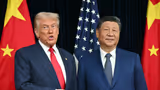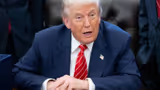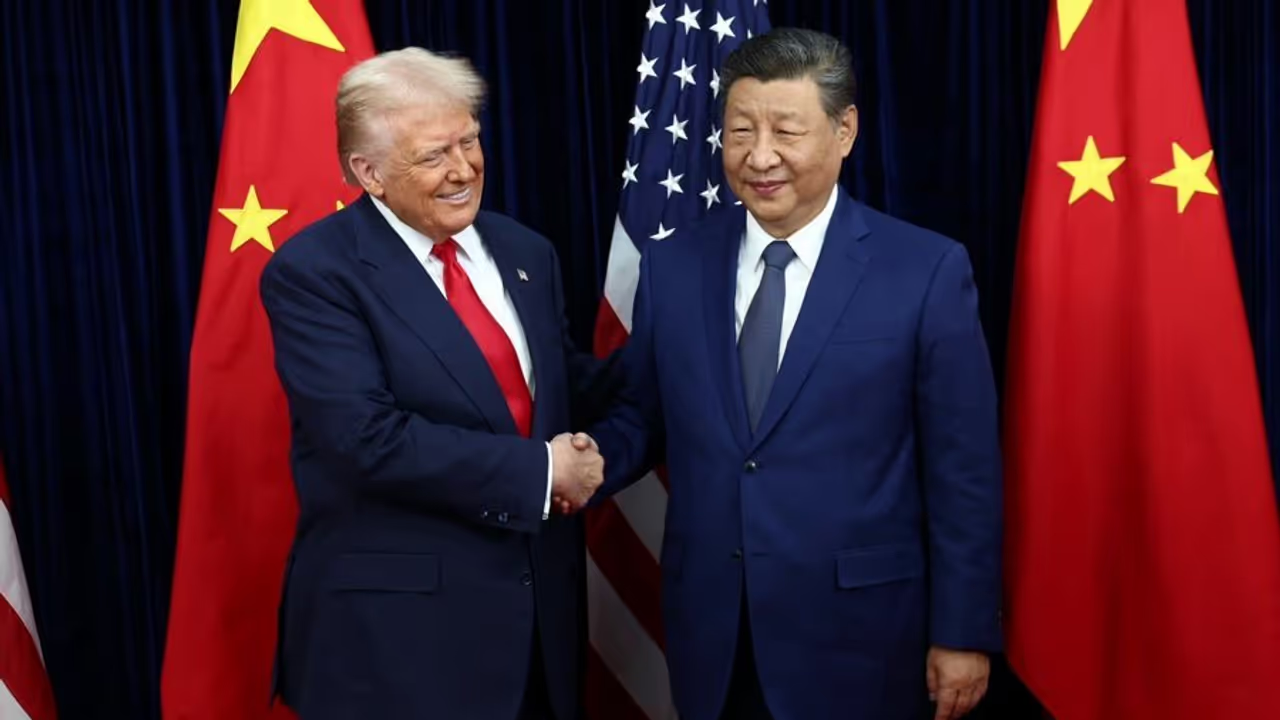
Donald Trump has said he expects a "big, fat hug" from China's Xi Jinping when they meet in Beijing this week, though multiple thorny issues between the two sides could see the US president kept at arm's length.
Donald Trump has said he expects a "big, fat hug" from China's Xi Jinping when they meet in Beijing this week, though multiple thorny issues between the two sides could see the US president kept at arm's length.
Taiwan, tariffs, rare earths and the war in Iran are among the contentious topics set to be discussed by the two leaders, whose styles of communication could hardly be more different.
Trump's often bombastic, freewheeling comportment on the international stage contrasts dramatically with Xi's measured, tight-lipped approach to foreign policy.
Related Articles

In mid-April, the US president predicted that Xi would greet him with a "big, fat hug" upon his arrival in Beijing, adding that "we are working together smartly, and very well!"
China, in contrast, did not confirm the visit was taking place until Monday, typical of its reserve on such matters.
Despite the clash of styles, Beijing's foreign ministry said Monday that China considers leader-to-leader diplomacy as playing an "irreplaceable strategic guiding role in China-US relations".
Trump's trip to China, set to begin Wednesday, is the first by a US president since his own in 2017.
During that first-term sojourn, he received what the Chinese termed "state visit-plus" treatment, including a private tea reception in the Forbidden City.
His 2026 trip is expected to include a tour of the Temple of Heaven and a state banquet, but analysts say the pomp will not match that of nine years ago.
Since Trump's first visit, China has learned that while "aggrandisement... plays to his ego, it cannot prevent him from a quick flip-flop in his attitude towards China", Wu Xinbo, director of the Center for American Studies at Shanghai's Fudan University, told AFP.
‘Less romantic’
In 2017, Chinese state media presented "personal diplomacy as opening a new phase of pragmatic cooperation and great power diplomacy", wrote the National University of Singapore's Bert Hofman in a newsletter on Monday.
But Trump's subsequent anti-China policy tack over the course of his first term, followed by a blistering trade war at the beginning of his second, disabused Beijing of that notion.
"The revived Trump-era discourse in 2025-2026 is less romantic about leader chemistry (in contrast to Trump's continued mentioning of his friendship with Xi)," Hofman wrote.
While there is no longer hope the two men's personal relationship can be transformative, there is acknowledgement it could "prevent derailment, restart channels, and produce tactical bargains", he said.
Beijing has rolled out the red carpet for a broad swathe of other foreign guests recently.
Russian President Vladimir Putin and North Korean leader Kim Jong Un were among the attendees to be warmly welcomed at a military parade in Beijing in September.
And French President Emmanuel Macron got significant facetime with Xi both in the capital and in the southwestern city of Chengdu.
But some analysts think the connection between the leaders of the world's two largest economies is unforced.
John Gong, professor at the University of International Business and Economics in Beijing, told AFP he thought Trump and Xi "really do get along very well".
"I think they genuinely have some kind of a warm relationship towards each other," he said.
'Modest' expectations
Whether that personal relationship trumps the many sore points in the bilateral one remains doubtful.
Trump, who will turn 80 next month, and Xi, who will turn 73 a day later, last met face-to-face in October on the sidelines of a regional summit in South Korea.
There, the two agreed to a one-year truce in a trade war that saw tariffs on many goods exceed 100 percent.
This week's talks will be overshadowed by the US-Israel war in Iran, the most recent addition to a long roster of issues on which the two sides find themselves at loggerheads.
Expectations for outcomes this time should be "modest", said Wendy Cutler, a trade diplomat and vice president of the Asia Society Policy Institute, in the Geoeconomic Competition podcast last week.
"This year, we may see a number of meetings between Presidents Trump and Xi Jinping, and so all the deliverables don't have to be announced at the first meeting," she said.
"For each leader, stabilisation makes sense in the relationship," she added.
(Except for the headline, this story has not been edited by Asianet Newsable English staff and is published from a syndicated feed)