
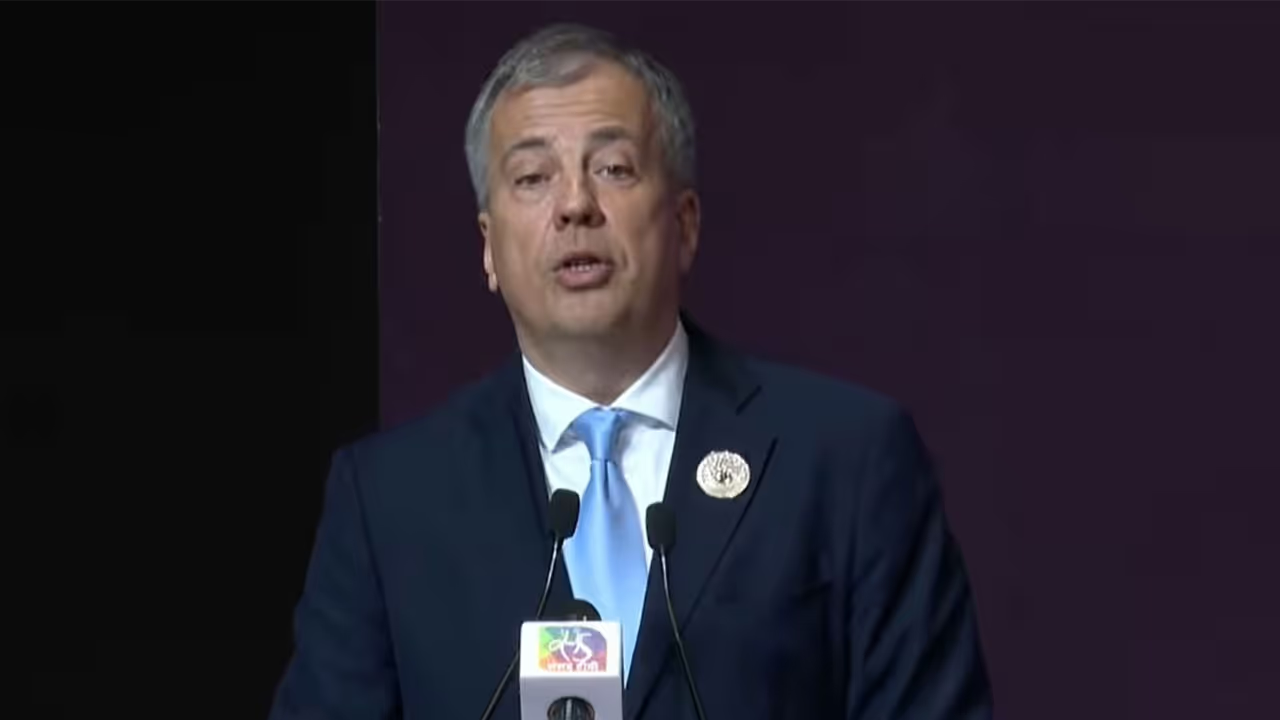
At the India AI Impact Summit 2026, Hungary's Deputy Speaker Lajos Olah warned that unchecked AI, a 'black box' technology, threatens to erode democracy by eliminating accountability and spreading convincing but fabricated content.
AI Threatens Democratic Accountability
Hungary's Deputy Speaker Lajos Olah on Friday warned that unchecked artificial intelligence could erode the very foundations of democratic systems and said that "democracy cannot function in the absence of accountability," as leaders gathered for a session titled "AI for Democracy- Reimagining Governance in the Age of Intelligence" at the India AI Impact Summit 2026. The session featured distinguished national and international leaders, including the Speaker of Parliament of India, Om Birla, Chairperson of South Asian Institute of Peace and Reconciliation (SAIPR), Chinmay Pandya, Inter-Parliamentary Union Secretary General, Martin Chungong, Deputy Speaker of Parliament of Hungary, Lajos Olah and President of HumAIn Foundation (Mexico), Jimena Sofia Viveros.
Speaking during the session, Olah cautioned that AI represents a technology whose "inner workings are not understood by the vast majority of the population, including many politicians," describing its internal processes as largely a "black box." "For the first time, a technology may reach, may reach a stage at which individuals can no longer reliably determine whether what they see is real," he said, pointing to the growing threat of fabricated yet convincing content and the erosion of public trust.
He warned of a scenario where elections may remain formally intact but lose their substantive meaning, as "manipulation becomes cheaper and faster than defending against it". In such circumstances, he said, political debate could "erode, accountability could gradually vanish", and there would be "no clear responsible actors, no effective legal remedies and no opportunity for institutional learning."
"If it happens, people can expect increasing demands for strong-handed leadership, declining tolerance and diminishing commitment to pluralism," Olah added.
Global Dialogue on AI Governance Needed
Addressing the session, Inter-Parliamentary Union Secretary General Martin Chungong underscored that the debate on artificial intelligence cannot be confined to "the capitals of a few nations or the boardrooms of technology companies."
"This dialogue must belong to all of humanity," he said, noting that India, as the world's largest democracy and a country with a strong technological track record, provided an appropriate venue for discussions linking democracy and technology.
Chungong said AI governance is not merely a question of "innovation but one of democratic power", determining "who receives public services, who qualifies for loans, and who may be flagged for surveillance".
"When the systems that govern aspects of people's daily lives, their access to information, services and economic opportunity are controlled by a small number of actors without meaningful public oversight, then the social contract itself is under strain," he said, stressing that AI governance must be framed as an issue of democratic accountability.
He highlighted the central role of parliaments in shaping AI regulation, noting that elected legislatures must debate trade-offs between innovation and safety, efficiency and equity, profit and public interest in a transparent and accountable manner.
The session brought together eminent policymakers, parliamentarians, and AI thought leaders to deliberate on the future of democratic governance in the age of Artificial Intelligence. (ANI)
(Except for the headline, this story has not been edited by Asianet Newsable English staff and is published from a syndicated feed.)