
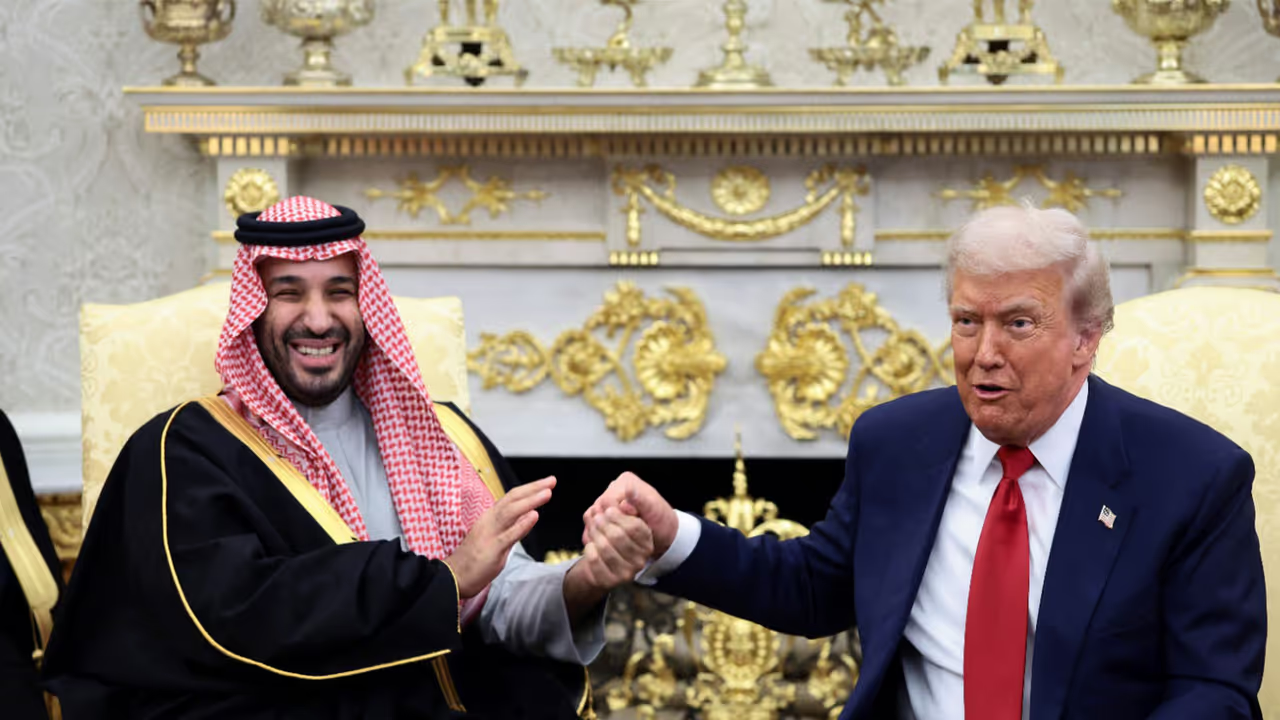
Donald Trump submitted a landmark civil nuclear deal with Saudi Arabia to Congress, making it contingent on Riyadh normalising relations with Israel. The deal could allow for uranium enrichment, sparking debate on nuclear proliferation in West Asia.
US President Donald Trump has submitted a landmark civil nuclear agreement with Saudi Arabia to the US Congress for review while maintaining that the deal is contingent on Riyadh normalising relations with Israel, The Wall Street Journal reported.
The 30-year accord, signed by US Energy Secretary Chris Wright and Saudi Energy Minister Prince Abdulaziz bin Salman, is expected to trigger months of debate among US lawmakers over expanding the American nuclear industry while preventing the spread of nuclear weapons in West Asia, as per the report.
Deal Contingent on Abraham Accords
According to The Wall Street Journal, the agreement would give US companies a central role in developing Saudi Arabia's nuclear infrastructure while potentially opening the door for uranium enrichment on Saudi territory. Trump had earlier linked the civil nuclear arrangement to Saudi Arabia joining the Abraham Accords, a framework of US-brokered agreements that established diplomatic relations between Israel and several Arab countries.
On July 23, Trump said the proposed nuclear cooperation would be limited to non-military applications and ruled out domestic uranium enrichment under the arrangement. "The Civil Nuclear Deal... will be approved, but is totally subject to Saudi Arabia joining the very respected and successful Abraham Accords," Trump said in a Truth Social post. "The United States is not opposed to Civil (Non-Enriched) Nuclear Facilities," he added.
Diplomatic Hurdles and Saudi Stance
By linking the nuclear partnership to normalisation with Israel, Trump has tied the civil energy agreement to a longstanding issue in West Asian diplomacy. Saudi Arabia has repeatedly maintained that formal diplomatic recognition of Israel is contingent on a clear and credible pathway towards the establishment of an independent Palestinian state.
Despite Washington's efforts to expand the Abraham Accords, Saudi officials have maintained their position on Palestinian statehood. Negotiations over a bilateral civil nuclear framework between Washington and Riyadh have continued across successive US administrations, with previous efforts encountering obstacles over non-proliferation requirements, The Wall Street Journal reported.
Agreement Details and Congressional Review
Unlike earlier proposals considered under former US President Joe Biden, the current draft does not require Saudi Arabia to sign the International Atomic Energy Agency's Additional Protocol, which gives inspectors short-notice access to undeclared sites. The White House has maintained that the accord complies with the US Atomic Energy Act and contains robust non-proliferation safeguards.
Saudi authorities have also said the agreement will support national energy diversification while maintaining international safety standards. The bilateral treaty, structured as a "123 Agreement", would facilitate the construction of AP1000 nuclear reactors using US technology in Saudi Arabia. The agreement is now subject to a 90-session-day review period in Congress and will automatically take effect unless lawmakers block it.
Criticism Over Proliferation Risks
The pact has drawn criticism from several Democratic lawmakers, who have warned that providing advanced nuclear technology to Saudi Arabia could fuel regional nuclear proliferation and an arms race in West Asia.
Background on Abraham Accords
The Abraham Accords, launched in 2020 under US mediation, established formal political, economic and security ties between Israel and several Arab countries, including the United Arab Emirates, Bahrain, Morocco and Sudan. (ANI)
(Except for the headline, this story has not been edited by Asianetnews Editorial staff and is published from a syndicated feed.)