
A newly announced agreement involving the United States, Denmark and Greenland is drawing global attention, but differing descriptions from all sides are raising fresh questions about what the deal actually changes.
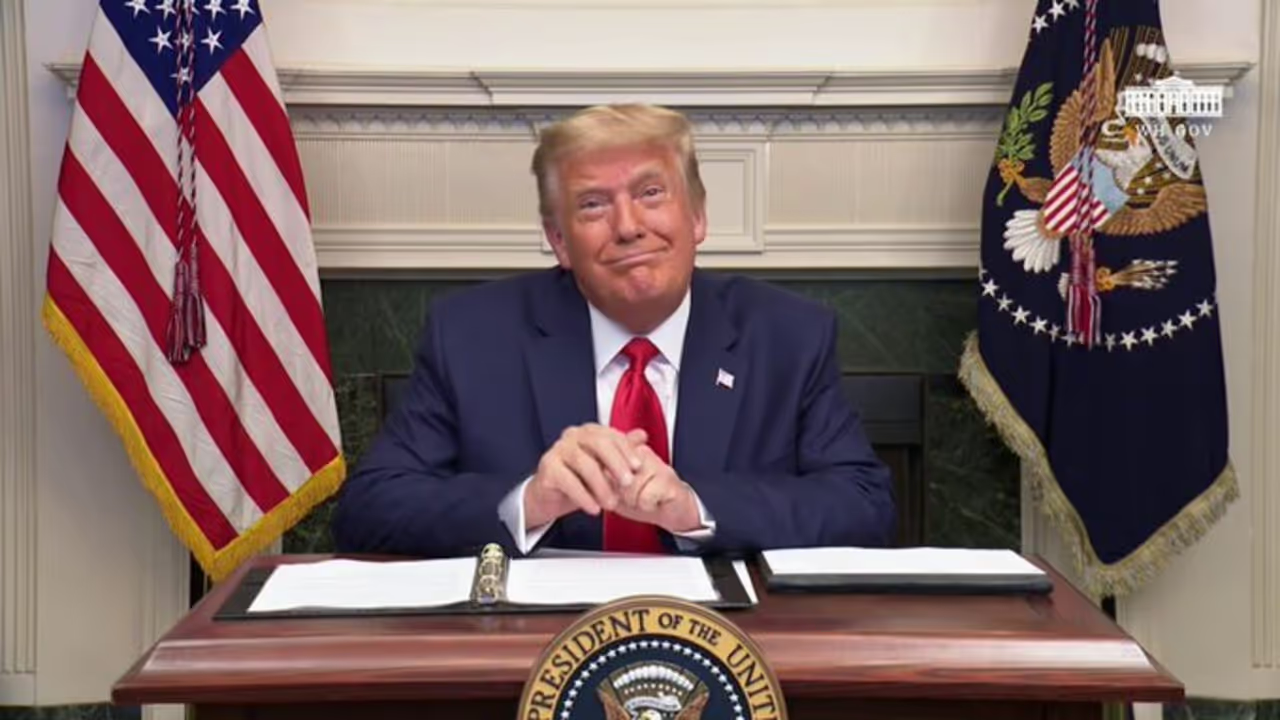
President Donald Trump announced on Friday that the United States had reached an agreement with Denmark and Greenland to expand its security presence in Greenland, a development that could ease months of tensions over the Arctic territory’s future and strategic importance.
The announcement comes after a prolonged period of diplomatic strain triggered by Trump's repeated calls for greater American control over Greenland. While Washington presented the deal as a major security breakthrough, leaders in Denmark and Greenland described it in significantly different terms, highlighting continuing differences over the agreement’s scope and meaning.
According to Trump, the arrangement gives the United States extensive authority over Greenland’s security interests and strengthens its strategic position in the Arctic. However, Danish and Greenlandic leaders emphasized that the agreement respects the sovereignty of the Kingdom of Denmark and maintains Greenland’s right to self-determination.
Officials indicated that a formal agreement is expected to be signed next week during the United Nations General Assembly in New York.
Trump said the deal would prevent any U.S. adversary from establishing military bases, maintaining a military presence or making sensitive investments in Greenland without American approval. He also stated that the United States would immediately begin plans for an expanded military footprint in the territory.
Still, details about exactly what powers Washington will gain under the arrangement remain unclear.
Sources familiar with the negotiations indicated that Trump’s characterization of “permanent control” over Greenland’s security may go beyond what was actually agreed. Reports suggest the U.S. military would continue working alongside Danish and Greenlandic counterparts rather than exercising direct authority over them.
Months Of Negotiations Followed Arctic Tensions
The apparent breakthrough follows months of confidential discussions involving officials from the United States, Greenland and Denmark. The negotiations emerged after a period of unusually high tensions between longtime NATO allies.
Trump has advocated acquiring Greenland since his first presidential term. Earlier this year, he argued that anything short of American ownership would be unacceptable and described possession of the territory as strategically important.
Those comments sparked alarm in Copenhagen and Nuuk, Greenland’s capital. Leaders in both places repeatedly rejected the idea of transferring ownership of the island.
As tensions intensified, discussions shifted toward security cooperation, military access and strategic investment controls rather than questions of sovereignty.
According to accounts of the negotiations, American officials sought stronger influence over major investment decisions in Greenland, particularly those involving geopolitical competitors such as Russia and China. Danish and Greenlandic officials were reportedly resistant to granting Washington extensive veto authority over domestic decisions.
Even so, negotiations continued as all sides explored ways to expand security cooperation while avoiding a deeper political confrontation.
The United States already maintains a longstanding military presence in Greenland. American forces first operated there during World War II, and a 1951 agreement with Denmark provided broad rights for military activities on the island.
That arrangement has continued for decades and currently includes the Pituffik Space Base in northwestern Greenland.
Arctic Security Remains Central Focus
The Arctic has attracted increasing attention from major powers because of its strategic location, shipping routes and natural resources.
Under the newly announced deal, non-NATO countries would reportedly not be permitted to establish military bases or maintain military installations in Greenland. The agreement is also expected to remain effective even if Greenland chooses independence in the future.
Denmark’s Prime Minister described the arrangement as a step that strengthens shared security across the Arctic and North Atlantic while supporting NATO interests.
Greenland’s leadership similarly presented the agreement as one that acknowledges Greenland’s interests and its role in international cooperation.
Meanwhile, Trump framed the development as a decisive achievement for American security policy.
Recent activity on the island suggests preparations for a larger U.S. military role may already be underway. Reports indicate American military personnel have visited Greenland in recent weeks to assess facilities and explore options for future operations, including reviews of older military sites.
Despite the announcement, questions remain about how much of the arrangement represents new authority and how much formalizes cooperation that already existed under previous agreements.
What is clear is that Greenland’s strategic importance continues to grow. The territory has become an increasingly significant focus of Arctic security planning, bringing together issues of military positioning, investment oversight and geopolitical competition.
The agreement may reduce tensions that threatened relations among NATO partners earlier this year, but its long-term significance will depend on how the provisions are implemented and how the United States, Denmark and Greenland interpret their respective roles moving forward.
