
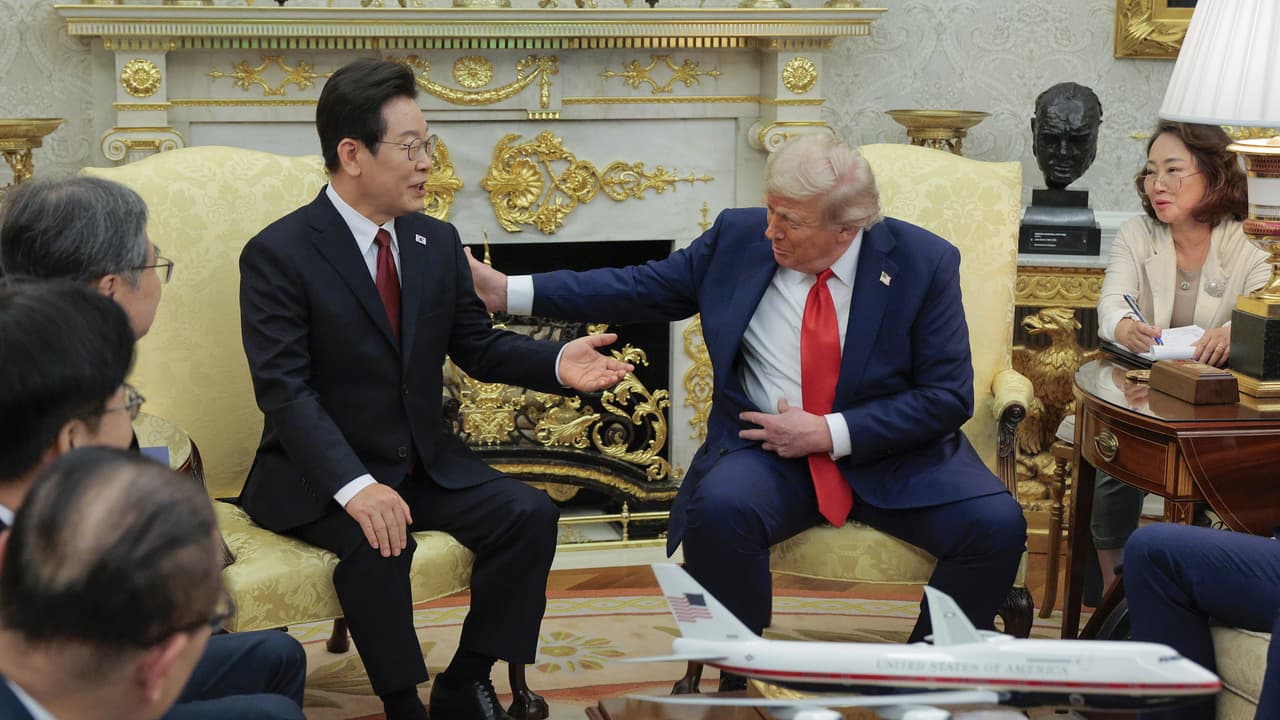
Seoul has drawn a firm line over its role in the Iran conflict, while President Lee Jae Myung faces mounting pressure from Washington and challenges on several domestic fronts.
South Korean President Lee Jae Myung said Friday that Seoul would not send troops or military assets to support the United States-led war against Iran, rejecting pressure from President Trump for greater assistance.
Lee said South Korea was instead considering widening the role of a navy destroyer and support ships currently operating off Somalia on antipiracy duties. If those vessels move closer to the Red Sea or Strait of Hormuz, he said, their mission would remain limited to protecting South Korean oil tankers and other commercial ships. They would not take part in operations that could be viewed as supporting the war against Iran.
Trump has previously complained that Seoul had declined to provide assistance, while American troops remain stationed on the Korean Peninsula to protect South Korea from North Korea. Last month, Trump recalled asking Lee to “give us a little hand” in the conflict and expressed frustration after Lee’s reported refusal.
The dispute comes as Lee faces several other challenges, including pressure over relations with Washington, domestic economic concerns and political controversy.
Seoul faces pressure on several fronts
Lee’s approval rating has fallen to 37 percent, according to the information cited in the report, about 15 months into his single five-year term. South Korea’s main stock index has also fallen sharply after being promoted as a major beneficiary of the global artificial intelligence boom, hurting individual investors.
The president has also faced criticism over rising housing costs. The opposition has accused him of seeking a constitutional amendment that could allow a president to serve a second term. Lee said Friday that although he supports changing the Constitution to permit future presidents to seek another term, he does not intend to run again himself, calling such a possibility constitutionally impossible and the allegation a political offensive.
His criminal trials on charges including election-law violations and inducing perjury have been suspended. Lee has denied the opposition’s allegations that he sought legislation to erase those charges, saying they were fabricated by his conservative predecessor, Yoon Suk Yeol, who was impeached and removed from office.
Lee also backed a special prosecutor to examine whether politicians, journalists and others were targeted in politically motivated investigations during Yoon’s presidency. However, he said the prosecutor should not have authority to drop criminal charges already filed against him. Referring to his falling approval rating, Lee said he had fallen short in consideration, sensitivity and communication.
Relations with Washington are also being tested by negotiations over an economic agreement announced last November. Under the pact, Trump reduced tariffs on major South Korean exports, including automobiles, from 25 percent to 15 percent and pledged U.S. support for South Korea’s plans involving nuclear-powered submarines and civilian uranium enrichment. Seoul committed to $350 billion in U.S. investments.
Lee said negotiations over implementation remained fierce but were nearing an agreement on the destination of the first investments. He said any projects had to be commercially reasonable and that both governments needed to settle how profits and losses would be shared.
The military dispute carries particular significance because the United States and South Korea have maintained an alliance for seven decades. Washington led United Nations forces during the Korean War, while South Korean troops later formed the largest foreign contingent fighting alongside U.S. forces in Vietnam.
South Korea’s previous participation in a U.S.-led conflict also remains politically sensitive. During the Iraq War, which began in 2003, President Roh Moo-hyun’s progressive government faced domestic opposition after sending mainly engineering and medical personnel. The decision badly damaged his approval ratings.
Public opinion remains an obstacle to intervention in Iran. A poll conducted this month found that 55 percent of South Koreans opposed deploying troops to the conflict, while 32 percent supported it. Lee’s remarks leave Seoul’s position clear: military protection of its commercial interests may be expanded, but direct involvement in the Iran conflict remains off the table.
