
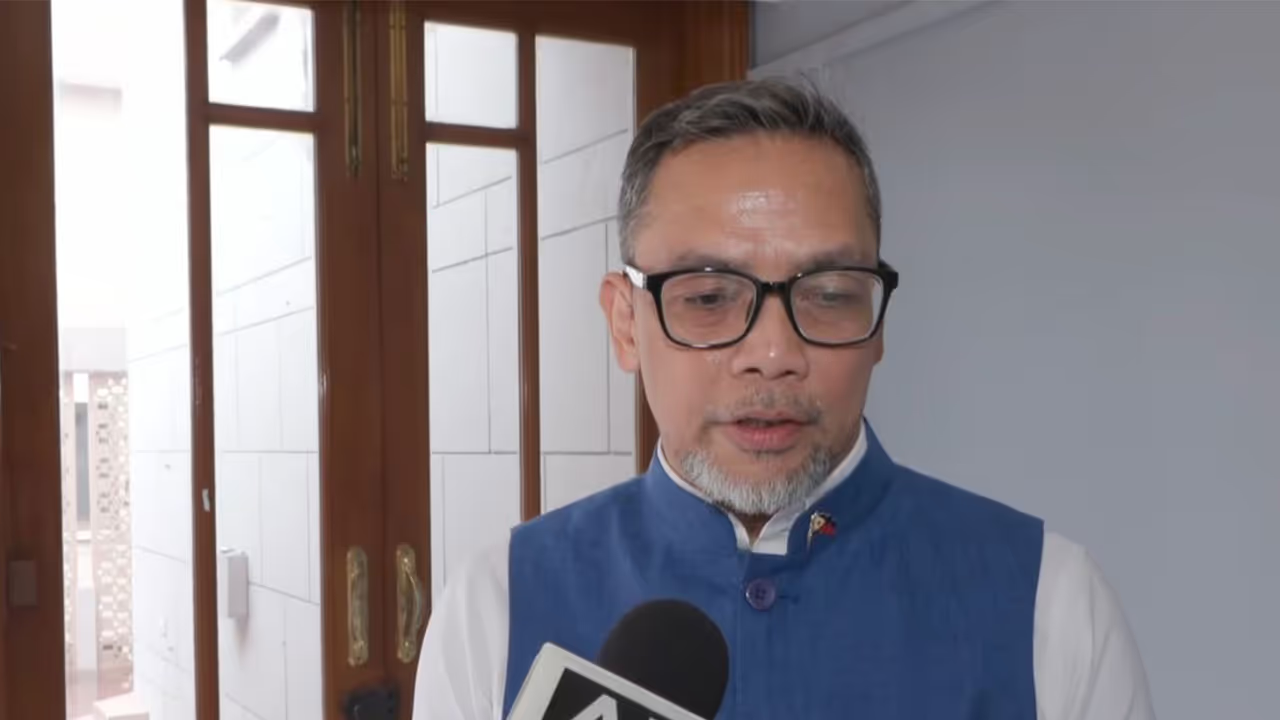
The Philippines' Ambassador to India, Josel F. Ignacio, reiterated that the 2016 PCA award on the South China Sea is "final and binding" on both the Philippines and China, invoking the principle that 'agreements must be honoured'.
Invoking the principle of 'pacta sunt servanda' [agreements must be honoured] the Philippines' Ambassador to India Josel F. Ignacio, on Tuesday said the 2016 Permanent Court of Arbitration (PCA) award on the South China Sea exposed "the extent to which some states are willing to be responsible actors" rather than the limitations of international law, asserting that the ruling remains "final and binding" on both the Philippines and China.
Speaking to ANI on the sidelines of a roundtable discussion on the theme 'Lines Drawn in the Water', organised by the Ananta Centre, the Ambassador was asked whether the PCA award had strengthened the rules-based international order or exposed its limitations as China continues to reject the ruling while maintaining its presence in disputed waters. "The award in the South China Sea arbitration is final and binding on the Philippines and China. And that's regardless of whether China participated or not. It's final and binding," the Ambassador said.
A Contribution to International Law
He said the ruling had made an important contribution to international law and the interpretation of the United Nations Convention on the Law of the Sea (UNCLOS). "We believe that the award in the South China Sea arbitration is an important contribution to international law and to the understanding and interpretation of the UN Convention on the Law of the Sea, because it clarified, for instance, what islands are, what low-tide elevations are. And in the end, it's a contribution to everyone's understanding of the application of the UN Convention on the Law of the Sea. And that, I think, ultimately results in bolstering the rule of law in the maritime space and in the global commons," he said.
'Agreements Must Be Honoured'
Referring to the international legal principle of 'pacta sunt servanda', meaning 'agreements must be honoured', the Ambassador said that while enforcing international law presents practical challenges, the South China Sea case should not be viewed as exposing the shortcomings of international law itself. "Maybe from a practical perspective, it shows that there are problems in enforcing international law. But I think for responsible states, what it shows is that those non-compliant states expose less the limitation of international law, but expose more the extent to which some states are willing to be responsible actors despite their pronouncements. So I think that's what this case shows. It is important for states to abide by their legal obligations," he said.
Roundtable on 'Lines Drawn in the Water'
During the roundtable discussion, Ambassador Ignacio gave a presentation on the background of '10 Years of the PCA Ruling on the South China Sea', which is basically the tenth anniversary of the tribunal's unanimous award delivered on July 12, 2016. He noted that leading up to the anniversary, China ramped up its criticism of the Philippines for initiating the 2016 legal case.
The discussions focused on the legal and technical aspects of the South China Sea under UNCLOS, particularly the distinctions between High-Tide Elevations (HTEs), commonly referred to as islands or rocks, and Low-Tide Elevations (LTEs), and the maritime entitlements associated with them.
India's Role and Regional Stability
The Ambassador also discussed the overlapping territorial and maritime claims in the South China Sea, particularly involving the Spratly Islands and Scarborough Shoal. He further highlighted India's consistent support for UNCLOS and a free, open and inclusive Indo-Pacific, and emphasised the role of the Quad and the Association of Southeast Asian Nations (ASEAN) in promoting a rules-based maritime order and regional stability in the Indo-Pacific.
The event was moderated by Indrani Bagchi, the Chief Executive Officer (CEO) of the Ananta Centre. (ANI)
(Except for the headline, this story has not been edited by Asianetnews Editorial staff and is published from a syndicated feed.)