At the SCO summit in China, PM Modi cautioned that connectivity without respecting sovereignty erodes trust, seen as a veiled swipe at China’s Belt and Road project. He underlined the need for sovereignty-based, transparent regional cooperation.
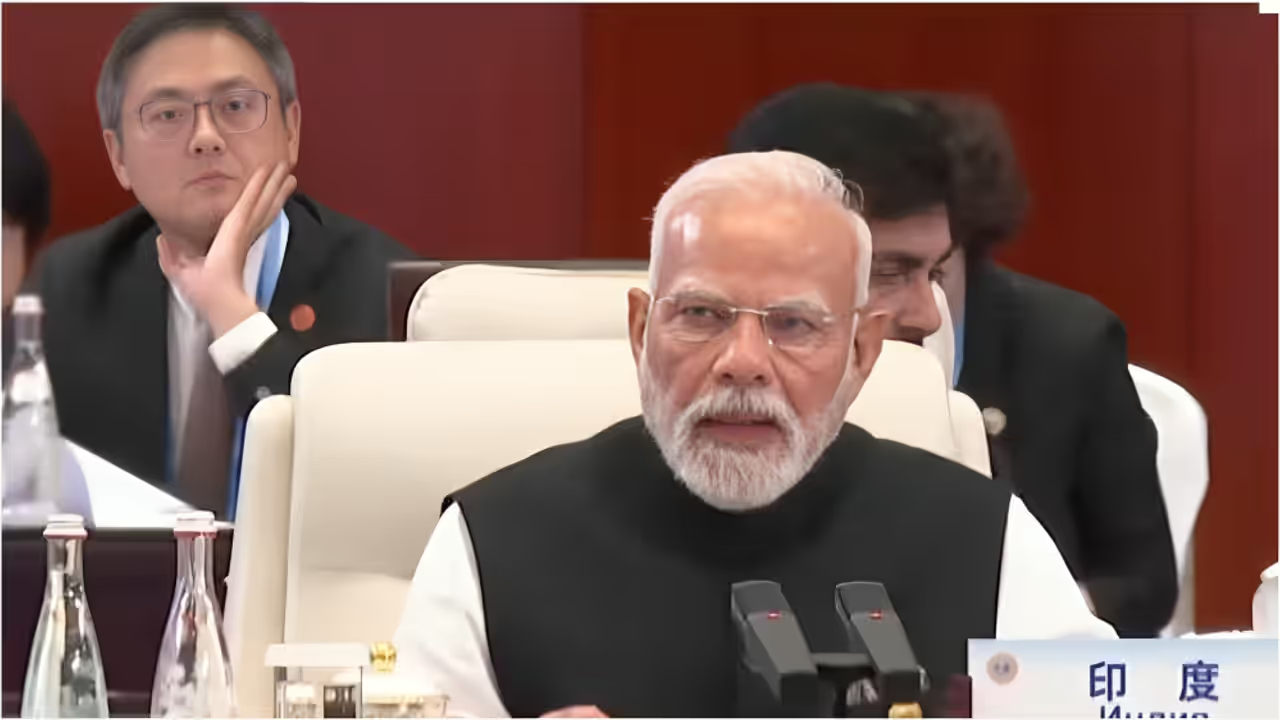
Prime Minister Narendra Modi, addressing the SCO Summit in China on Monday, indirectly criticised Beijing's Belt and Road Initiative. He stressed that regional connectivity projects must respect sovereignty and territorial integrity, warning that initiatives bypassing these principles risk losing trust and legitimacy. In a subtle, veiled jibe at China in Tianjin, the PM said, "...Connectivity that bypasses sovereignty loses trust and meaning..."
PM Modi said at the SCO Summit, “India has always believed that strong connectivity not only boosts trade but also opens doors to growth and trust. With this in mind, we are working on initiatives like the Chabahar Port and the International North-South Transport Corridor. This will help us improve connectivity with Afghanistan and the Central Asia.”
The Belt and Road Initiative is China's flagship global project to connect continents through infrastructure and trade, boosting its economic and political influence worldwide. The Belt and Road Initiative (BRI), also known as the One Belt, One Road (OBOR) project, is China’s massive global infrastructure and economic development plan. It was announced in 2013 by Chinese President Xi Jinping.
What's Belt and Road Initiative
The BRI is a strategy to boost trade and connectivity across Asia, Africa, Europe and beyond. It aims to rebuild ancient trade routes:
Related Articles

- The Silk Road Economic Belt (land routes connecting China to Central Asia, Europe, and the Middle East).
- The 21st Century Maritime Silk Road (sea routes through Southeast Asia, South Asia, Africa, and Europe).
- Involves 150+ countries and international organizations.
China funds projects through banks like the Asian Infrastructure Investment Bank (AIIB), Silk Road Fund and state-owned banks.
Xi Jinping's appeal to SCO to back Belt and Road
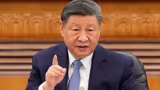
Earlier, Chinese President Xi Jinping on Monday called on Shanghai Cooperation Organisation (SCO) member states to work for mutual benefit and 'win-win results'. Addressing the 25th Meeting of the Council of Heads of State in Tianjin, Xi stressed that members should align their development strategies and support the high-quality implementation of the Belt and Road Initiative (BRI). He also appealed for greater fairness and justice in international cooperation, saying the SCO should leverage its large markets and complementary economies to boost trade and investment. Xi underlined that stronger people-to-people ties were necessary for fostering understanding and cultural exchanges across the bloc. To back his proposals, he pledged a grant of 2 billion yuan (about 281 million US dollars) to SCO member states within this year.
"We need to better align our development strategies and promote the high-quality implementation of the Belt and Road Initiative," Xinhua quoted Xi. Xi further added, "SCO member states need to enhance mutual understanding and friendship through people-to-people exchanges, firmly support one another in economic cooperation, and jointly cultivate a garden of civilizations in which all cultures flourish in prosperity and harmony through mutual enlightenment."
PM Modi, Xi and Putin share warm exchange
Ahead of the SCO plenary session, Prime Minister Narendra Modi engaged with both President Xi Jinping and Russian President Vladimir Putin. PM Modi posted pictures on X showing him interacting with the two leaders in Tianjin, highlighting the ongoing exchanges of perspectives at the summit. His camaraderie with Putin drew attention as the two greeted each other warmly with smiles and hugs. Modi also shared photographs walking hand in hand with Putin as they approached Xi. The three leaders exchanged light remarks before joining other member states for the traditional family photo of the SCO summit, underscoring a visible moment of ease between the key leaders despite wider geopolitical strains.
(With inputs from agencies)