
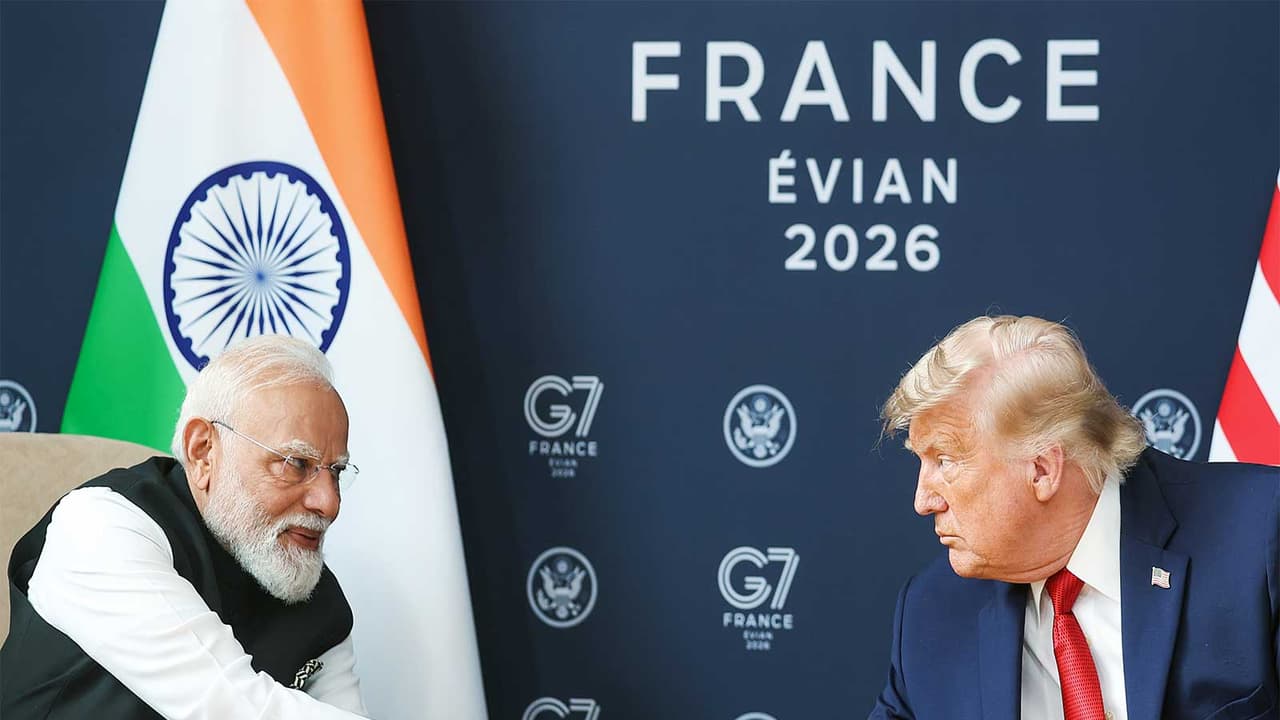
PM Narendra Modi and US President Donald Trump held a phone call, reviewing bilateral cooperation in trade, defence, and energy. They reaffirmed their commitment to the India-US strategic partnership and exchanged views on regional and global issues.
Prime Minister Narendra Modi held a telephone conversation with US President Donald Trump on Wednesday and the two leaders reviewed progress in bilateral cooperation across sectors such as trade, defence, energy and critical technologies.
A PMO release said that the two leaders reaffirmed their commitment to advancing the India-US Comprehensive Global Strategic Partnership and agreed to maintain close engagement to deepen cooperation for the benefit of the people of both countries.
PM Modi and President Trump also exchanged views on regional and international developments and discussed ongoing efforts to promote global peace and security. “The two leaders reviewed progress in bilateral cooperation across trade, defence, energy, critical technologies and other areas of mutual interest,” the release said.
In a post on X, PM Modi said that he had productive conversation with President Trump “Had a productive conversation with President Trump. We reviewed our bilateral cooperation in trade, defence, energy, critical technologies and other areas. We agreed to maintain close engagement to take our Comprehensive Global Strategic Partnership forward. We also exchanged views on regional and international issues, including ongoing efforts to advance global peace and security,” PM Modi said.
Progress on Trade Deal
India and US have been engaged in talks to finalise a mutually-beneficial trade deal between the two countries.
External Affairs Minister S Jaishankar said during his visit to the US that the two sides have now moved closer to an understanding. “Expectation that it could rapidly move forward, I think, was tested against a ground reality which was much more complex. So, today, I think we have reached a situation where there is more or less an understanding on the trade agreement,” he said.
Jaishankar also flagged changes in US tariff rules and the Section 301 process as key issues. "The 301 process is still in the works; it's still unfolding. So the issue for us is at what point do you close out an agreement which is very, very far advanced," he noted.
Section 301 of the US Trade Act of 1974 allows the US to investigate trade practices it considers unfair and take enforcement action, including imposing additional tariffs. The US Trade Representative (USTR) is responsible for conducting such investigations and responding to practices that may violate US trade rights or agreements.
India's Concerns Over US Legislation
India has also articulated its concerns following the passage of the Sanctioning Russia and Iran Act (SRIA) in the US Congress earlier this month. The legislation allows Trump administration to levy tarrifs on Moscow and its top energy buyers, including India and China.
In its statement following the passage of the bill, Ministry of External Affairs had said India remains firmly committed to ensuring energy security for its 1.4 billion people. “It will continue to do so through diversified sourcing and on the basis of evolving market dynamics. This issue has been discussed at high levels in recent months with various US interlocutors. Its potential implications for not just the bilateral relationship but also the international energy market have been very clearly articulated by the Indian side,” MEA had said in its statement.
“The Indian side has also made clear its determination to take all necessary measures to protect its trade and economic interests. The government will work closely with Indian trade and industry bodies to deal with the implications of these developments,” the statement noted.
Foreign Secretary Vikram Misri had a meeting with the Congressional delegation and conveyed India’s concerns “in regard to SRIA legislation as to the kind of implications it would have for bilateral relationship, as also for the international energy market”. (ANI)
(Except for the headline, this story has not been edited by Asianetnews Editorial staff and is published from a syndicated feed.)