
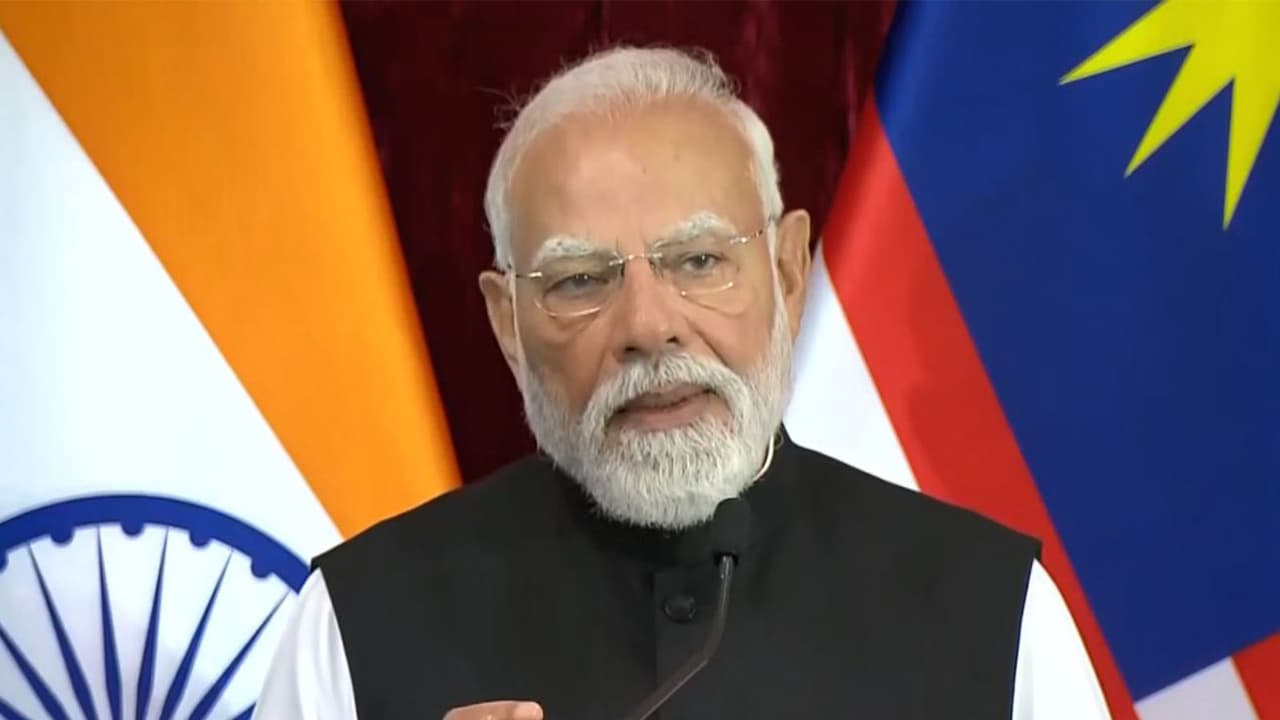
PM Modi's Malaysia visit saw key pacts signed with PM Anwar Ibrahim, boosting the Comprehensive Strategic Partnership. They stressed cultural ties, including a shared love for Tamil, and enhanced cooperation in defence, economy, and technology.
Prime Minister Narendra Modi on Sunday oversaw the signing of key agreements between India and Malaysia, fulfilling a commitment made last year. He highlighted the cultural connections between the two countries, including their "shared love for the Tamil language", as both sides stepped up efforts to expand cultural, economic, and strategic cooperation.
Addressing a joint press statement alongside Malaysian Prime Minister Anwar Ibrahim after witnessing the signing of joint agreements between the two countries, PM Modi noted that the vibrant role of Tamil in Malaysia's schools, media, and cultural activities demonstrated the lasting bonds between their peoples. "Shared love for the Tamil language also connects India and Malaysia. In Malaysia, the strong and living presence of Tamil can be seen in education, media and cultural life. I am confident that with today's Audio Visual Agreement, film and music, especially Tamil films, will bring our hearts closer," PM Modi said.
Reflecting on his earlier commitment, PM Modi noted that although he missed the ASEAN Summit the previous year, he had assured his counterpart that he would visit soon after. "Last year, I could not come to Malaysia for the ASEAN Summit, but I had promised my dear friend that I would visit Malaysia at the earliest. For my foreign visit of 2026, I have come to Malaysia."
Enhanced Security and Future-Tech Cooperation
The two leaders engaged in extensive discussions during PM Modi's two-day official visit, which represented a significant step in advancing the Comprehensive Strategic Partnership between the two countries. Following delegation-level talks with Anwar, PM Modi outlined enhanced collaboration in vital security fields. "In the security sector, we will strengthen cooperation in counter-terrorism, intelligence sharing and maritime security. We will also make defence cooperation more comprehensive," he said.
He further highlighted progress in forward-looking areas, stating, "Along with AI and digital technologies, we will further advance our partnership in semiconductor, health and food security."
Boosting Economic and Trade Relations
On the economic front, PM Modi pointed out fresh prospects arising from the day's CEO forum. "The CEO forum organised today has thrown open new opportunities for trade and investment. We will pave a path to economic transformation through strategic trust."
Malaysian Prime Minister Anwar Ibrahim commended India's rapid economic expansion and called for broadening cooperation beyond current trade levels. "India is growing by leaps and bounds, which is one spectacular rise in the international economic trade scene," Anwar said. He also referenced potential within the ASEAN framework, adding, "We certainly benefit immensely if we could secure more ways and opportunities to collaborate with India, extending beyond the $18.59 billion that we achieved in 2025." Anwar welcomed the shift toward using local currencies in bilateral dealings, calling it a "remarkable feat".
Strengthening Educational Links
Regarding educational links, Anwar noted that many Malaysians have studied in India, and that an increasing number of Indian students are choosing Malaysia. "Under the premiership of my good friend Prime Minister Modi, you have seen spectacular recognition of Indian centres of excellence in education," he said, adding, "We would certainly explore increasing the number of students in various disciplines to study in India."
Ceremonial Welcome and Community Engagement
The day began with a private discussion between PM Modi and Anwar Ibrahim, followed by broader delegation talks at Perdana Putra. This came after PM Modi received a ceremonial welcome and Guard of Honour at the venue. The formalities followed PM Modi's arrival in Kuala Lumpur on Saturday, where Anwar Ibrahim greeted him personally at the airport.
Malaysian Human Resources Minister Ramanan Ramakrishnan and Deputy Foreign Minister Lukanisman bin Awang Sauni were also in attendance. The arrival included a red-carpet reception accompanied by traditional music and dance displays that showcased the common cultural heritage.
After the official events, the two leaders jointly attended a gathering with the Indian community in Kuala Lumpur. PM Modi shared his thoughts on X, posting, "Deeply touched by the warm welcome extended by my friend, Prime Minister Anwar Ibrahim at the airport. I look forward to our conversations and to further strengthening the bonds of friendship between India and Malaysia." He later added, "Celebrating the India-Malaysia people-to-people connect! PM Anwar Ibrahim and I are heading to the community programme in Kuala Lumpur."
Deepening a 'Special Relationship'
In the lead-up to the visit, PM Modi had described it as a chance to build on cooperation in key sectors. "The historic ties between India and Malaysia have seen steadfast progress in recent years," he had said. "We will aim to deepen our defence and security ties, enhance our economic and innovation partnership, and expand our collaboration into new domains," he added.
The External Affairs Ministry spokesperson Randhir Jaiswal described the visit as featuring a "rich agenda" that would provide "a major boost to the special partnership between India and Malaysia".
PM Modi reaffirmed that India and Malaysia enjoy a "special relationship" grounded in history, culture, and robust people-to-people connections, with the partnership now set to gain momentum in defence, innovation, and economic areas. This marked PM Modi's third visit to Malaysia and his first since the bilateral relationship was elevated to a Comprehensive Strategic Partnership in August 2024. The longstanding relations between India and Malaysia are influenced by shared history, civilization, and culture, bolstered by Malaysia's Indian-origin population of roughly 2.9 million, which forms the third-largest overseas Indian community worldwide. (ANI)
(Except for the headline, this story has not been edited by Asianet Newsable English staff and is published from a syndicated feed.)
