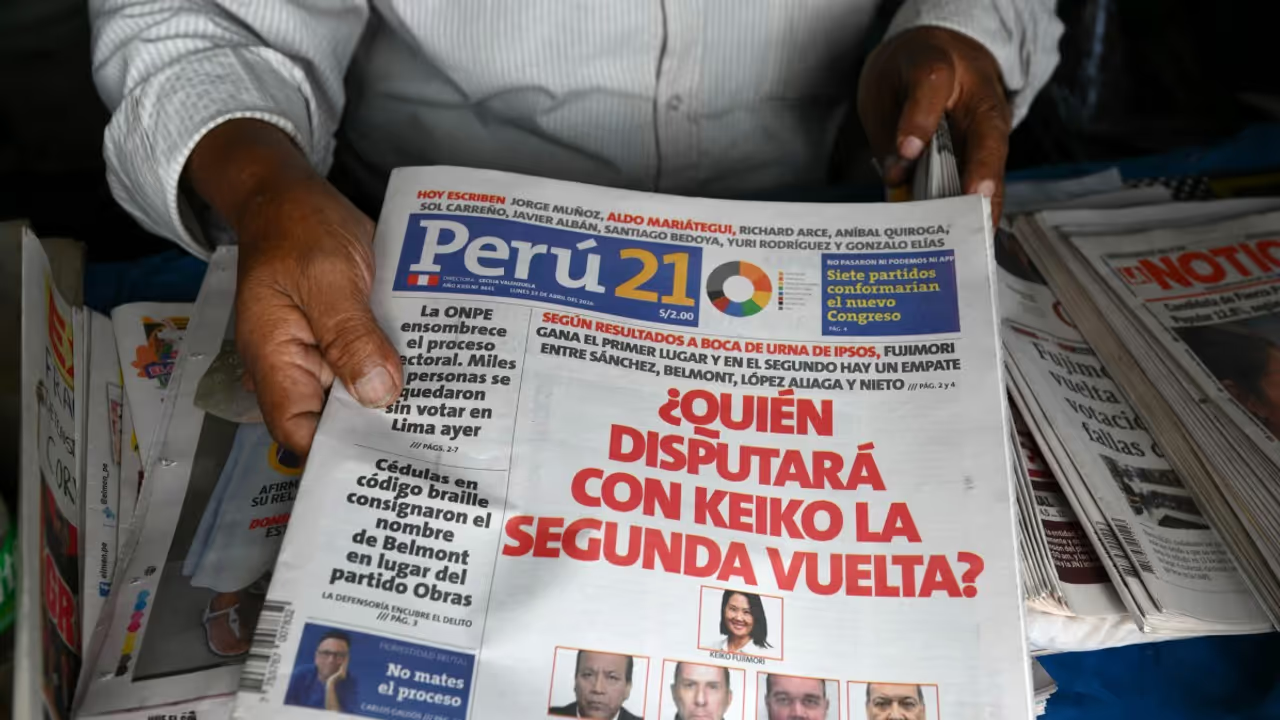
With none of the candidates polling above 50 per cent threshold needed for a clear victory, Peru is headed for a runoff.
Peru’s 2026 Presidential election should have been a moment of democratic realignment. Instead, it once again revealed a deeper and more permanent crisis which is the lack of faith among voters in the electoral processes to re-establish legitimacy to a state that is defined by political instability and transience.
The first round has generated inconclusive results, which was expected by most Peruvians voters, especially after the last decade when the country has seen Presidents in ten years. With none of the candidates polling above 50 per cent threshold needed for a clear victory, the country is headed for a runoff. However, the more significant take away is, that voter faith in the system has remained low and none of the candidates have been able to restore it to an extent that they could muster up the majority vote in a democratic country.
Peru’s predicament is now recurring, but no less striking for its repetition. In less than a decade, the state has cycled through nine presidents. Some descended to corruption accusations, others to congressional manipulation, and still others to the chronic volatility which has become the central characteristic of Peruvian politics. Governments have changed, constitutions have been argued, coalitions have swung, but the deeper malady has persisted. Peru has preserved the forms of democracy without generating faith in its voters.
Related Articles

The conduct of this election also adds to the problem. Administrative failures, ballot shortages, delayed openings and logistical disappointments forced the extension of voting in parts of Lima and for overseas Peruvians. In a state where confidence in public institutions is already low, procedural failures carry emblematic significance. Elections can’t be treated as an eligibility qualification for minimalist democracies; they are rituals of legitimacy. When the state struggles to conduct the most fundamental and formative exercise of democracy, it reinforces cynicism against itself among voters.
Peru’s crisis is no longer a simple ideological contest. The fault line in Peruvian politics has shifted from Left versus Right, to order versus dysfunction. Voters are not just choosing between battling policy predictions; they are searching, for a state that can fulfil its duties of governance. The runoff is quite easily explained by this lack of confidence among Peruvian voters.
The likely runoff scenarios uncover Peru’s persistent political enigma. If Keiko Fujimori proceeds, the election will again restore Peru’s most recurring predicament, the promise of order against the fear of authoritarian restoration. Fujimori’s appeal lays on a promise of stability, economic continuity and tougher law-and-order policies. Yet her surname also stirs up an extremely polarising legacy. The memory of Alberto Fujimori’s often coercive rule still divides Peru.
If Rafael López Aliaga consolidates support, the runoff could shift further towards hardline conservatism and security populism, a trend that also echoes global politics. His ascent exhibits the greater Latin American trend in which public fatigue with elite disfunction generates space for muscular rhetoric and outsider posturing. Yet Peru’s recent history should caution against mistaking anger for a governing mandate.
A centrist breakthrough is less likely, as centrism in Peru has frequently struggled not because it lacks appeal, but because the state lacks the administrative ability that is needed to translate moderation into lasting governance.
This is where Peru’s recent electoral reforms assume significance. The restoration of a bicameral legislature and the return of the Senate after more than three decades, was aimed at improving legislative inquiry and soothe executive-legislative confrontation. In principle, this is a reasonable reform. A second chamber can improve negotiation, decrease impulsive lawmaking and create greater institutional equilibrium.
But institutional design, by itself, is seldom a cure for political scepticism. Peru’s dilemma has never been the lack of constitutional innovation. It has been the deficiency of political limitation. A bicameral legislature may yet become another pitch for transactional bartering unless supplemented by deeper reforms to party formations, campaign finance and legislative culpability.
Peru’s election should matter beyond its borders. Across Latin America, democracies are facing similar challenges; how to preserve legitimacy when institutions no longer command trust. Peru is an especially bleak case because it depicts the limits of electoralism without state capacity.
For democracies across the Global South, Peru’s experience offers a sobering reminder. Institutional erosion seldom occurs in isolated dramatic ruptures. More often, it progresses through amassed misgivings, procedural failures and the slow standardisation of disfunction. Its important to note that elections are not inadequate in themselves, but they alone cannot carry the burden of democratic legitimacy.
(Author is an Asst Professor at Amity Institute of Defence and Strategic Studies, and has a PhD in Latin American Studies from the Centre for Americas, Jawaharlal Nehru University)