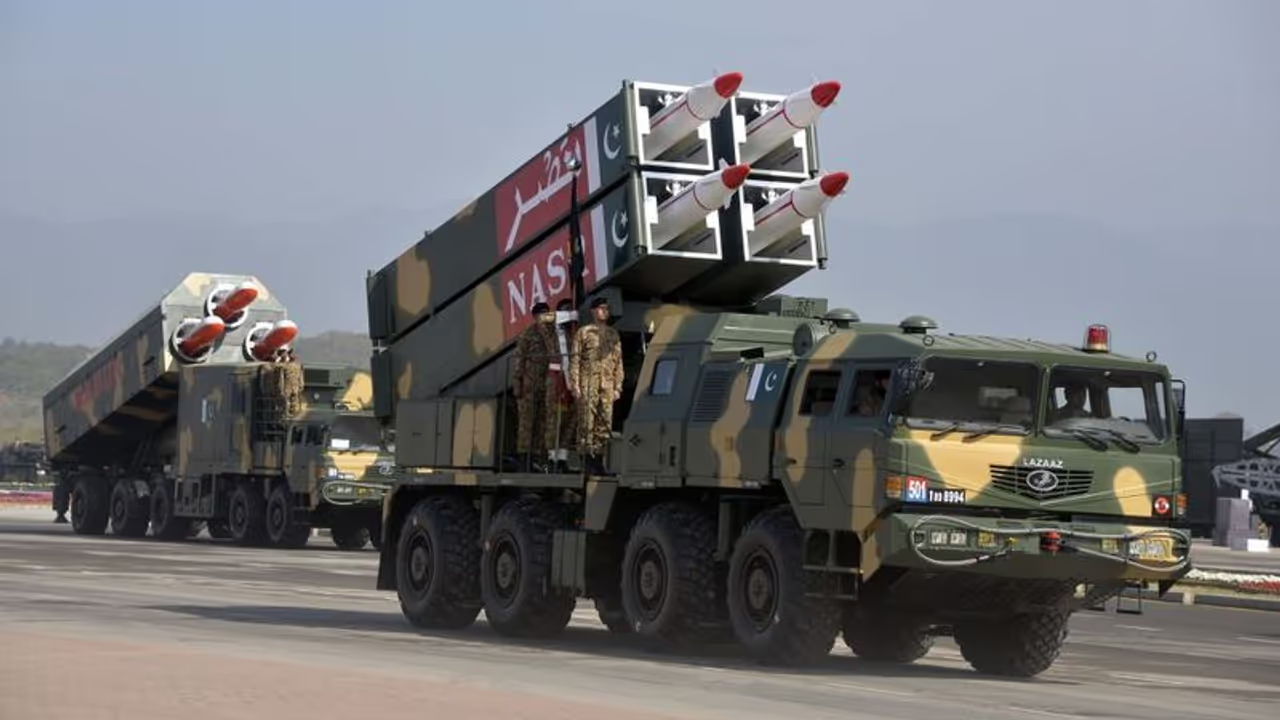
Pakistan claims its SMASH missile can hit moving warships using advanced terminal guidance. However, no public evidence supports these assertions. Analysts note the absence of seeker footage, tracking data, or electronic warfare tests.
New Delhi: Pakistan has promoted its reportedly developed P-282 SMASH missile as a modern anti-ship ballistic system capable of striking moving naval targets with precision.
Supporters online describe it as a weapon that can target enemy warships in the final seconds of flight using advanced seekers and high-end guidance. But when analysts look for actual evidence of such features, they find very little. Most of what is known comes from vague official language, assumptions, or speculation.
The key technologies that would make the missile effective in real naval warfare remain unclear, unverified and unproven in the public domain.
Related Articles

This uncertainty is most obvious in the area of guidance and seeker performance, especially during the final phase of the missile’s flight.
Impressive appearance, capability in question
A missile may look impressive on launch, but its true capability is defined by how it behaves in the last few seconds before impact. That is the moment when the seeker must identify the target, reject decoys, resist jamming, and correct its path. Without real evidence of this behaviour, the missile’s advertised performance remains theoretical.
Pakistan's official statements suggest that the SMASH missile uses a combination of inertial navigation and some form of satellite correction. This is a common approach for many ballistic or quasi-ballistic missiles.
Inertial systems guide the missile through the early and mid-course phases, while satellite inputs help correct the path. But this only gets the missile into the general area of the target. Hitting a moving warship requires far more - especially in the terminal phase.
Some Pakistani handles claim the missile carries an advanced terminal seeker that uses radar and electro-optical or infrared sensors to lock onto the target during the final dive. If true, this would place SMASH in the same category as some modern anti-ship ballistic missiles.
The key issue, however, is that none of these claims have been independently verified. There is no released video of the seeker view. There is no thermal imagery, radar snapshot or flight profile to confirm how the seeker behaves. Foreign analysts have seen no evidence of the missile recognising, tracking or adjusting to a moving target.
This is important because a moving ship is not a simple target. It constantly changes direction and speed.
Naval groups also use decoys, chaff, jammers and electronic warfare systems to confuse missile seekers.
A real anti-ship ballistic missile must prove it can operate under these conditions. Pakistan has shown no such proof. The publicly available flight footage only displays a missile launching and a distant explosion on a static location - nothing more.
There is also the claim, repeated in some online commentary, that SMASH can operate in a “home-on-jam” mode. This would allow the missile to guide itself towards the source of enemy jamming signals if its seeker is interfered with.
In principle, this is a useful feature in modern naval combat. But in the case of SMASH, this claim remains entirely speculative. No official document mentions it clearly. No analyst report confirms it. No test footage demonstrates it. Right now, it is an idea circulating on social media, not an established capability.
Without data, the performance of the seeker remains a matter of guesswork. This stands in contrast to how major missile-producing nations demonstrate capability.
When China showcased the DF-21D, it released tracking footage and radar paths. When India tested the Agni series and its precision guidance improvements, it released flight telemetry, impact images and seeker evaluations.
The United States Missile Defense Agency routinely publishes detailed graphs and infrared views of terminal intercepts. Even Iran, which is usually secretive, provides partial tracking information during major tests.
Pakistan has released none of this for the SMASH system. There are no seeker logs, no trajectory diagrams, no post-impact analysis photos and no demonstrations of terminal manoeuvres.
For a missile being advertised as a precision anti-ship weapon, this silence is significant. It suggests either that the missile’s terminal seeker is still under development or that its performance is not yet reliable enough for public display.
This uncertainty affects the missile’s strategic value. A ballistic missile with unclear terminal guidance cannot reliably threaten moving naval vessels. At best, it can strike fixed or slow-moving targets. At worst, it becomes a psychological weapon—useful for propaganda but not dependable in real combat.
Without proof of advanced seeker capability, external analysts will treat the missile cautiously, judging it as an experimental or early-stage system rather than a fully operational anti-ship threat.
The difference between a working anti-ship ballistic missile and a basic guided missile lies almost entirely in the terminal phase. This is the phase Pakistan has not shown and until it does, the SMASH system remains surrounded by more questions than answers.
The story is straightforward. Pakistan says the SMASH missile has modern guidance and seeker features, but it has provided no clear evidence. The missile may have inertial navigation and some form of satellite correction, but there is no independent verification of seeker performance, no demonstration of target discrimination, and no proof that the missile can handle electronic warfare. Claims of special modes like 'home-on-jam' remain unproven.
In short, the SMASH missile’s terminal guidance is still an unknown. And in missile warfare, the unknown is the same as unverified capability.
Until Pakistan shows real data, the world will continue to view the seeker and guidance claims with caution. The missile may fly fast but its most important technologies remain hidden in uncertainty.