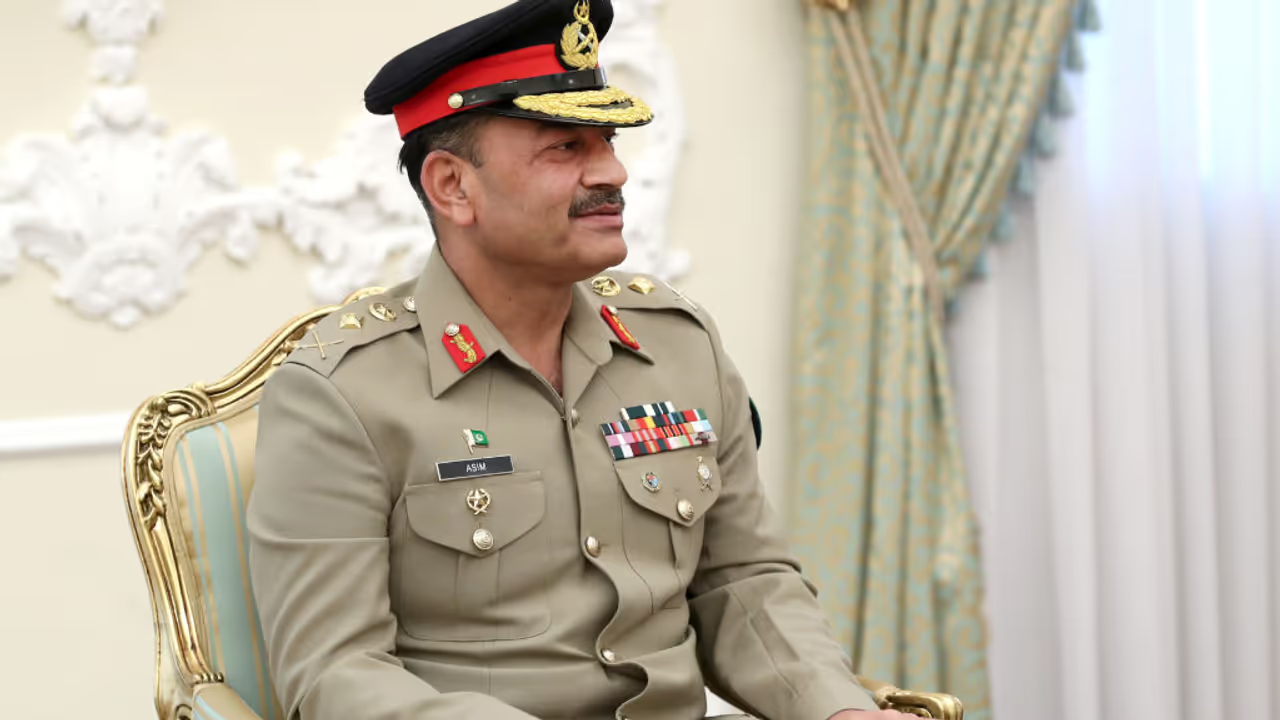
Pakistan Army chief Asim Munir is reportedly scheduled to visit Washington DC, for the US Army Day celebrations to mark its 250th anniversary on June 14. The trip comes amid recent escalation of tensions between New Delhi and Islamabad.
Pakistan Army chief, General Asim Munir, is reportedly scheduled to visit Washington DC, for the US Army Day celebrations on June 14. The trip comes amid recent escalation of tensions between New Delhi and Islamabad and American President Donald Trump’s claim that he brokered a ceasefire between the rival neighbours.
Asim Munir's trip—timed with America’s 250th Army Day celebrations on June 14—goes far beyond ceremonial handshakes and military parades, raising diplomatic eyebrows in New Delhi. Analysts see deeper strategic undertones that could recalibrate regional dynamics, particularly for India.
Should India be worried?
General Munir, who rose to the rank of Field Marshal after Operation Sindh, is widely regarded as the real power behind Pakistan’s governance, given the military’s overarching influence. His presence in Washington underscores Pakistan’s enduring significance in America’s security calculus, despite shifting global alliances.
Related Articles

According to diplomatic sources, the visit will serve as a platform for wide-ranging strategic discussions, with Washington expected to engage Pakistan on counter-terror cooperation in the volatile Afghanistan-Pakistan corridor; China’s Belt and Road Initiative, especially the contentious China-Pakistan Economic Corridor (CPEC) and military realignment in light of Pakistan’s deepening ties with Beijing.
For the US, this is a rare opportunity to recalibrate its military understanding with Islamabad, while subtly attempting to counterbalance China’s growing footprint in South Asia.
Meanwhile, India views this high-profile visit with a degree of trepidation—and rightly so. From supporting terror outfits like Lashkar-e-Taiba (LeT) and Jaish-e-Mohammed to expanding CPEC infrastructure through Pakistan-occupied Kashmir (PoK), Pakistan’s moves have often been in direct opposition to Indian interests.
India’s key concerns:
Ongoing support to cross-border terror outfits that remain active along the Line of Control (LoC);
Insufficient action against TTP and Afghan spillover networks, despite international pressure;
Deepening China-Pakistan military and economic nexus, especially in territories claimed by India.
The strategic re-engagement between Washington and Islamabad—especially one that brushes over these issues—could embolden Pakistan diplomatically, while further complicating India’s security concerns.
Back home in Pakistan, General Munir’s visit is not without controversy. Supporters of ousted Prime Minister Imran Khan are planning protests in Washington, accusing the military establishment of orchestrating Khan’s removal and imposing a “hybrid regime” that stifles democratic dissent.
The shadow of internal political unrest is expected to follow Munir to the US capital, where members of the Pakistani diaspora affiliated with Khan’s PTI party are mobilizing against what they see as military overreach.
While Islamabad maintains a façade of civilian rule, it is widely accepted—both domestically and internationally—that Pakistan’s real authority lies with its military brass. Munir, a former ISI and military intelligence chief, embodies that authority. The US, fully aware of this reality, often prefers direct engagement with Pakistan’s generals rather than its elected officials.