
JSMM Chairman Shafi Muhammad Burfat has called on the UN to investigate repression against Sindhi, Baloch, and other peoples in Pakistan, demanding an internationally supervised referendum on the independence of Sindhudesh.
Jeay Sindh Muttahida Mahaz (JSMM) Chairman Shafi Muhammad Burfat has called on the United Nations, international human rights organisations and governments to initiate an international process to examine what he described as systematic political repression, economic exploitation and human rights violations against the Sindhi, Baloch, Pashtun and Seraiki peoples, as well as the populations of Pakistan-occupied Kashmir and Gilgit-Baltistan.
'Internal colonies of Punjab'
In an official statement and diplomatic appeal, Burfat alleged that Pakistan's state structure had transformed the country's historic nations into “internal colonies of Punjab”, depriving them of political and economic self-determination and threatening their languages, cultures, territorial integrity and historical identity.
“It is our firm political position that the national questions concerning the Sindhi, Pashtun, Baloch, and Seraiki peoples…cannot be trivialised as mere administrative or provincial disputes,” Burfat said. He called for these questions to be examined through the principles of history, national identity, political consent, control over natural resources and the right to self-determination.
The Case of Sindh
Burfat described Sindh as the “historical cradle and epicentre of the ancient Indus Civilisation" and said the Sindhi people possessed a distinct homeland, language, culture and national identity. He claimed that Sindh had historically existed as a free and sovereign country and referred to it as “Sapta Sindhuvah (Sindhudesh)”.
“We explicitly assert that the moral, legal, and democratic legitimacy of any political settlement governing the future of historic nations is valid only if founded upon their unfettered and free political consent,” he said.
Allegations of Human Rights Violations
Burfat alleged that the historic nations within Pakistan had been subjected to political coercion and ideological manipulation, resulting in the erosion of their political and economic rights.
The JSMM chairman alleged that fundamental human rights were being systematically violated in Pakistan and said international institutions had documented concerns over arbitrary detention, enforced disappearances, alleged extrajudicial killings, torture and restrictions on freedom of expression and peaceful assembly.
He also referred to what he described as communications issued by UN Special Procedures in 2025 concerning the situation in Balochistan and the treatment of activists associated with the Baloch Yakjehti Committee. According to Burfat, the UN communications raised concerns regarding enforced disappearances, alleged extrajudicial killings, mass arrests, excessive force against demonstrators and restrictions on activists and the media.
He also cited Human Rights Watch's World Report 2026, claiming that repression against journalists, political dissidents and civil society had intensified in Pakistan during 2025.
“These independent international findings underscore that the human rights situation in Pakistan demands continuous, unhindered, and rigorous international oversight,” Burfat said.
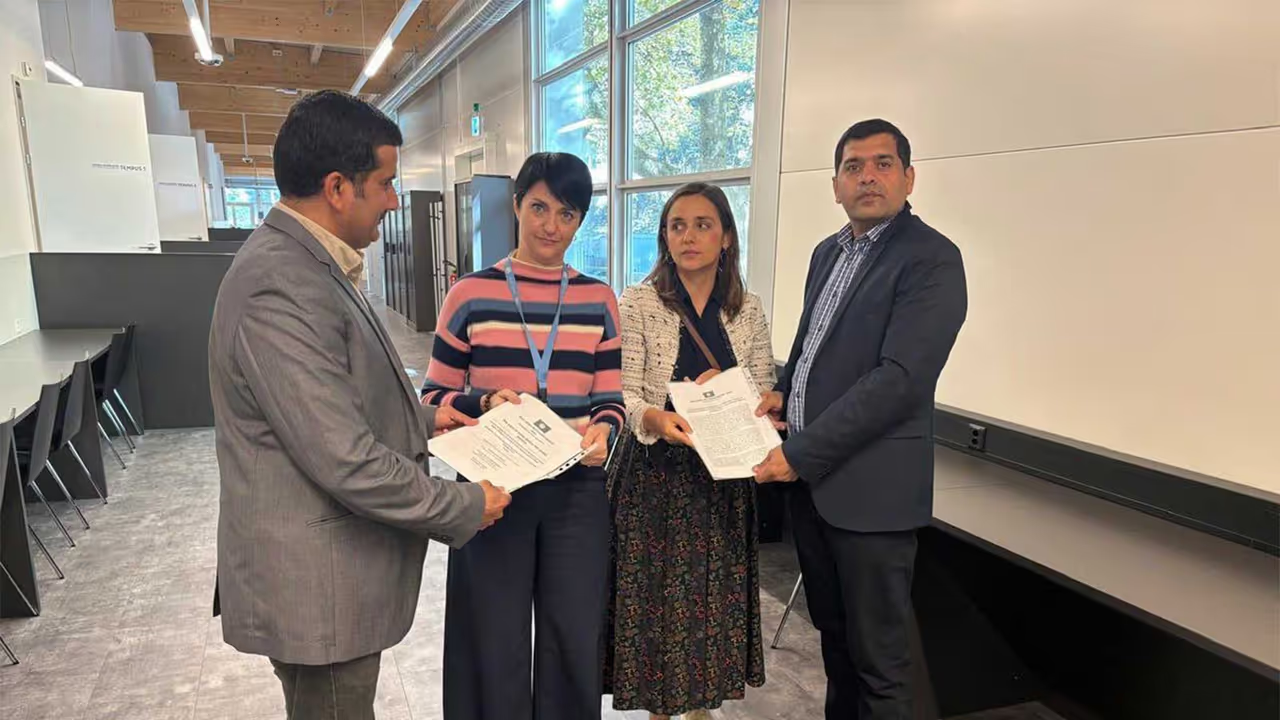
Burfat said JSMM Vice Chairman Sajjad Shar and General Secretary Shahnawaz Bhutto had presented what the organisation calls the “Case of Sindh” to human rights representatives in Geneva on September 18. According to the statement, the submission contained what JSMM described as primary documentary evidence concerning alleged abductions, enforced disappearances, extrajudicial killings and prolonged arbitrary detention of political activists. The organisation also alleged institutionalised political repression and economic exploitation in Sindh.
Terrorism and International Scrutiny
Burfat called on the international community to examine Pakistan's record concerning religious extremism and terrorism on the basis of what he described as verified and documented evidence. He referred to Pakistan's previous placement under increased monitoring by the Financial Action Task Force (FATF) over deficiencies related to anti-money laundering and counter-terrorist financing measures.
The JSMM chairman also referred to the presence of Osama bin Laden in Pakistan, alleging that the country had failed to meet its international responsibilities in combating terrorism. He urged the United Nations and international community to maintain what he called “continuous, transparent, and independent scrutiny” of Pakistan.
Call for Self-Determination and Referendum
With specific reference to Sindh, Burfat called for international intervention to safeguard what he described as the region's national identity, geographical integrity, language, culture, natural resources, water rights, ancestral lands and political self-determination. He called for an internationally supervised referendum on the independence of Sindhudesh.
“The international community must ensure that the political will of the Sindhi people is expressed and safeguarded through peaceful and democratic means,” he said.
Burfat said any decision on the political future of historic nations should be based on the free and uncoerced consent of their people. “Our guiding principle is not disorder or chaos, but the uncoerced political consent of the people,” he said.
Demands for International Action
He called on the UN and international community to facilitate political dialogue, international monitoring and consideration of “internationally credible democratic mechanisms” to determine the political will of the Sindhi, Pashtun, Baloch and other historic nations.
The JSMM chairman urged UN member states to condition diplomatic, military, financial and trade relations with Pakistan on what he described as measurable progress on human rights. His demands included an immediate end to enforced disappearances, eradication of torture and extrajudicial executions, restoration of freedom of expression and political association, institutional accountability for alleged state crimes and progress towards internationally supervised referendums on self-determination.
He also called on the UN Human Rights Council, OHCHR, the Working Group on Enforced or Involuntary Disappearances and relevant Special Rapporteurs to maintain oversight of alleged arbitrary detentions, state violence, custodial killings, reprisals against activists and media restrictions.
Burfat also called for international consideration of Article 6 of the UN Charter, which provides for the expulsion of a UN member that has “persistently violated the principles contained in the present Charter”, following a recommendation by the Security Council and action by the General Assembly. He argued that Pakistan's alleged violations should not be overlooked because of geopolitical considerations.
Pakistan's Nuclear Arsenal
“A state that holds historic nations in colonial subjugation, sponsors religious extremism and terrorism, and brandishes nuclear weapons that pose an existential threat to regional and global security has forfeited its moral and legal right to sit among civilised nations,” Burfat said. He further demanded that Pakistan's nuclear weapons be placed under international custody and safeguards, citing what he described as the potential danger posed by the country's nuclear arsenal.
An Appeal for a New Path to Peace
Burfat concluded by urging the international community to place the political and self-determination demands of what he described as the historic nations within Pakistan on the global agenda.
“We appeal to the global community to recognise that enduring peace in South Asia cannot be achieved by merely preserving existing, coercive state borders at the cost of the freedom, dignity, national identities, human rights, political consent, and justice of its constituent peoples,” he said. “Peace cannot be maintained through violence, nor is enforced silence synonymous with stability,” Burfat said, calling for what he described as a peaceful and democratic process to determine the political future of the region's constituent peoples. (ANI)
(Except for the headline, this story has not been edited by Asianet Newsable English staff and is published from a syndicated feed.)