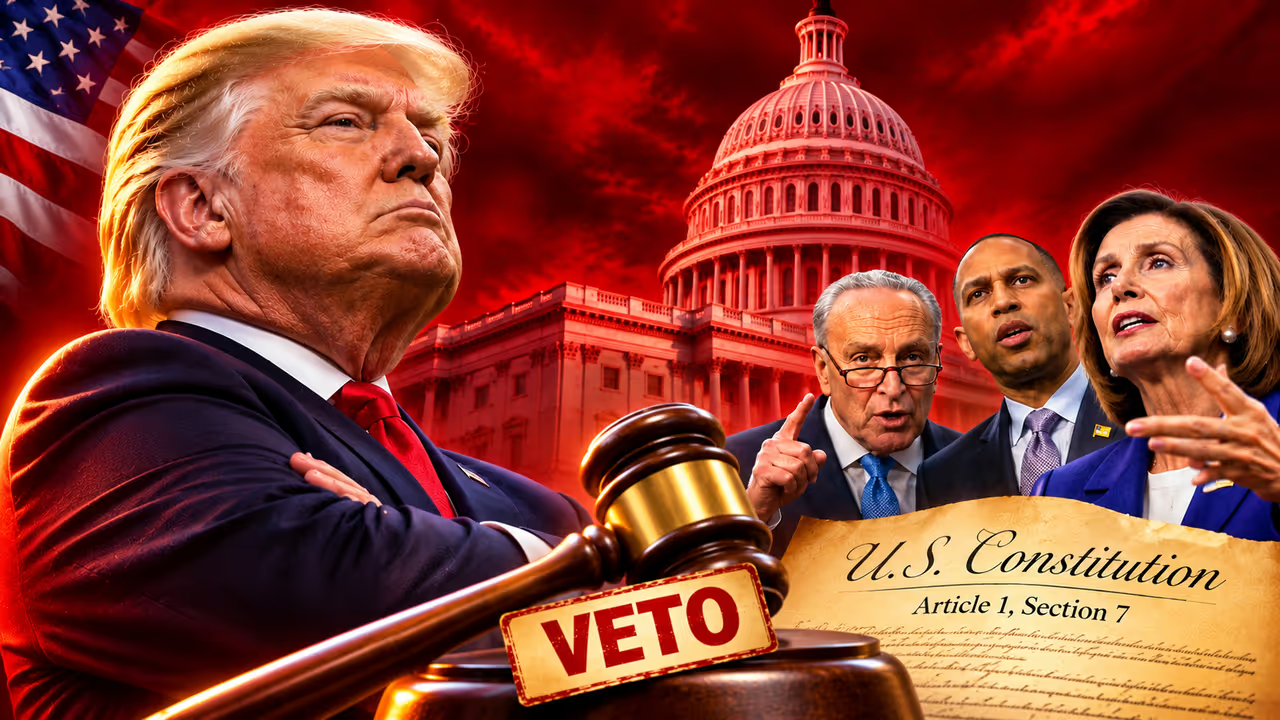
After Democrats won control of both chambers of Congress in midterm polls, Trump warned he could veto legislation he opposes. Constitution allows a president to reject a bill, but Congress can override veto with two-thirds vote in House and Senate.
Imagine a cricket match in which one team has won the toss, batted magnificently, and still finds that the umpire can refuse to count the runs. That, in essence, is the situation Washington now faces after the 2026 midterm elections, held halfway through a president's four-year term, where Democrats swept tocontrol of both the House of Representatives and the Senate, picking up seats even in territory that had long leaned Republican. For President Donald Trump, the outcome is a clear setback to his agenda, and the months ahead promise a tense, often adversarial relationship between the White House and a Congress now empowered to shape legislation and intensify oversight of his administration.
Trump's response has been to point to a single word: veto. In an interview with CBS News before the polls, he called it the ultimate power and warned that if Democrats would not cooperate, "Otherwise, I just veto everything, and they're not going to want that." He even embraced the nickname "Mr Veto," hinting that this authority may become the backbone of his strategy for dealing with a Democratic-led Congress.
So what exactly is this power? The Constitution grants it, in Article 1, Section 7. Think of a bill as a parcel that must pass through three checkpoints before it becomes law. The House and the Senate are the first two; the president's desk is the third. When a bill lands there, the president may sign it into law, or return it to Congress with his objections. That return is a veto.
Related Articles

There is also a clock ticking. If the president neither signs nor returns the bill within ten days, not counting Sundays, it becomes law on its own, provided Congress is still in session. But if Congress adjourns during that window, the president cannot send the bill back, and it simply dies. This quiet manoeuvre is known as a pocket veto, much like leaving a letter unanswered until the deadline passes.
One important limitation applies. The president cannot pick and choose. He must accept or reject the whole bill; he has no authority to strike out individual clauses or rewrite provisions after Congress has passed them. It is all or nothing.
Congress, however, is not left helpless. A veto can be overridden, but only with a two-thirds majority in both chambers. That means 290 votes in the 435-member House and 67 votes in the 100-member Senate. For Democrats, unless they command such supermajorities themselves, every override would require persuading a substantial number of Republican lawmakers to break ranks in both the House and the Senate. History underlines how steep that climb is: according to Congress, only a small fraction of presidential vetoes have ever been overridden since the founding of the federal government.
Yet the veto's real influence is often felt long before a bill reaches the White House. The mere threat of rejection can reshape negotiations. If Democrats draft legislation Trump dislikes, he can signal in advance that he will refuse it, nudging lawmakers to soften provisions or bargain with the administration to win his signature.
Trump has made plain that this is how he expects matters to unfold. "Historically, you veto for a couple of months, and then they come and say, 'We've got to make a deal,'" he told CBS News.
What emerges is a test of endurance, with consequences reaching into ordinary households. Democrats carry the mandate of voters who handed them both chambers; Trump carries the constitutional pen that can stall them. Between them lies the override, a door that opens only when 290 members of the House and 67 senators agree. Whether America's government moves forward or stands still will depend on how often that door is tried, and how willing both sides are to meet halfway.
(Girish Linganna is an award-winning science communicator and a Defence, Aerospace & Geopolitical Analyst. He is the Managing Director of ADD Engineering Components India Pvt. Ltd., a subsidiary of ADD Engineering GmbH, Germany.)