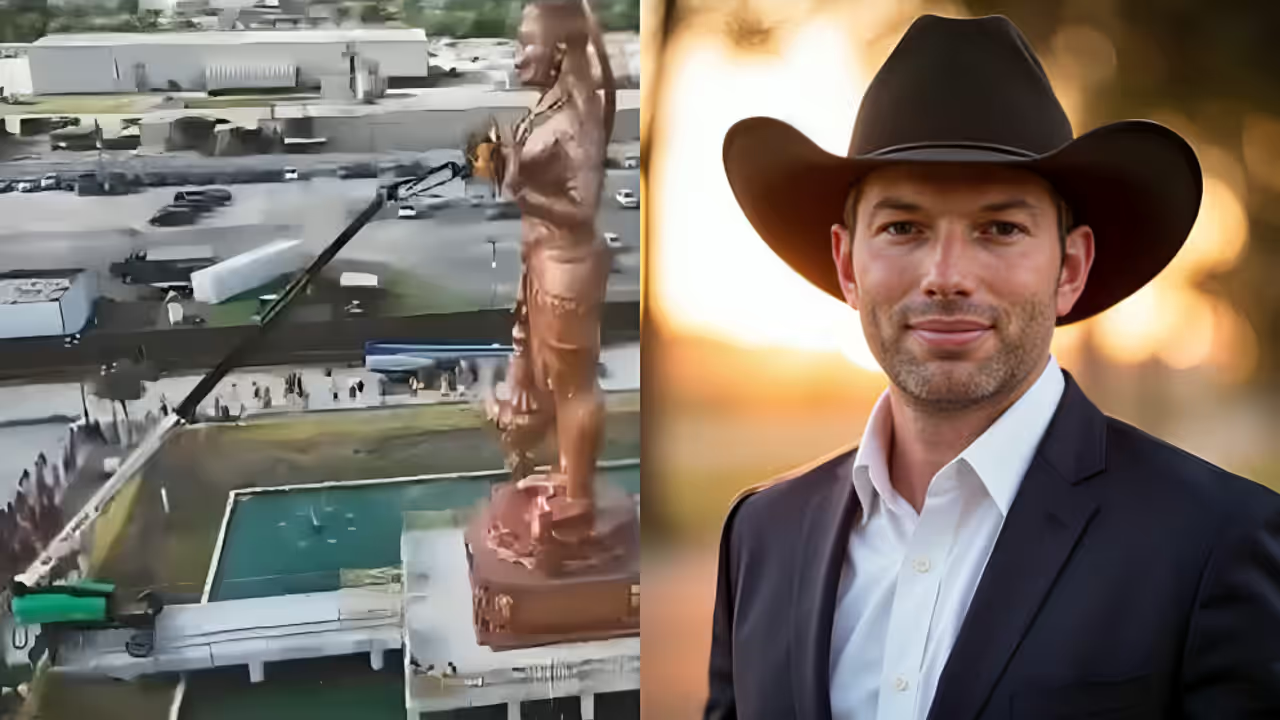
Texas leader Alexander Duncan asked why a 90-foot statue of Hanuman stands in Texas, calling it 'false Hindu God' and claiming the US is a Christian nation. His remarks sparked sharp criticisms over religious freedom and constitutional values.
A Texas Republican leader, Alexander Duncan, has caused a major controversy by criticising the Statue of Union, a 90-foot statue of the Hindu deity Lord Hanuman located in Sugar Land, Texas. In social media posts, Duncan demanded to know, “Why are we allowing a false statue of a false Hindu God to be here in Texas? We are a CHRISTIAN nation. He further quoted passages from the Bible (Exodus 20:3-4) that forbid worship of other gods or making of idols.
What is the Statue of Union
The Statue of Union is a 90-foot tall bronze statue of Lord Hanuman, built at the Sri Ashtalakshmi Temple in Sugar Land, Texas. It was unveiled on August 18, 2024.
It is one of the tallest Hindu monuments in the US. The statue is named 'Statue of Union' because Hanuman in the Ramayana helps reunite Lord Rama with Sita, the statue symbolizes selflessness, devotion and unity.
How people are reacting
Hindu American Foundation (HAF) immediately condemned Duncan's remarks, calling them 'anti-Hindu and inflammatory'. They filed a formal complaint with the Texas Republican Party, asking whether Duncan will be disciplined. Many in the Indian-American and broader Hindu communities responded with indignation, pointing out that US constitutional rights protect freedom of religion. Social media users reminded Duncan that calling someone else's faith 'false' goes against the principles of religious pluralism and freedom.
Related Articles

Some critics have also pointed out that the 'Christian nation' framing is challenged by the US Constitution's First Amendment, especially the Establishment Clause which prohibits the government from establishing any religion.
The significance of religious freedom and pluralism
The United States has a legal and cultural tradition of religious freedom. The Establishment Clause and Free Exercise Clause together ensure that citizens are free to practice any religion and that government or political actors do not impose a specific religion. Many see Duncan’s remarks as contradicting these constitutional values.
Identity, immigration and politics
The row comes at a time when tensions are high between Indian-Americans and some elements of US politics over issues like H-1B visas, trade, tariffs, and immigration policy. Some see this kind of rhetoric as feeding into anti-India or anti-Hindu sentiment.
For many Hindus in the US, the statue is more than a religious symbol, it is also a sign of belonging, community, and cultural identity in a country where they are a minority. Criticism of such symbols is therefore felt very deeply.
What Duncan has said exactly
In one post on X, Duncan asked, "Why are we allowing a false statue of a false Hindu God to be here in Texas? We are a CHRISTIAN nation!"
In another post, he quoted Exodus 20:3-4: “You must not have any other god but me. You must not make for yourself an idol of any kind…”
Duncan is running for the US Senate seat from Texas.
Statues, context and precedent
The Statue of Union was inaugurated in August 2024 after a three-day ceremony (August 15-18), including traditional Hindu rituals. The statue is constructed in panchaloha (a traditional five-metal alloy) and features design elements like elephants and floral motifs at its base.
Among Hindu and cultural organizations, such statues are seen not just as religious icons but also as way of preserving heritage, giving a sense of identity to younger generations born in the diaspora.
Possible fallout
The Texas Republican Party now faces pressure resulting from HAF's complaint: will Duncan be disciplined or acknowledged by his party leadership?
Politically, for Indian-Americans and Hindu voters, these remarks might affect opinions and voting behaviour. Some of these communities have already expressed concerns about anti-Hindu or anti-immigrant rhetoric.
The incident is part of larger discussions about what symbols are acceptable in public spaces, how minority faiths are treated and how free speech and religious respect should coexist.
Discussions and debates are ongoing on social media, in Indian-American communities and among civil rights groups about the implications.