
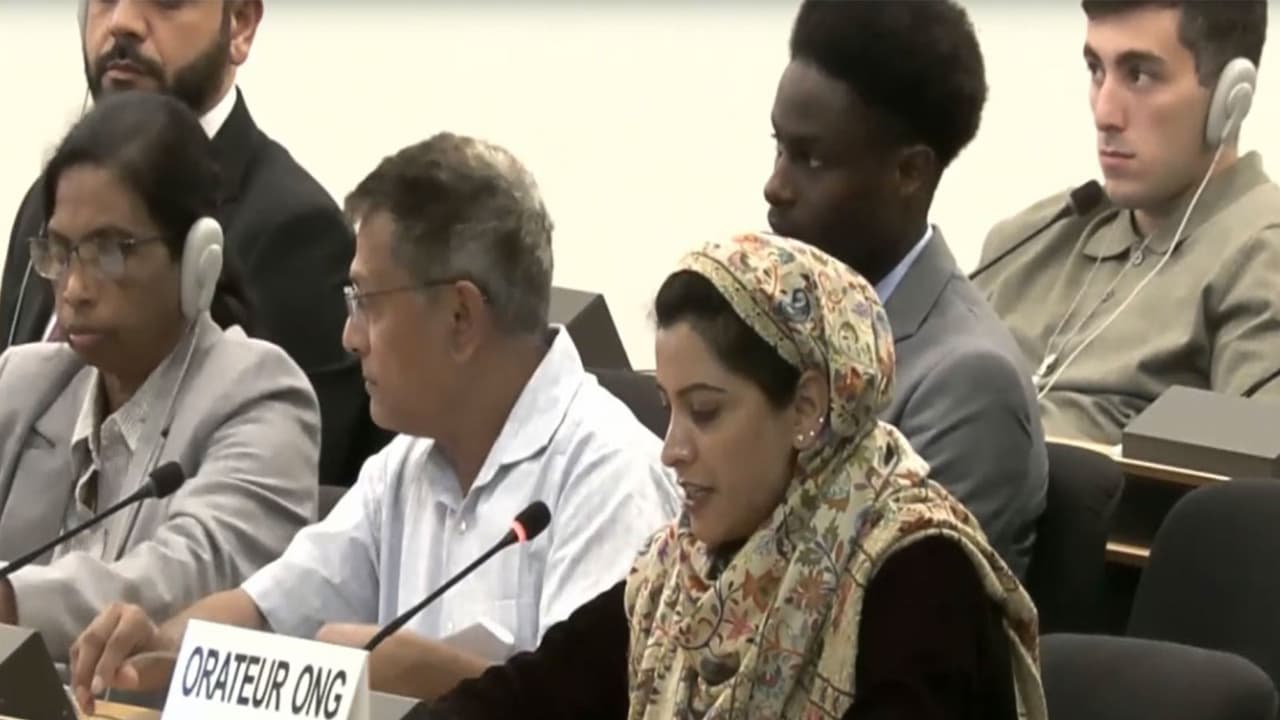
Human rights defender Tasleema Akhter told the UNHRC about a growing contrast between PoJK and Indian Jammu and Kashmir. She cited protests and crackdowns in PoJK while highlighting skill development and infrastructure growth in Jammu and Kashmir.
Human rights defender Tasleema Akhter, from Jammu and Kashmir, highlighted what she described as a growing contrast in governance, civic space, human rights and development between Pakistan-occupied Jammu and Kashmir (PoJK) and Jammu and Kashmir in India during an intervention at the 63rd session of the United Nations Human Rights Council (UNHRC) in Geneva.
Addressing the Council, Akhter said human rights in the present era should contribute to inclusive development, strengthen democratic values and ensure protection of the basic necessities of life. “Human rights in the present era create inclusive development of individuals, society and nations as a whole, bring in more democratic values and offer protection of the basic necessities of life,” she said.
Crackdown and Rights Violations in PoJK
Referring to recent developments in PoJK, Akhter said the region had witnessed sustained protests led by the Joint Awami Action Committee (JAAC) and other civil society groups over governance and economic issues. She alleged that the subsequent crackdown by Pakistani authorities had resulted in arrests and detentions, restrictions on communications and violent clashes involving protesters and security forces.
Independent reports from June 2026 documented a major crackdown and clashes in Pakistan-administered Kashmir. Reuters reported that at least 24 people, including civilians and police personnel, were killed during nearly two weeks of unrest, while more than 500 people were detained. Amnesty International also reported internet restrictions, mass arrests and the use of deadly force.
Akhter said the situation raised concerns over the availability of civic space in PoJK and called for measures to protect civilians and restore communications. “There is a lack of civic space in PoJK besides cases of large-scale reprisals, which require to be addressed,” she said.
“The ongoing killing of innocent civilians by Pakistani security forces in PoJK needs to be stopped at once with immediate protective measures. Restoration of civic space and communications needs to be done with immediate intervention through the UNHRC,” Akhter said. She further called for independent investigations into reported deaths. “There should be independent inquiries into each killing, with free and fair access to information related to all cases,” she said.
Development Initiatives in Indian Jammu and Kashmir
Drawing a comparison with Jammu and Kashmir in India, Akhter referred to developments in skill development, infrastructure and employment opportunities. She said initiatives aimed at strengthening skills and livelihoods had created new opportunities for young people and local businesses.
The Jammu and Kashmir Skill Development Mission says its programmes are designed to train unskilled and semi-skilled youth and connect them with employment opportunities. Its current programmes cover sectors ranging from IT and electronics to tourism, healthcare, agriculture, logistics and emerging technologies.
A government order issued in December 2024 also outlined a five-year roadmap for strengthening employability and skill development in urban and rural sectors, including emerging technologies and artificial intelligence, services, manufacturing and renewable energy.
Akhter said such initiatives, along with Smart City projects and improvements in rural infrastructure, were contributing to the development trajectory of Jammu and Kashmir.
The intervention came during the 63rd session of the UN Human Rights Council, which is being held in Geneva from September 7 to October 7, 2026.
(Except for the headline, this story has not been edited by Asianet Newsable English staff and is published from a syndicated feed.)