
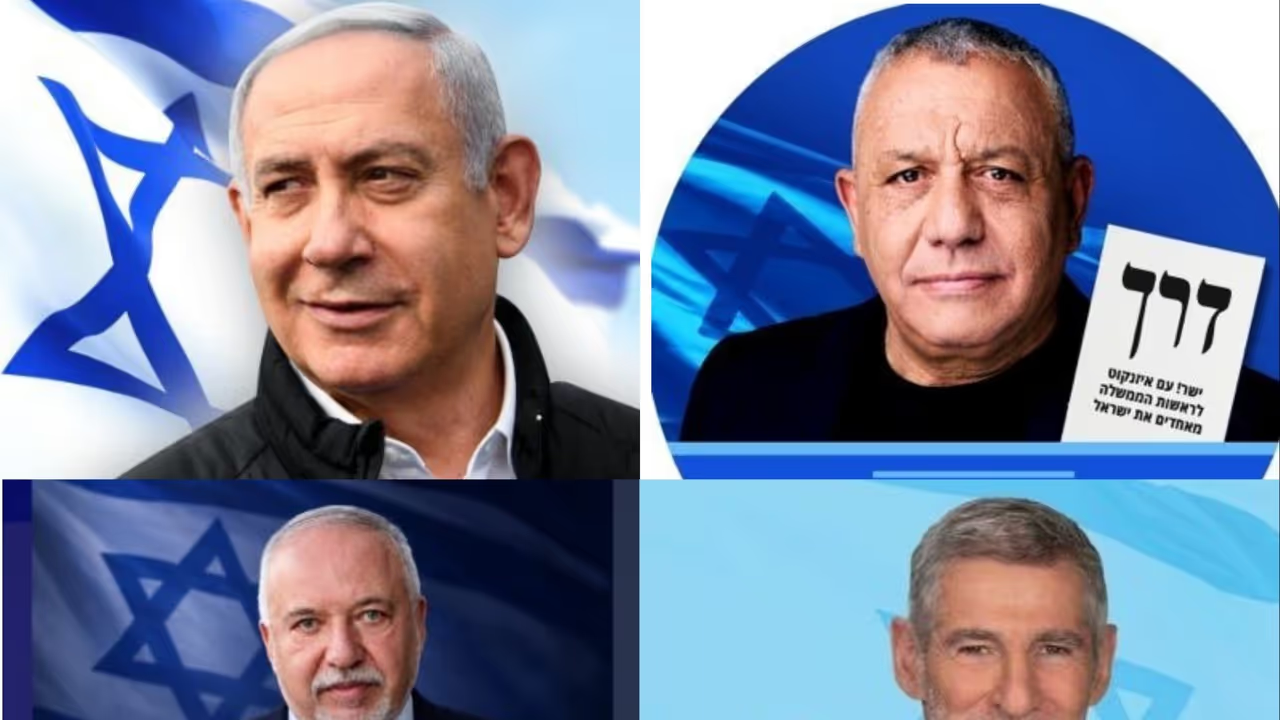
Israel votes in its first election since the October 7 attack, with Benjamin Netanyahu facing a tough challenge from Gadi Eisenkot amid deep national divisions over security, accountability, and the future of the country's leadership.
Israel Votes in High-Stakes Election
In a few hours from now, Israel's 7,331,981 voters will step out to decide who will take charge of the country and which of the 34 parties will be in a position to take control of the Knesset. Today's vote, the first since the Hamas-led massacre of October 7, 2023, comes amid profound divisions on issues including accountability for the failures that allowed the attack and independence of Israel’s democratic institutions and judiciary.
The Political Landscape
Netanyahu who has been at the centre of power for 19 years has managed to keep his coalition in power for a full 4-year term, a rarity in Israel's politics. Now, he faces a formidable challenge in the form of former IDF Chief of Staff Gadi Eisenkot and his Yashar party, which at the moment leads in the various opinion surveys. Also riding up against Netanyahu are the three other Zionist Opposition parties-Naftali Bennett’s B’Yachad, Avigdor Liberman’s Yisrael Beytenu and Yair Golan’s Democrats, who according to the surveys have collectively outpolled Likud led bloc. However, neither bloc is projected to win the magic 61 seats needed for a majority government on its own.
Coalition Scenarios and Opposition Perspectives
Yaron Decel, senior journalist says that a possible national unity government or a minority government could be seen if the nation is to avoid another poll in four months. Decel believes that the opposition parties could come together just to keep Netanyahu in power who has been the longest serving Prime Minister. "Mr. Netanyahu is a controversial Prime Minister for a very long time. So, people here and we see the opposition bloc, the glue between the four parties is to try to replace the government of Mr. Netanyahu with a new government. Mr. Netanyahu has served as Prime Minister the longest time ever, 19 years, not consecutive terms. And he is very controversial. And the bloc that is against Mr. Netanyahu would like him to be removed and replaced,' he said.
Netanyahu is playing to that strength characterising his rivals as a left-leaning bloc which could have to rely on support of the Arab parties to form a government, something that voters don't want. "Israel's enemies only want us to lose - because then a dangerous left-wing government of Eisenkot and Lieberman, with Yair Golan and the Arab parties, will rise here. The way to stop them is to go out and vote only Likud," Netanyahu posted in a late night message on Monday.
The opposition bloc led by Eisenkot is pushing on the issues of accountability for October 7, and demanding an independent commission of inquiry. Eisenkot himself is characterised as a security hawk and his campaign is centred around calling Netanyahu dangerous for Israel's security. "Benjamin Netanyahu will conclude his role immediately following the election results that will take place tomorrow and the establishment of the next government, which will be carried out expeditiously. We will ensure that this is how it will be. The people of Israel will elect a prime minister whose considerations will always be for the good of Israel, who will never act out of political interests at the expense of Israel's security and the fighters of the IDF," Eisenkot posted in his final message ahead of Tuesday's poll.
Avigdor Liberman's message also echoes the same, saying that a vote against Netanyahu is a vote for a stronger State of Israel. Posting a picture with his grandson on polling eve, Liberman said, "If we all go out to vote, my sweet-hearted grandson will wake up in a country that chose for everyone to serve in the army or civilian service, for everyone to bear the burden and for everyone to be equal before the law! A country that will allow civil marriages, where all its children will study core curricula, a country of "live and let live" and not of coercion! My dear grandson will grow up in a thriving, Zionist, sane, and strong State of Israel. This is my commitment. To fulfil it, I need you at the polling station! For Lev, and for all our children and grandchildren, everyone floods the polling stations to vote."
Yair Golan is also calling for change, harping on the fact that Netanyahu's government has so far resisted the formation of the independent commission to probe the October 7 attack. "Only a true vote will ensure both Netanyahu's replacement and the replacement of his path. Only a big Democratic bloc will guarantee that we replace the prime minister and that there will truly be a government of change. Netanyahu’s government has resisted establishing such a commission — saying a politically appointed commission should be formed instead — while the prime minister has declined to accept personal responsibility for the failures on his watch," he said on Polling eve.
The Path to Government Formation
After the votes are tallied on Tuesday, President Isaac Herzog will consult the leaders of the elected parties before tasking the lawmaker he believes has the best chance of forming a government. That candidate will have 28 days to cobble together a coalition, with a possible 14-day extension. If those efforts fail, a second party leader may be given 28 days (without an extension) to try, and if that attempt falls short, a majority of 61 MKs can request that the president assign the task to a particular lawmaker within a further 21-day period. A government must ultimately win the majority of the Knesset’s votes to take office, though a minority government can take office with fewer than 61 supporters if abstentions leave it with more votes in favour than against. If all attempts fail, Israel faces another election, with Netanyahu remaining caretaker prime minister until a new government is formed.
"There are three scenarios according to the polls. When we see that each block doesn't get the majority of 61 out of 120 members of the Israeli parliament. One, that nobody will be able to form a government. We had it in the past, and it means another round of elections in around four months because the parliament cannot produce a stable government. The other scenario is a minority government, which seems to be right now likely by the opposition bloc under Mr. Eisenkot. They will not get 61. They will get less than 61, let's say, like 56. But against them, there will be 52 and two Arab parties will abstain, and it gives them a majority but not of 61. It's called a minority government. And the third scenario is a national unity government under Mr. Netanyahu and Mr. Eisenkot. We did have national unity governments in the past. Some of them survived long-term. There is no bad blood among the two gentlemen, and they have to find a way to form such a government. This is also an option right now to see at the end of the day, a national unity government considering the open fronts with Iran, with the Hezbollah, with Hamas and with the Houthis. It might be for the sake of the interests of Israel," senior journalist Yaron Decel told ANI in Jerusalem.
The battle-lines are drawn firmly, consummate political survivor Bibi Netanyahu versus a former Military Chief in a no-holds barred contest. The victory of either could well reshape not just the politics of Israel but also the situation in West Asia. (ANI)
(Except for the headline, this story has not been edited by Asianetnews Editorial staff and is published from a syndicated feed.)