
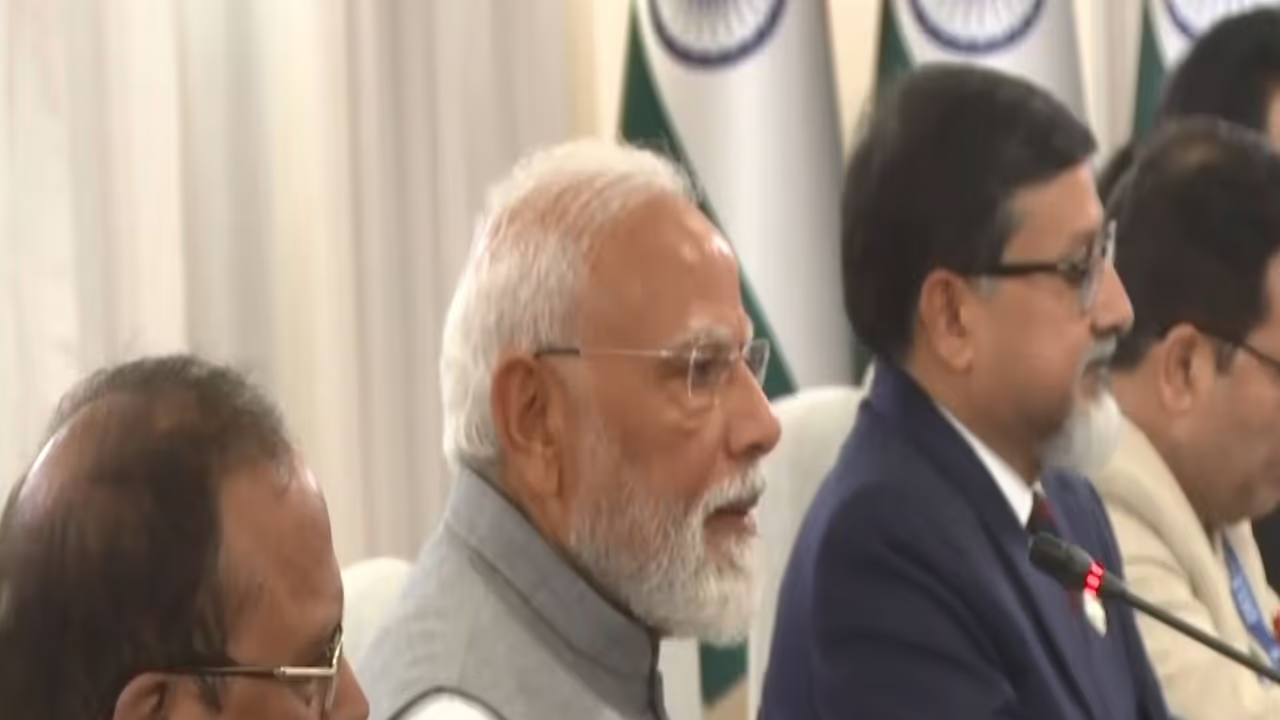
PM Narendra Modi met his Ethiopian counterpart Abiy Ahmed Ali to strengthen ties, citing ancient links, shared democratic values, and partnership in the Global South. The visit also focuses on BRICS coordination ahead of India's 2026 chairmanship.
Prime Minister Narendra Modi on Tuesday held delegation-level discussions with his Ethiopian counterpart, Abiy Ahmed Ali, focusing on strengthening India-Ethiopia ties around enduring civilisational links, shared democratic principles, and a common commitment as partners in the Global South.
During the talks, Prime Minister Modi referred to the communication and exchange for "thousands of years" between the two nations, underlining the longevity of their interaction. "India and Ethiopia have had contact, communication and exchange for thousands of years," he said.
Partnership Based on Shared Values
Drawing a connection between history and present-day cooperation, the Prime Minister highlighted the cultural ethos underpinning the relationship, pointing out that both countries reflect harmony in diversity. "Our two countries, which are rich in languages and traditions, are symbols of unity in diversity," he said.
Prime Minister Modi described India and Ethiopia as democratic nations working towards peace and human welfare. "Both countries are democratic powers committed to peace and the welfare of humanity," he stated.
The Prime Minister characterised the two countries as collaborators in promoting the voice of the Global South. "We are co-passengers and partners of the Global South," he said. He also noted the consistent mutual support extended by both sides in multilateral settings. "On international platforms, we have stood shoulder-to-shoulder."
Deepening Multilateral Cooperation
Prime Minister Modi drew attention to Ethiopia's diplomatic stature in Africa, citing Addis Ababa's central role in continental affairs. "African Union HQ in Ethiopia makes Ethiopia the meeting point of African diplomacy," he said.
Reflecting on India's G20 Presidency, he recalled New Delhi's efforts to amplify Africa's participation in global governance. "Inspired by the common vision of inclusive world, in 2023, India ensured that African Union become a G20 member," he said.
Strategic Focus on BRICS
The delegation-level engagement formed part of Prime Minister Modi's two-day State visit to Ethiopia, aligned with India's broader foreign policy focus on Africa and the Global South. The visit underscores New Delhi's intent to deepen strategic partnerships on the continent, strengthen multilateral cooperation, and prepare diplomatic ground ahead of India assuming the BRICS chairmanship on January 1, 2026.
The visit, undertaken at the invitation of Prime Minister Abiy Ahmed Ali, is PM Modi's first official visit to Ethiopia and his third trip to Africa this year. It comes after his engagements in Jordan and ahead of his scheduled visit to Oman, placing Ethiopia at the centre of India's broader West Asia-Africa diplomatic outreach.
Officials have described this leg of the tour as strategically important in view of BRICS expansion and Africa's rising influence in global governance. Ethiopia's entry into BRICS has further elevated the strategic dimension of bilateral relations. The grouping, founded by Brazil, Russia, India and China in 2006, with South Africa joining subsequently, has expanded in recent years.
Ethiopia became a full BRICS member in January 2024 following an invitation extended during South Africa's chairmanship of the grouping in August 2023. Egypt, Iran and the United Arab Emirates were inducted simultaneously, marking a notable phase in BRICS' enlargement. With India set to assume the BRICS chair in 2026, Prime Minister Modi's Ethiopia visit is expected to prioritise coordination among member states. The visit is also expected to focus on discussions on the bloc's future trajectory and alignment on major global issues, including reforms of the United Nations system. (ANI)
(Except for the headline, this story has not been edited by Asianet Newsable English staff and is published from a syndicated feed.)