
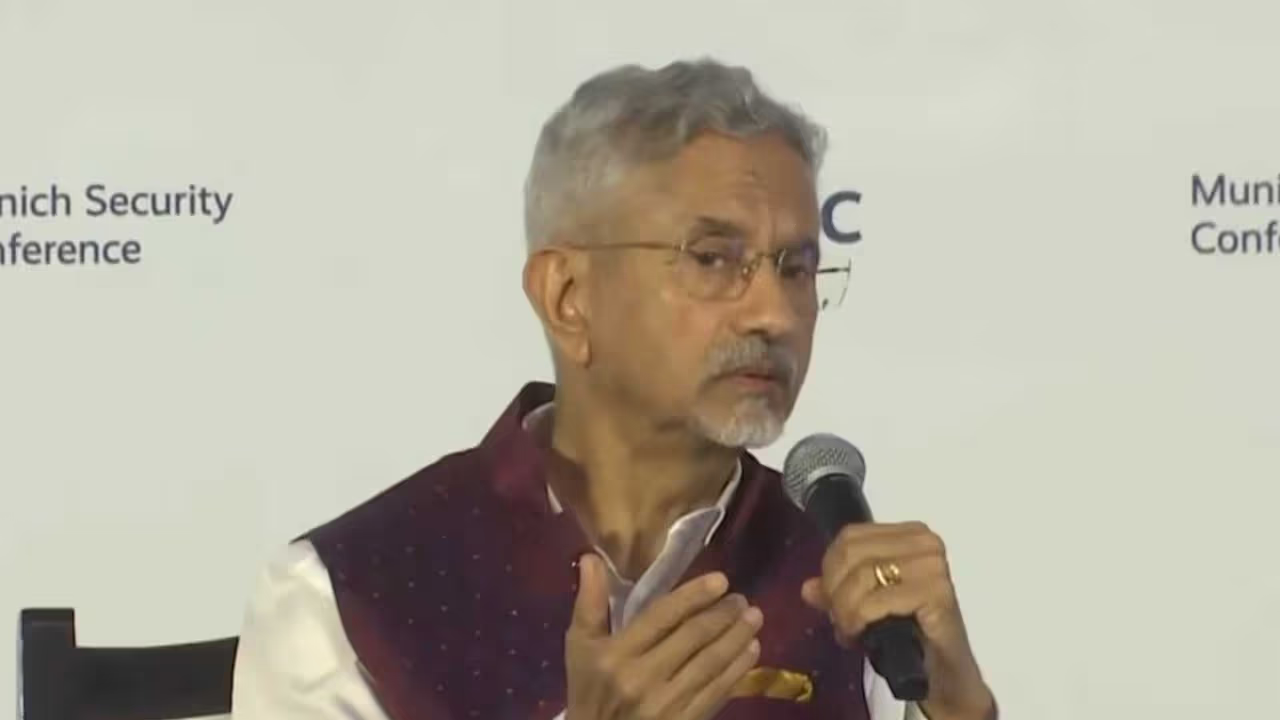
EAM S Jaishankar stressed India's distinct NPT stance from Iran's, highlighting concerns over energy market disruptions from the West Asia conflict. The report also notes US-Iran tensions, with Trump's warnings and Tehran's defiance against sanctions.
Jaishankar on NPT, West Asia Conflict's Economic Fallout
Drawing a sharp line between India’s stance on nuclear non-proliferation and Tehran's international commitments, External Affairs Minister S Jaishankar emphasised that while India reserved its rights as a non-signatory to the Nuclear Non-Proliferation Treaty (NPT), Iran is bound as a signatory state. Addressing the Munich Leaders Meeting on the economic fallout from the escalating West Asia conflict, Jaishankar warned that deeply volatile energy markets directly threaten the daily lives, employment, and domestic budgets of ordinary citizens worldwide.
Addressing the diplomatic nuances surrounding Iran's nuclear posture, Jaishankar clarified India's distinct standing under international agreements: "On the Iran issue, India was a country that did not sign the NPT and reserved its rights. Iran signed the NPT. The situation is very different. For us, the concern is more immediately on the energy and trade disruptions which have happened as a consequence of this conflict," said Jaishankar.
India is one of only four UN member states that never signed the NPT (alongside Pakistan, Israel, and South Sudan) and retains a recognised non-NPT nuclear weapons capability with a non-first-use policy. In contrast, Iran signed the NPT in 1968 and ratified it in 1970 as a Non-Nuclear Weapon State (NNWS), subjecting its facilities to International Atomic Energy Agency (IAEA) safeguards.
Highlighting how volatile supply lines in West Asia hit home for energy-dependent nations, Jaishankar pointed to the real-world impact on ordinary citizens. "Energy markets are deeply unsettled. This is people's kitchens, jobs, and their livelihoods, and these are all on the line for us because we were primarily dependent on that part of the world."
India imports over 85% of its crude oil requirements. Disruptions along Persian Gulf shipping routes or volatile crude prices directly translate into domestic inflation, elevated fuel costs, and increased pressure on household budgets.
He urged an immediate return to established legal principles to restore trade and supply corridors. "What we want to see today is a restoration of that uninterrupted flow of energy, trade, and mobility, because we are paying the price in many ways for conflicts in which we have no part and are often very distant from us. We also hope that whatever emerges is in consonance with international law."
Trump Warns Iran of 'Easy or Hard Way'
Earlier on Saturday (local time), US President Donald Trump said that Washington will take a decision on Iran, stating that the outcome would come either the "easy way or the hard way", while asserting that Iran has been "decimated".
"We have a decision that I'll make about Iran. Iran's been decimated. So the only question is, it'll either be the easy way or the hard way. We'll have it the easy way or the hard way," Trump said to reporters outside the White House.
Trump's remarks came as he continued to withhold details of his forthcoming actions concerning Iran, while saying that the situation was progressing favourably and that Iran was not doing well. Speaking to reporters on Friday, Trump, when asked about his upcoming strategy regarding Iran, initially suggested that revealing his plans would generate significant headlines. "If I told you, you'd have a major story, right? But you'll see. Working out very well. Iran is not doing well," Trump said. The US President did not provide further details about potential administration measures or a timeline for his next steps.
Iran Vows to Manage US Sanctions
On the other hand, Iranian President Masoud Pezeshkian said that Tehran "adopted a new arrangement" to manage what he described as special conditions, as the United States intensifies economic pressure and sanctions targeting Iran's financial and commercial networks.
In a post on X, Pezeshkian accused its adversaries, particularly the US, of seeking to cut off the Islamic Republic's vital economic lifelines to pressure its people. He further noted that despite the mounting pressure, public support and government measures had prevented those objectives from being achieved.
"The government has adopted a new arrangement to manage these special conditions. The enemy's plan in recent months has been to cut off the country's vital arteries with the aim of pressuring the noble people of Iran. Economic pressure has intensified, but by the grace of God, with the accompaniment of the people and the measures taken by our colleagues in the government, we have not allowed the enemy's objectives in the economic war to be realised," the post read. The latest measures form part of a wider US sanctions regime targeting Iran's economy, including its energy, shipping, technology, gold and digital-asset sectors. (ANI)
(Except for the headline, this story has not been edited by Asianet Newsable English staff and is published from a syndicated feed.)