
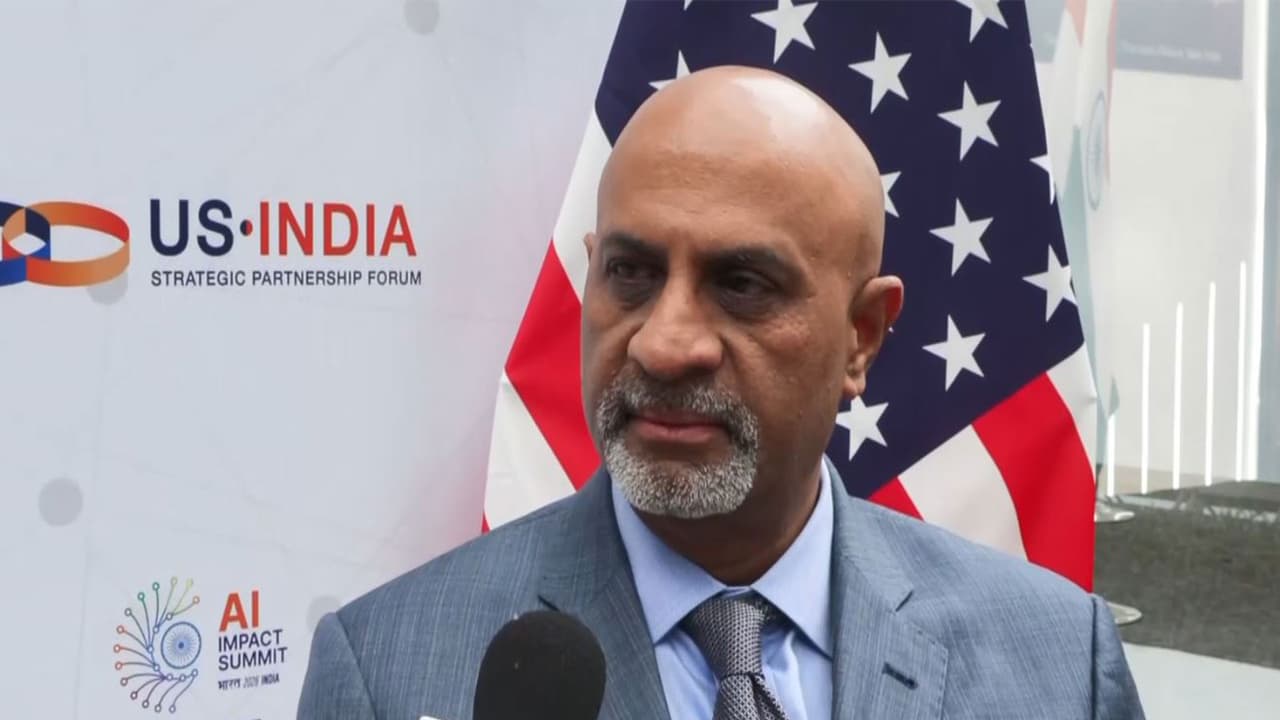
Kore.ai CEO Raj Koneru asserted that India is uniquely positioned to lead the next AI wave by focusing on 'applied AI'. He urged using existing models for practical solutions rather than creating expensive new ones to leverage India's human potential.
Raj Koneru, CEO and Founder of Kore.ai, on Wednesday asserted that India is better suited than any other nation to lead the next wave of artificial intelligence, urging the country to prioritise building "applied AI" to fully leverage its massive human potential. Speaking to ANI in the national capital, Koneru highlighted India's unique position in the global AI landscape.
Focus on Applied AI, Not Foundational Models
While acknowledging that developing foundational models is resource-intensive and India lags in that area, he emphasised that the real opportunity lies in practical application and enablement. "I think India should focus on creating applied AI, not creation of new models. I think creation of new models is way too expensive, and India is way behind in that. But using the models and using every other innovation that's happening in the world, building applied AI is the opportunity," Koneru stated.
Practical Applications and Enterprise Solutions
He pointed out that Kore.ai, a company "born out of India," has been developing AI products for over 12 years using local talent. This expertise is now helping global enterprises optimise operations through automation. "We provide an enterprise AI platform and applications for enterprises to build out their use cases. So these use cases span customer service automation, employee experience and productivity process automation. So these result in huge outcomes in terms of reducing cost, improving service, improving customer satisfaction and overall increasing the speed of business," he said.
The Human and Machine Dynamic
Addressing the rapidly evolving nature of the technology, Koneru noted that intelligence itself is being redefined as it is "taught to machines," describing the process as both exciting and unpredictable. "Machines are becoming more intelligent, thanks to all of the innovation that humans are doing in terms of AI. So you can't predict how far intelligence can be fed to a machine. A machine can use that intelligence to make humanity better. Basically, it's very difficult to predict that," he remarked.
Addressing Job Displacement Fears
Despite the fast pace of innovation, Koneru dismissed fears of large-scale job losses, comparing the current AI revolution to the arrival of email or the internet. He stressed human adaptability and the emergence of new roles. "I don't think the fear is real. I think job displacement happens anytime there's new technology. But people adapt. People learn new skills. I say that there are two types of jobs. One where you do a job by using AI. The other one is you create AI for other people to do their jobs. That's how people will change their skill sets," he explained.
India's AI Future: A Call for Enablement
Looking ahead, Koneru envisioned AI becoming deeply integrated into every aspect of Indian life, from personal assistants to enterprise efficiency, with the country's large population and diverse culture providing a unique advantage. "India has to focus on training more humans on how to build with AI, not just use AI. It should start in schools, it should be in colleges, it should be in work environments. Enablement is the key. After enablement comes creation, and after creation comes value. Basically, India is better suited than most other countries to take advantage of that," he said.
About the India AI Impact Summit 2026
Koneru's comments come amid the ongoing India AI Impact Summit 2026 at Bharat Mandapam, New Delhi, from February 16 to February 20. The summit has brought together government policymakers, industry AI experts, academicians, technology innovators, and civil society representatives from across the world to advance global discussions on artificial intelligence.
As the first global AI summit hosted in the Global South, the event aims to reflect on the transformative potential of AI, aligning with India's national vision of "Sarvajana Hitaya, Sarvajana Sukhaya" (welfare for all, happiness for all) and the broader global principle of AI for Humanity.
The summit features participation from more than 110 countries and 30 international organisations, including around 20 heads of state or government and about 45 ministers. It forms part of an evolving international process focused on strengthening global cooperation on AI governance, safety, and societal impact. Guided by the three foundational Sutras -- People, Planet, and Progress -- the India AI Impact Summit 2026 promotes human-centric AI that safeguards rights and ensures equitable benefits across societies, environmentally sustainable advancement of AI, and inclusive economic and technological progress. (ANI)
(Except for the headline, this story has not been edited by Asianet Newsable English staff and is published from a syndicated feed.)