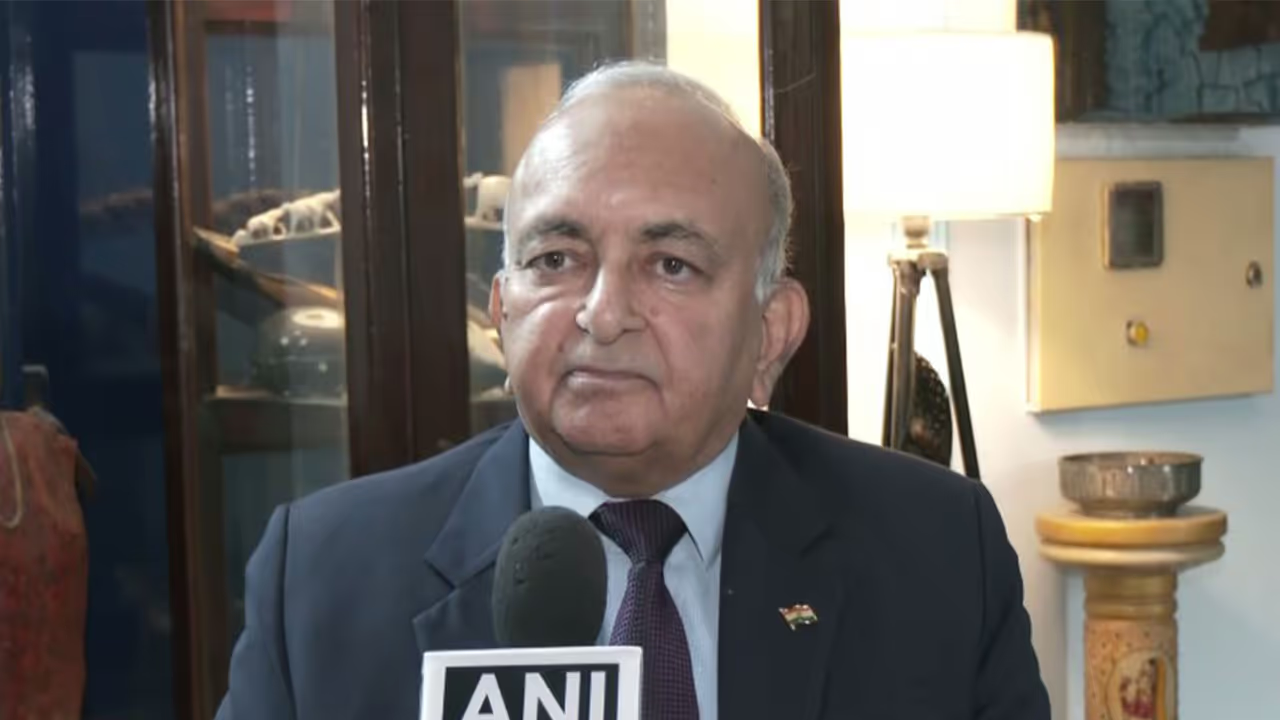
Former diplomat Mahesh Sachdev confirms that India-Israel relations will remain stable despite Israel's inconclusive election results, emphasizing that strategic cooperation between the two nations will continue regardless of the coalition formed.
Stable Outlook for Indo-Israeli Ties
Former diplomat Mahesh Sachdev said on Thursday that the bilateral ties between India and Israel will stay on a stable trajectory regardless of who leads Israel’s next coalition government, asserting that any emerging administration will rely on strong government-to-government continuity with New Delhi. Analysing the broader diplomatic implications of Israel’s inconclusive election results, Sachdev expressed confidence that strategic cooperation will endure regardless of which coalition leader eventually secures power in Jerusalem.
"India has good government-to-government relations and people-to-people relations with Israel. These have continued and prospered for many decades under various prime ministers," Sachdev said. "So one would be reasonably certain that whoever becomes a prime minister would pay special attention to ties with India," he added, pointing to Israel's acute need for reliable international partners amid mounting global pressure.
Impact of Regional Conflict
Sachdev emphasised that Jerusalem's ongoing military campaigns across Gaza, Lebanon, and West Asia have led to growing diplomatic strain, making ties with New Delhi even more critical. "Israel continues to be largely isolated from its Western friends as well as from the Third World countries where sympathy for Palestinians, for Gazans, for Lebanese, war victims, civilians, et cetera, is prevalent," he stated.
Addressing potential policy divergences, Sachdev noted that despite differences over the broader Middle East peace framework, both nations prioritise pragmatic bilateral engagement. "India has its own well-known policy about two-state solutions and the Middle East crisis itself," Sachdev explained. "Israel, though, does not agree with many of these formulations that we subscribe to, has focused on bilateralism, and that would continue to happen."
Political Complexity in Israel
Coalition Gridlock
Explaining the mechanics behind Israel’s proportional representation system, Sachdev noted that despite a small electorate of 7.3 million voters, the nation's multi-party structure creates significant political complexity. With dozens of parties competing for the 120-seat Knesset and a 61-seat majority threshold, the latest results point toward coalition gridlock. “As none of the three coalitions has a majority, the President is most likely to call Mr Netanyahu to try and form a new government,” Sachdev explained. “If he cannot do so, then maybe the opposition coalition would be asked to do the same. If that also fails, then there's no getting away from another election.”
Shifts in the Political Landscape
Highlighting a crucial shift in the nation's political landscape, Sachdev emphasised the historic emergence of Arab-Israeli parties. "Another message from the election is that Arab communities, which are citizens of Israel, constituting 21% of Israel's population, seem to have become a political force in their own right... They cannot be taken for granted or ostracised as untouchables in a political way. If a government is to be formed, it'll have to take into consideration this huge 15% block of Knesset votes," he said. "Also a takeaway from the elections is that nearly half a million young voters have come of age since the last election. And many of these voters are radically right-wingers. So, Israel as a society has exercised its democratic rights, but at the same time, it's worrisome that the nationalist mainstream has hardened, making any compromise solutions and a political way for Gaza, in the West Bank, and in Lebanon, as well as with Iran, more difficult," he added.
The election, the first since the October 7, 2023 Hamas attack, served as a crucial referendum on national security and governance. While Israel has since engaged in multi-front conflict against Hamas, Hezbollah, the Houthis, and Iran, Sachdev observed that military operations have yet to deliver a definitive victory while imposing steep economic and social costs. "All these foes are still standing. They have been decimated, but they have not yet succumbed to the Israeli war pressure," Sachdev said, pointing out that voters were heavily influenced by security failures and war fatigue. Furthermore, he noted that domestic challenges, including Netanyahu's ongoing corruption trial, controversial judicial overhaul efforts, and international legal scrutiny, heavily weighed on voter sentiment.
Sachdev highlighted that the conflict has "caused a major dent to Israel's own image, as the International Criminal Court has temporarily decided that Israel had been conducting a genocide in Gaza." He further warned that if coalition talks fail and Netanyahu remains as caretaker prime minister for an extended period, an unconstrained caretaker administration could “further vitiate the regional atmosphere and create obstacles in the way of a political settlement.”
The majority continues to evade any of the coalition blocs. As of now, incumbent PM Benjamin Netanyahu’s Likud is projected to have 26 seats, making it the largest party in the Knesset. Along with his coalition allies like United Torah Judaism, Shas, and Otzma Yehudit, the Likud-led bloc is projected to win 53 seats, which is short of the 61 needed for a majority. The opposition bloc, comprising Gadi Eisenkot's Yashar, Naftali Bennett's B’Yachad, Avigdor Liberman's Yisrael Beytenu, and Yair Golan's The Democrats, was projected to win 48 seats. The Arab parties, which include the Joint List and Ra'am, are projected to win 19 seats. (ANI)
(Except for the headline, this story has not been edited by Asianetnews Editorial staff and is published from a syndicated feed.)