
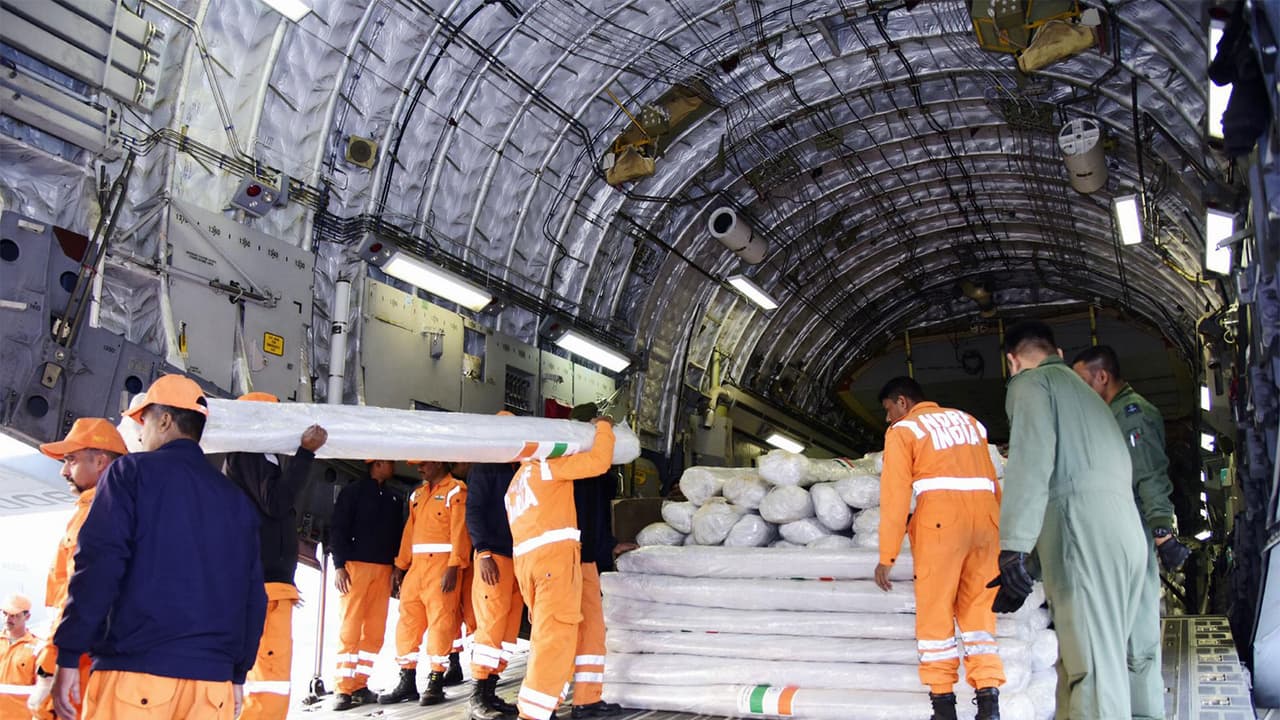
India has dispatched 30 tonnes of humanitarian aid to the Philippines following Super Typhoon Fung-wong. An Indian Air Force C-17 carried NDRF material, medicines, and a BHISHM Cube to assist in relief and recovery efforts.
India on Monday dispatched humanitarian assistance to the Philippines in the wake of the recent Super Typhoon, reiterating its commitment to support partner countries in times of need.
In a post on X, MEA spokesperson Randhir Jaiswal said, "India stands with the Philippines". Highlighting the support being sent, Jaiswal said an Indian Air Force C-17 aircraft departed for Clark Air Base on Monday morning carrying around 30 tonnes of humanitarian assistance for relief and recovery efforts.
"An @IAF_MCC C-17 aircraft departed for Clark Air Base this morning, carrying ~30 tonnes of humanitarian assistance, including NDRF relief material, essential medicines & BHISHM Cube, to assist in the relief & recovery efforts of Philippines Government after the recent Super Typhoon," Jaiswal said.
India stands with the Philippines 🇮🇳🤝🇵🇭 An @IAF_MCC C-17 aircraft departed for Clark Air Base this morning, carrying ~30 tonnes of humanitarian assistance, including NDRF relief material, essential medicines & BHISHM Cube, to assist in the relief & recovery efforts of 🇵🇭… pic.twitter.com/HPy8M4bE3h — Randhir Jaiswal (@MEAIndia) January 19, 2026
Reiterating India's humanitarian outreach, he added, "India remains committed to provide #HADR support to partner countries in times of need."
About Super Typhoon Fung-wong
The assistance is being dispatched following the impact of Typhoon Fung-wong, known in the Philippines as Super Typhoon Uwan, which struck the Philippines, Taiwan and Japan's Ryukyu Islands in early November 2025.
The storm was the twenty-sixth named system and the twelfth typhoon of the 2025 Pacific typhoon season, developing from a broad low-pressure area northeast of Chuuk on November 3 and gradually becoming more organised over the following days.
Intensification and Landfall
Under increasingly favourable atmospheric conditions, the system intensified rapidly on November 8.
The Japan Meteorological Agency (JMA) classified it as a typhoon on November 7, and early the next day, the Philippine Atmospheric, Geophysical and Astronomical Services Administration (PAGASA) upgraded it to a super typhoon.
Soon after, the Joint Typhoon Warning Center (JTWC) assessed Fung-wong as a Category 4-equivalent typhoon. It later made landfall in Dinalungan, Aurora, on the evening of November 9.
Path and Historical Context
After crossing Luzon, the storm weakened and re-emerged over the West Philippine Sea before recurving towards Taiwan.
It made landfall in Hengchun Township, Pingtung County, as a tropical storm on November 12, weakened further and dissipated on November 13.
Fung-wong was the first storm to make landfall in Taiwan in November since Typhoon Gilda in 1967, and the second storm to strike Taiwan's western plains in 2025 since Typhoon Danas in July.
Impact and Casualties
The typhoon struck the Philippines just five days after Typhoon Kalmaegi battered central parts of the country, further complicating recovery efforts.
Fung-wong triggered widespread flooding and strong winds, particularly across the Bicol Region and Northern Luzon.
The storm caused at least 33 deaths and 52 injuries in the Philippines, mostly due to floods and landslides.
In Taiwan, one death and 95 injuries were reported. (ANI)
(Except for the headline, this story has not been edited by Asianet Newsable English staff and is published from a syndicated feed.)