
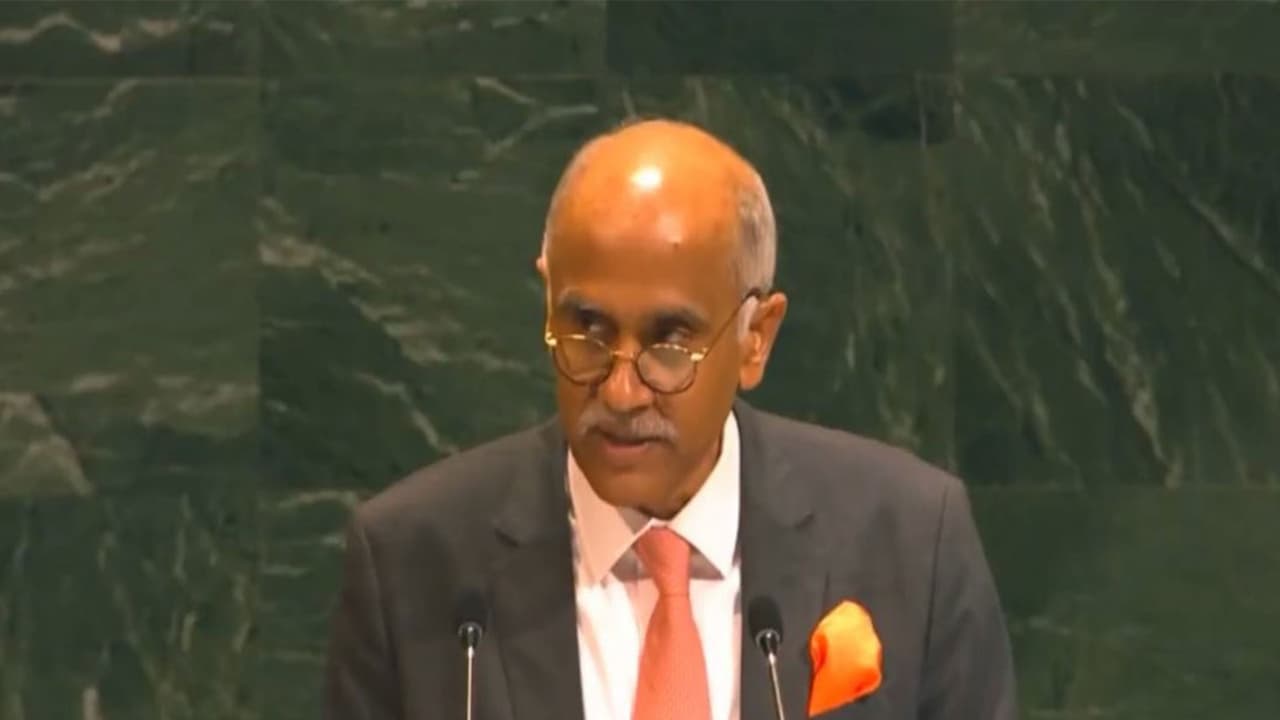
India called for urgent, comprehensive reforms of the UN Security Council, including expansion of permanent and non-permanent seats. Ambassador Harish Parvathaneni argued the current structure reflects a 'bygone era' and strains multilateralism.
India on Monday called for comprehensive reforms of the United Nations Security Council (UNSC) on grounds of multilateralism and changes in global dynamics, noting that the current structure reflects a "geopolitical reality of a bygone era".
Speaking at the UN Security Council Open Debate on "Reaffirming International Rule of Law: Pathways to Reinvigorating Peace, Justice, and Multilateralism", India's Permanent Representative to the UN, Ambassador Harish Parvathaneni argued that the credibility of multilateralism and the international rule of law depends on adapting global governance structures to contemporary geopolitical realities.
'Rule of Law' and Multilateralism Under Strain
"The Rule of law is at the very heart of the core mandate of the United Nations Security Council - maintenance of international peace and security. It is critical to addressing conflicts and fostering trust among member states," the Ambassador said.
He noted that multilateralism based on universal membership, with the UN at its core, is under significant strain. Beyond budgetary challenges, he pointed to paralysis and lack of effectiveness in addressing conflicts as major shortcomings, leading to a growing perception that the UN is failing to deliver on its primary mandate of maintaining international peace and security, warning that this trend risks further weakening multilateral institutions.
From Theory to Pragmatic Solutions
Ambassador Parvathaneni emphasised that the rule of law lies at the heart of the Security Council's mandate but stressed that it cannot remain theoretical, while calling for a shift from abstract legal constructs to pragmatic solutions that deliver tangible outcomes for people.
"The rule of law is barren without enforceability. The focus must shift from arcane constructs to pragmatic solutions and outcomes that positively impact the daily lives of our citizens," the Ambassador said. Highlighting the rapid transformation across political, economic, and technological domains, he underscored the need for continuous review and updating of international legal and institutional frameworks to prevent obsolescence, arguing that for multilateralism and international rule of law to remain effective and credible, global governance structures must evolve in line with changing power dynamics, demographics, and global challenges.
Urgent Call for Comprehensive Reform
"Continuous review, updation and reinvigoration are an imperative to avoid obsolescence," he stated.
Expansion in Permanent and Non-Permanent Categories
Parvathaneni reiterated India's long-standing position that reform of the Security Council must include expansion in both permanent and non-permanent categories to enhance its legitimacy, representativeness, and effectiveness.
"For multilateralism and international rule of law to remain effective and credible, global governance structures must evolve to reflect contemporary realities. The current architecture of the United Nations, particularly the composition of the Security Council, reflects a geopolitical reality of a bygone era," he noted. "In light of the profound global transformation of the last eight decades in power dynamics, demographics, and the nature of global challenges, there is an urgent and compelling need to undertake comprehensive reform, including expansion in the permanent and non-permanent categories," he added.
Warning Against Misuse of International Law
The Indian envoy also called for greater synergy among the UN's principal organs to advance the rule of law, advocating process-oriented reforms, predictable and adequate resources, capacity-building, and technical assistance tailored to local contexts. At the same time, he cautioned against the misuse of international law to interfere in the internal affairs of states or undermine their sovereignty and territorial integrity.
Stressing the need for adaptability, he warned that rigid and selective application of international legal principles could accelerate the emergence of alternative formats of global engagement. "International rule of law should not be weaponised to question state sovereignty and interfere in internal affairs of states," he said.
Plea for Consistency and No Double Standards
Concluding his remarks, Ambassador Parvathaneni emphasised that the application of international rule of law must be consistent, objective, and free from double standards if the United Nations is to retain its relevance and authority in a rapidly changing world. "The application of international rule of law calls for consistency, objectivity and predictability with no double standards," the ambassador concluded. (ANI)
(Except for the headline, this story has not been edited by Asianet Newsable English staff and is published from a syndicated feed.)