
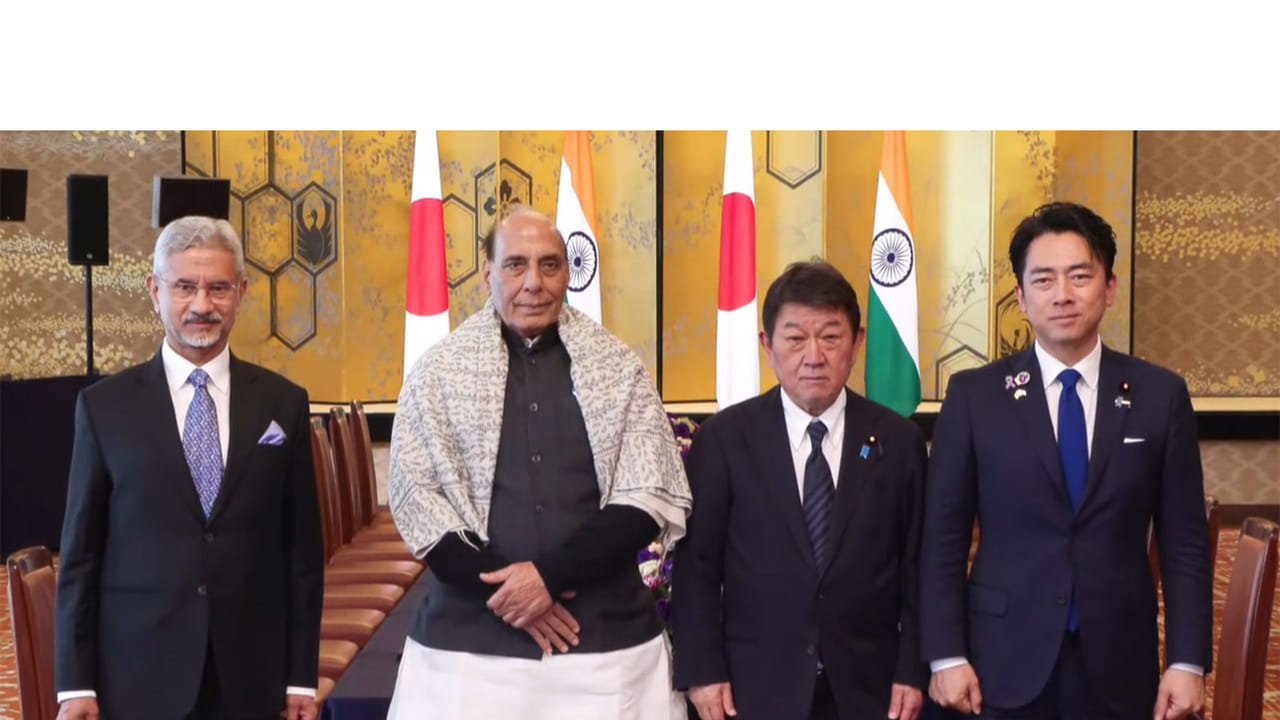
India and Japan hold their 4th 2+2 ministerial dialogue in Tokyo, focusing on bolstering defence technology, maritime security, and strategic cooperation to ensure a free, open, and rules-based Indo-Pacific region for future stability.
India and Japan Hold 4th 2+2 Dialogue to Strengthen Strategic Ties
Tokyo [Japan], November 19 (ANI): External Affairs Minister S Jaishankar and Defence Minister Rajnath Singh on Thursday met Japan's Foreign Minister Toshimitsu Motegi and Defence Minister Shinjirō Koizumi for the 4th 2+2 dialogue in Tokyo. During the dialogue, the two countries will assess the entire range of their bilateral defence and strategic partnership, discuss regional and global issues, and reiterate their joint resolve towards a free, open, inclusive and rules-based Indo-Pacific, according to the Ministry of Defence (MoD).
Alongside the 2+2 format, this bilateral engagement marks the third meeting between Rajnath Singh and Koizumi in 2026. Carrying forward the progress made during their previous interactions in New Delhi in August and on the margins of the ASEAN Defence Ministers' Meeting-Plus in Cebu in October, the two ministers will deliberate on boosting collaboration in defence technology and equipment, strengthening maritime security, expanding the scope and sophistication of tri-service joint exercises, and fostering closer industrial ties.
Additionally, during the visit, EAM Jaishankar is also scheduled to hold the 19th India-Japan Foreign Ministers' Strategic Dialogue, while Rajnath Singh will hold bilateral discussions with his Japanese counterpart, Shinjiro Koizumi. Earlier on Wednesday, Defence Minister Rajnath Singh arrived at the Ministry of Defence in Tokyo, where he was received by his Japanese counterpart, Shinjiro Koizumi. The duo then visited the Japan Maritime Self-Defense Force (JMSDF) Naval Base in Yokosuka and toured the Mogami-class multi-mission frigate, JS Natori. Highlighting the growing maritime cooperation between the two countries, the Defence Minister said, "Our growing maritime cooperation reflects the deep trust and shared commitment of India and Japan toward ensuring a free, open, and rules-based Indo-Pacific."
Meanwhile, Jaishankar said India and Japan must deepen their cooperation and strengthen their national capacities to maintain a free and open Indo-Pacific, asserting that the changing global order has created a compelling rationale for closer bilateral ties. Addressing the inaugural session of Raisina Tokyo 2026, Jaishankar said the Indo-Pacific was particularly affected by the five defining features of the current global order, including repeated shocks to the international system, weaponisation of resources and technology, greater risk-taking, economic de-risking and the growing importance of trusted partnerships.
The Observer Research Foundation (ORF) and ORF America, in partnership with the Ministry of External Affairs of India, the Japan Bank for International Cooperation (JBIC), and Keizai Doyukai, are hosting the third edition of Raisina Tokyo on 18–19 November. Building on former Japanese Prime Minister Shinzo Abe’s vision of a Free and Open Indo-Pacific, the dialogue brings together leaders from government, business, and civil society across the Indo-Pacific and beyond to examine the changing contours of global trade and investment, defence and deterrence, frontier technologies, energy transitions, and regional architecture.












