The post–Cold War era of “long peace” is ending as economic interdependence gives way to competitive geoeconomics, weaponized supply chains, energy politics, and strategic rivalry shaping global order.
By Dr Aparaajita Pandey: The world post the Cold War, has enjoyed what is called an era of long peace; the dominant narrative of the times has been that economic interdependence finds a way to trump geopolitical rivalry. The expansion of global supply chains, energy markets, and financial integration did seem to highlight the idea that the world had entered a period in which economic cooperation would overcome strategic competition. However, that assumption is looking increasingly fragile. The world is witnessing a series of regional crises that is leading to a gradual reconfiguration of the international system into a form of competitive geoeconomics, where economic networks, energy flows, and technological systems are increasingly shaped by strategic rivalry.
Energy Geopolitics: The New Battleground
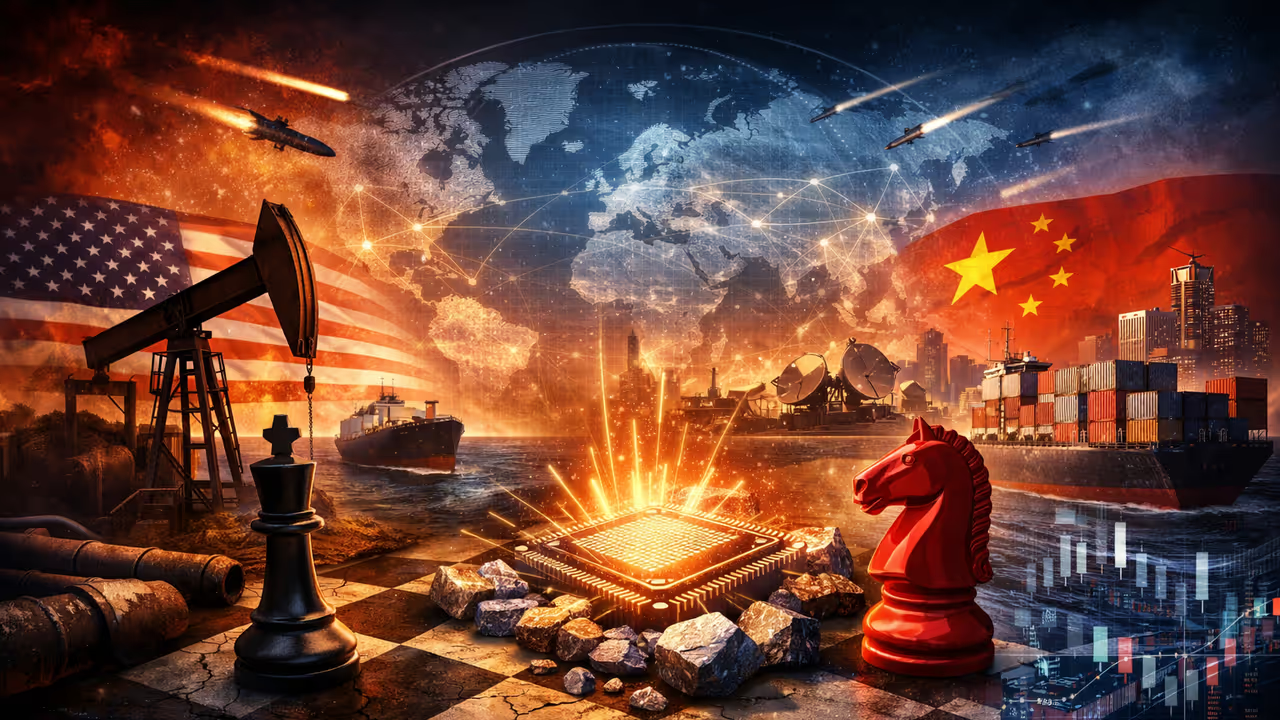
Energy geopolitics offers a wonderful illustration of how geoeconomics being used to impact deeper geopolitical rivalries, which is diametrically opposite to peace dividend argument that the world has revelled in for decades. China’s key oil suppliers including Iran and Venezuela that have for long operated under varying degrees of sanctions and political pressure; have now been at the receiving end of the US’ wrath and an obvious ramification of this is the impending avalanche in China’s energy security calculations. The challenge for Beijing is not only the price of crude but also the reliability of access to crude. For Washington on the other hand, a marginally more vulnerable China provides them with strategic leverage at the same time broadcasts their presence in the rest of the world which had seem to lose its shine in the recent past. In addition to the Beijing – Washington dynamics, there are systemic implications for the structure of global energy markets.
Weaponization of Interdependence
This reflects a broader phenomenon of the weaponization of interdependence. The networks that once fortified globalization are progressively susceptible to geopolitical manipulation. The use of tactics like control over chokepoints, regulatory regimes, and payment systems enables states to apply influence beyond their immediate geographic sphere. Subsequently, economic statecraft has become inseparable from national security strategy.
Related Articles

Technology as a Strategic Asset
Technology supply chains, rare-earth minerals, semiconductor manufacturing, and digital infrastructure can now all be referred to as strategic assets instead of just economic tools. Governments have begun to treat these sectors not merely as economic domains but as pillars of national strength and geopolitical leverage. Export controls, investment screening mechanisms, and industrial policy are therefore becoming central components of strategic competition. The shift is that economics that was once supposed to be used as means of greater global consolidation, is now being used to strengthen rivalries leading to an increasingly fragmented globe.
Erosion of Global Institutions
This transformation also reflects a deeper structural transition in the international system. The post–Cold War order leaned on the assumption that global institutions and common systems could control economic competition. Yet the authority of many of such institutions has steadily weakened. Trade disputes progressively circumvent multilateral mechanisms, sanctions regimes mushroom beyond established frameworks, and strategic rivalries spill into domains formerly presided by economic norms. The result is a world in which economic governance is increasingly shaped by power politics rather than institutional accord.
However, this is hardly a departure from the norm, this emerging landscape bears a resemblance to earlier periods of international history. The late nineteenth century, often labelled as the first age of globalization, exhibited a similar blend of economic integration and geopolitical rivalry. European powers contested fiercely for access to resources, maritime routes, and colonial markets as global trade expanded rapidly. Economic networks have the tendency to be able to facilitate both cooperation and competition.
Rise of Regional Security Architectures
The present world mirrors earlier eras in several important aspects. Energy resources have superseded colonial commodities as the strategic prize, and maritime chokepoints from the Strait of Hormuz to the South China Sea essentially have become modern equivalents of the imperial sea lanes that were once so dearly wanted by European navies. Infrastructure investment, digital connectivity, and port development have turned into agents of influence analogous to the railway networks and telegraph lines that once highlighted imperial expansion. The mechanisms have changed, but the underlying logic remains the same; economic connectivity can augment success, and it can also increase contention.
Another historical parallel is the increasing regionalization of security arrangements. The institutions that once had a global character and promised collective security are becoming increasingly regional in their outlook and actions. Europe continues to rely primarily on transatlantic security structures, while the Indo-Pacific is witnessing the rise of flexible strategic alignments as countries seek to balance competing powers. The international system is evolving toward a mosaic of regional security architectures.
Challenges for the Global South
These are uncertain times for the Global South. The recent events have made it clear that states that are considered the most powerful and have been entrusted with the upholding of the global order have little regard for it. Countries that control strategic resources, maritime routes, or critical markets hold better bargaining leverage and at the same time are also at a greater risk of being trampled over by a larger power or at the very least being roped into a proxy war.
Security-Driven Economic Policy
The economic ramifications of this shift are already visible. Defence spending has risen across regions; this rise is a function of the rising uncertainty around the world. Governments are investing in strategic sectors ranging from semiconductors to energy infrastructure, to decrease weaknesses that could be exploited by geopolitical hostilities. These efforts signal a broader movement that has been termed security-driven economic policy. Economic interdependence can no longer be assumed to be fundamentally stabilizing; it is gradually considered a potential source of vulnerability.
The world may be returning to a recurring historical pattern; a period of intense economic integration that is followed by renewed geopolitical competition. Such a system forces prosperity and rivalry to coexist albeit uneasily. Markets tend to expand even as strategic distrust deepens.
To understand this transformation, one requires to move beyond the notion that geopolitics and economics operate in silos. Energy markets, supply chains, and financial systems have become the terrain on which power is contested. The emerging international order will therefore be defined not only by the balance of military capabilities but also by the ability of states to shape the economic networks that sustain global power.
(The author is a Professor at Institute of Defence and Strategic Studies, Amity University, NOIDA)
Disclaimer: The opinions expressed are solely those of the author and do not reflect the views or stance of the organization. The organization assumes no responsibility for the content shared.