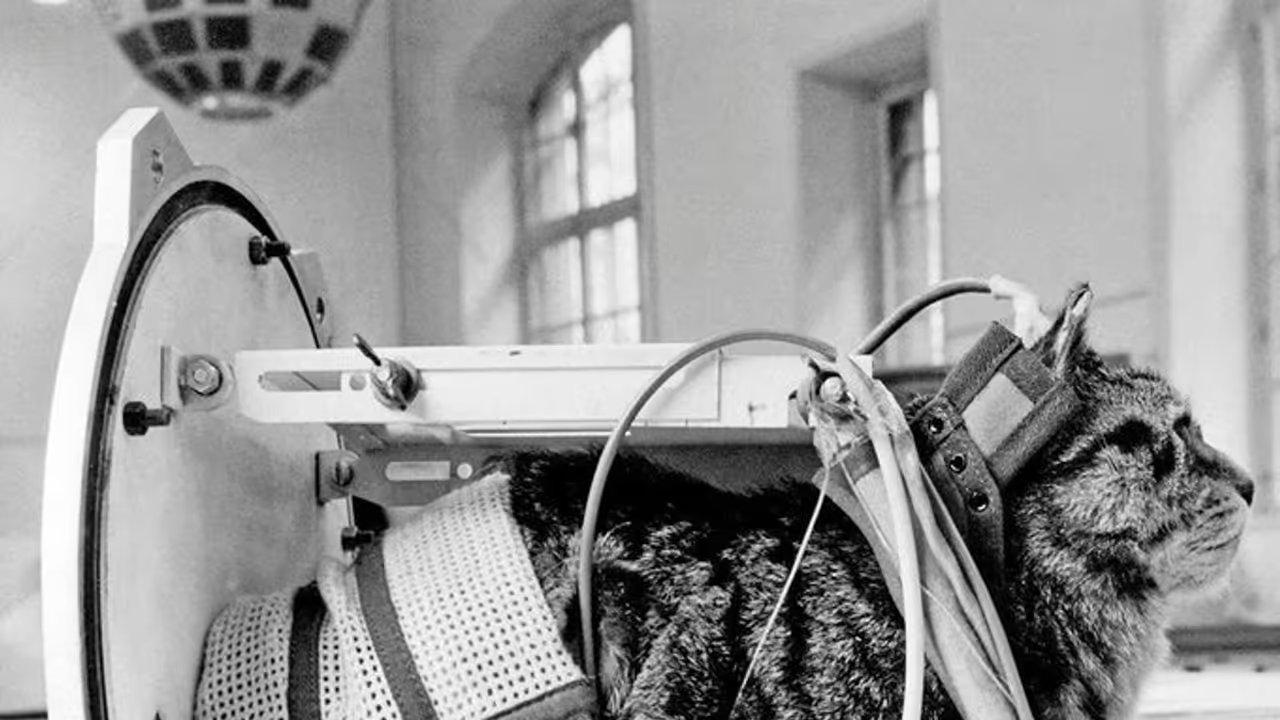
Felicette: The small black-and-white former stray etched her name into history on October 18, 1963, becoming the first and only cat to survive a journey beyond Earth.
Cats are famous for their curiosity, but Felicette took hers to extraordinary heights - all the way into space. The small black-and-white former stray etched her name into history on October 18, 1963, becoming the first and only cat to survive a journey beyond Earth.
Although her historic flight lasted less than 15 minutes, Felicette played a significant role in the early days of space exploration. Decades later, her remarkable contribution finally received a permanent tribute through a bronze statue in France, ensuring that the pioneering feline would not be forgotten.
Before Felicette's mission, both the United States and the Soviet Union had sent animals into space to study the effects of space travel on living organisms. Among the most famous were Laika, the Soviet dog launched in 1957, and Ham, the chimpanzee sent into space by the United States in 1961.
Related Articles

France had already conducted space-related experiments involving rats. However, researchers at the Centre d'Enseignement et de Recherches de Medecine Aeronautique (CERMA) chose Felicette from a group of 14 cats trained for the mission, according to Mental Floss.
In October 1963, Felicette, identified by the mission code C341, blasted off from a launch site in the Sahara Desert. Her capsule soared approximately 98 miles above Earth, while electrodes attached to her body monitored her heart rate and breathing, helping scientists study how a living organism responded to the conditions of spaceflight.
After separating from the rocket, the capsule descended by parachute, bringing Félicette safely back to Earth. Her survival marked a remarkable milestone in the history of animal spaceflight. However, her story took a heartbreaking turn several months later, when researchers euthanized her to examine her brain and further investigate the effects of the journey.
Despite her contribution to scientific research, Felicette received considerably less recognition than several other animals that helped pave the way for human space exploration.
An effort to correct that oversight began in 2017, when Matthew Serge Guy launched a Kickstarter campaign to raise funds for a memorial honouring the pioneering cat. The initiative attracted more than 1,100 supporters and raised $57,000, turning a long-overdue tribute into reality.
Sculptor Gill Parker created a five-foot-tall bronze statue depicting Felicette perched atop a representation of Earth, gazing towards the sky. Unveiled in December 2019 at the International Space University in Strasbourg, France, the monument finally gave the trailblazing feline a lasting place in the story of space exploration.