
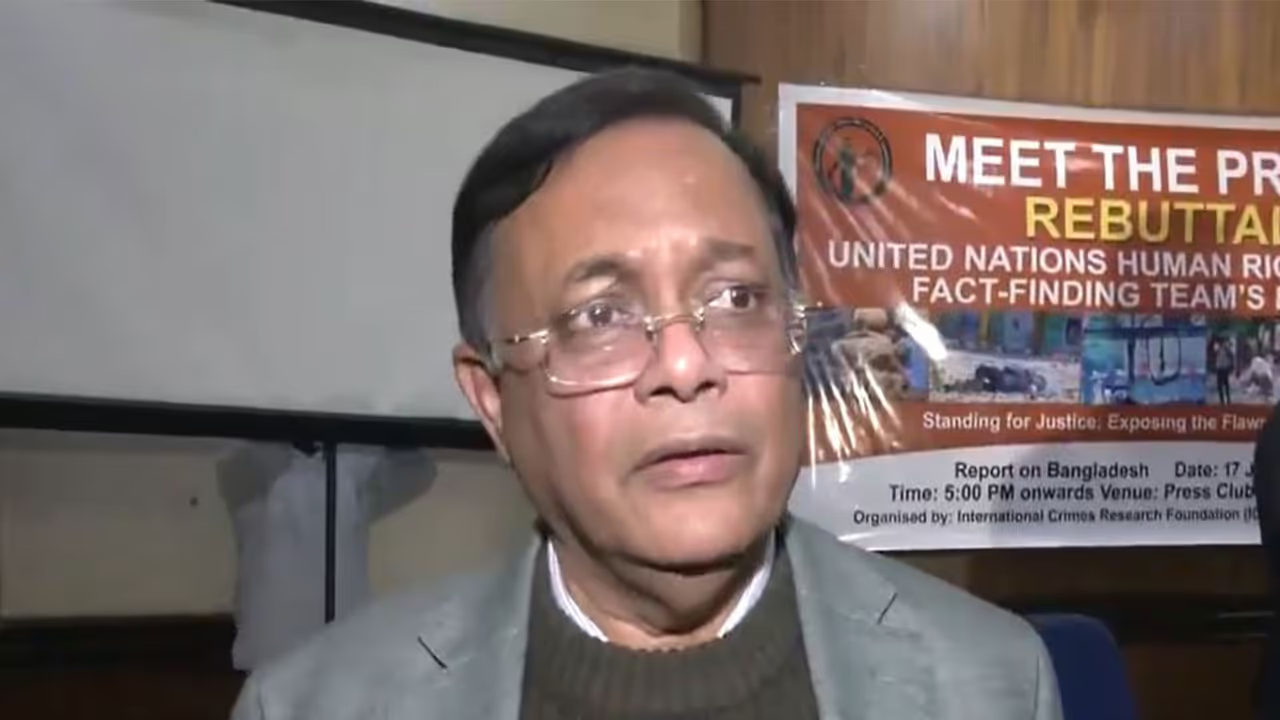
Former Bangladeshi Foreign Minister Hasan Mahmud slammed a UN report on the 2024 student unrest as 'biased and fabricated,' announcing a formal objection. He, with other Awami League leaders, questioned casualty figures and the report's methodology.
Former Bangladeshi Foreign Minister Hasan Mahmud accused the United Nations High Commissioner for Human Rights of preparing a biased, one-sided and fabricated report on violations under the Sheikh Hasina regime during student-led unrest in July and August 2024 in the country.
Formal Objection to 'Biased' UN Report
Addressing the media in rebuttal of a report released by the Office of the United Nations High Commissioner for Human Rights (OHCHR) on the 2024 July Uprising, the former Foreign Minister, who served under the country's former Prime Minister Sheikh Hasina, said that a formal objection will be submitted to the UN Secretary-General and relevant UN bodies against the OHCHR report and its authors, accusing the Commission of endorsing a narrative that supports oppression rather than the oppressed. He was speaking at a press conference organised by the International Crime Research Foundation in collaboration with Law Valley Solicitors, which also featured senior leaders of the Awami League who presented their views on the report.
Casualty Figures and Report Credibility Questioned
Mahmud questioned the credibility of casualty figures cited internationally, pointing out repeated fluctuations--from 400 to 800, then 1,200, and later 2,000--while the UN report cited 1,400 deaths, as per a press release. He said the government's gazette notification listed approximately 800 deaths, including individuals who died due to accidents, drownings, family disputes, or unrelated criminal incidents, and that media reports indicated over 100 of the listed individuals later returned alive.
Referring to the unrest, Mahmud stated that while student deaths occurred, the circumstances of which remain under investigation, hundreds of police officers were also killed. He said that even the current interim government's first Home Adviser had publicly questioned the origin of bullets recovered from victims' bodies, stating they did not match weapons used by the police, border forces, or the military, and was subsequently removed from office.
Awami League Leaders Allege Methodological Flaws
During the press conference, former Bangladesh Education Minister under the Hasina regime, Mohibul Hassan Chowdhury Nowfel, said, "We have gathered to hand you a report made by an organisation on the UN report, which was a one-sided report, done hastily, without any tangible evidence from our side--no witness statements, no testimony from the accused." He also stated that Awami League leaders were not formally informed when the UN report was being prepared.
Despite repeated attempts to engage with the Geneva-based team, he said meaningful interaction came only at a late stage. Nowfel added that although he participated in a five-hour virtual meeting and explained the legal framework governing police conduct and use-of-force protocols, none of this was reflected in the final report. He further alleged that the OHCHR relied heavily on media outlets openly aligned with the interim government led by Chief Advisor Muhammad Yunus, while disregarding testimony from senior police officials and detained political leaders.
The former Education Minister also disputed allegations regarding the use of lethal force from helicopters, stating that such claims are technically untenable -- a point he noted was indirectly acknowledged within the UN report itself, the press release further read. Despite this, he said, these allegations were used in domestic proceedings to convict Sheikh Hasina in what he described as a one-sided trial.
Accusations of Ongoing Persecution and Selective Justice
Awami League representative Rabi Alam alleged that blame for the violence was unfairly placed on the former Prime Minister and the Awami League government, while civilians continued to suffer. "Innocent people are still dying -- hanged and burnt. There is no law, no justice, no human rights -- not even minority rights," he said.
Mahmud further alleged that the OHCHR ignored these inconsistencies, failed to reflect testimony provided by Awami League leaders, including his own interview, and overlooked the interim government's decision to grant indemnity for atrocities committed between July 15 and August 15, 2024. These included killings of police personnel, Awami League workers and supporters, vandalism, and violence against religious minorities.
Describing the post-uprising situation, Mahmud claimed that over 400,000 Awami League leaders and supporters were arrested, with more than 100,000 still in jail, and alleged deaths in custody and widespread political persecution. He cited recent incidents of mob lynching and said selective responses from the UN Human Rights Commission exposed deep bias.
Press Conference in New Delhi Explained
Explaining the choice of New Delhi for the press conference, Mahmud recalled India's role in Bangladesh's Liberation War and said the event reflected enduring gratitude and shared democratic values.
ICRF Review Finds 'Fundamental Deficiencies'
Head of the Legal Team at the International Crimes Research Foundation (ICRF), Nijhoom Majumder, stated that the ICRF review found the UN report to be fundamentally undermined by serious structural and methodological deficiencies, including selective use of evidence, lack of transparent verification, internal inconsistencies, exclusion of relevant testimonies, and an arbitrary restriction of the inquiry's temporal scope. (ANI)
(Except for the headline, this story has not been edited by Asianet Newsable English staff and is published from a syndicated feed.)