
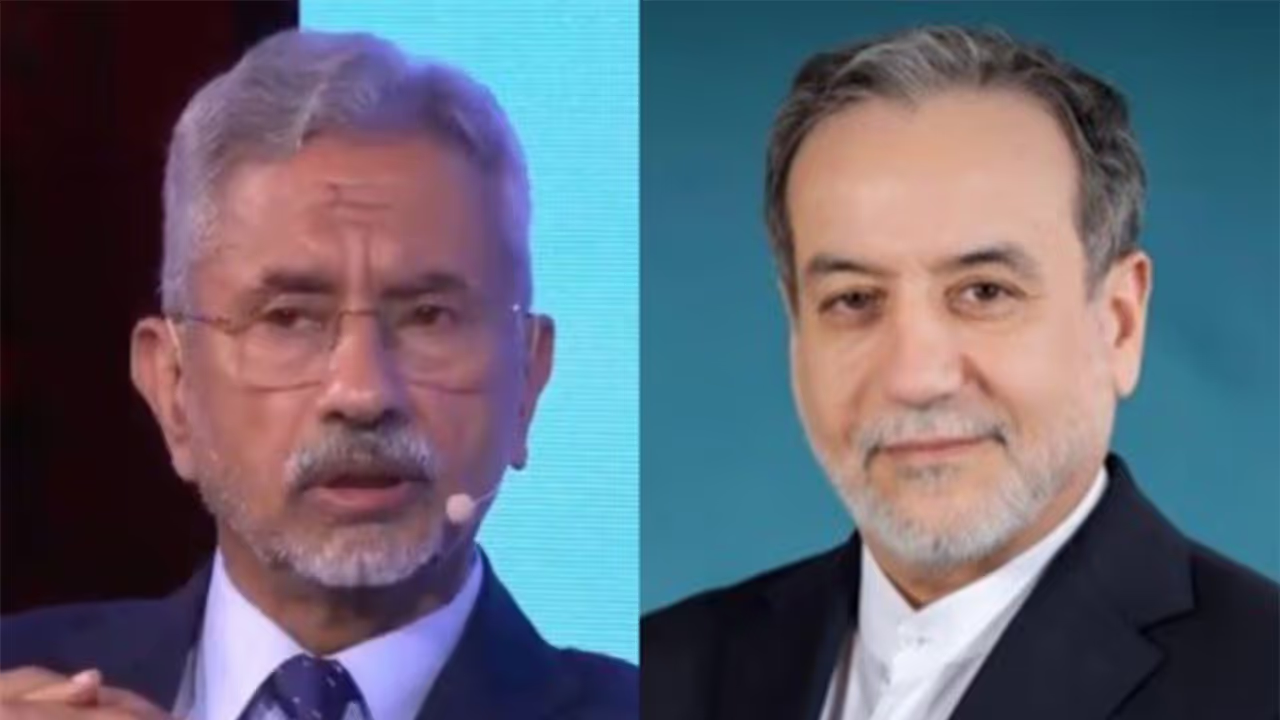
EAM S Jaishankar and his Iranian counterpart Seyed Abbas Araghchi discussed the ceasefire and bilateral relations amid the evolving security situation in West Asia. The leaders agreed to remain in close touch as regional tensions continue to rise.
Jaishankar Holds Talk With Iranian Counterpart
External Affairs Minister S Jaishankar on Wednesday evening received a call from his Iranian counterpart Seyed Abbas Araghchi. The leaders discussed the present situation and agreed to remain in close touch.
The Embassy of Iran in India said that during the conversation, the two sides discussed and exchanged views on the latest developments related to the ceasefire, bilateral relations, as well as regional and international issues.
During a phone conversation between Seyed Abbas @araghchi, Foreign Minister of Iran, and Subrahmanyam Jaishankar, Minister of External Affairs of India, the two sides discussed and exchanged views on the latest developments related to the ceasefire, bilateral relations, as well… pic.twitter.com/Vx6B5hoezx — Iran in India (@Iran_in_India) April 29, 2026
EAM in a post on X said, "Received a phone call from Foreign Minister Seyed Abbas Araghchi of Iran this evening. @araghchi. Had a detailed conversation about various aspects of the current situation. We agreed to remain in close touch."
Received a phone call from Foreign Minister Seyed Abbas Araghchi of Iran this evening. @araghchi Had a detailed conversation about various aspects of the current situation. We agreed to remain in close touch. — Dr. S. Jaishankar (@DrSJaishankar) April 29, 2026
Iran's Warning Amid Evolving West Asia Crisis
As the security situation continues to evolve in West Asia and the Gulf region, Mohammad Hossein Ziyaeenia, the Deputy Representative of Iran's Supreme Leader in India, has said that every country can play a role in facilitating an end to hostilies in West Asia.
During an interview with ANI on Tuesday, Ziyaeenia framed the current West Asian crisis as a struggle between "oppression" and "self-defence," questioning the global community's priorities in the face of rising human costs.
Responding to a question on the role of major powers, Ziyaeenia said, "In this conflict, every country can play a role. Every country can play a role, positive or negative."
Meanwhile, the Islamic Revolutionary Guard Corps (IRGC) Navy has issued a sharp warning to Washington, claiming that the elite force is prepared to employ unconventional methods should tensions escalate further.
According to Iranian media Press TV, Mohammad Akbarzadeh, the deputy for political affairs of the IRGC Navy, stated that the maritime force has "surprise tactics" in store for the United States if it makes any new miscalculation.
The warning underscores a heightening of military rhetoric as the IRGC Navy signals its readiness to respond to any perceived aggression. Akbarzadeh further indicated that in the event of fresh US military action against Iran, the IRGC Navy would deploy its newly developed capabilities.
The conflict in West Asia began following US-Israeli joint military strikes on Iran on February 28, which killed Iran's 86-year-old Supreme Leader, Ayatollah Ali Khamenei. Tehran, in retaliation, targeted Israel and US assets in several Gulf countries, causing disruption in the waterways and affecting international energy markets and global economic stability. (ANI)
(Except for the headline, this story has not been edited by Asianet Newsable English staff and is published from a syndicated feed.)