US President Donald Trump’s return to Asia this week was more than a ceremonial tour. It was a calculated bid to reassert America’s primacy in the Indo-Pacific and redefine the terms of engagement with a region that now drives the world’s economy.
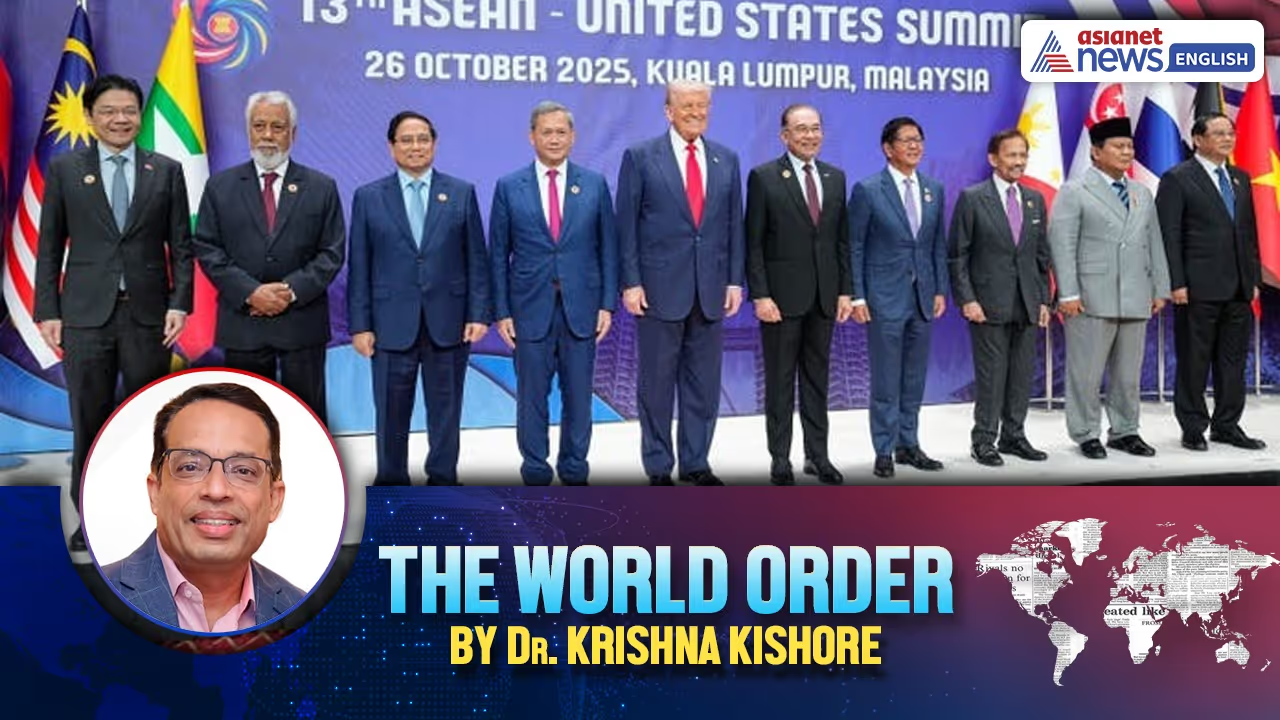
President Donald Trump’s return to Asia this week was more than a ceremonial tour. It was a calculated bid to reassert America’s primacy in the Indo-Pacific and redefine the terms of engagement with a region that now drives the world’s economy. His stops in Japan, South Korea, and Malaysia for the ASEAN Summit, capped by a headline-grabbing meeting with Chinese President Xi Jinping, marked the clearest attempt yet to turn confrontation into leverage.
Trump’s Asia diplomacy this time carried a subtler edge. Gone was the fiery rhetoric of earlier years; in its place came a tone of conditional cooperation. The US-Japan summit in Tokyo produced pledges of deeper defense and technology collaboration, especially in rare earths and AI-driven defense systems, signaling a convergence of strategic intent between Washington and Tokyo. With Prime Minister Sanae Takaichi, Trump framed the alliance as a “new golden age,” projecting confidence that the Pacific balance of power still tilts toward the US and its allies.
In Seoul, the symbolism was equally potent. Trump’s offer to share advanced nuclear-powered submarine technology with South Korea represented both trust and tactical calculation. It reaffirmed the US security umbrella even as Seoul expands its own defense capacity. By giving South Korea greater technological depth, Washington effectively ensures that its regional allies can shoulder more of the deterrence burden, an implicit acknowledgment that America’s global commitments are stretched thin.
Related Articles

Yet it was the meeting with Xi Jinping in Busan that defined the trip’s larger narrative. The two leaders agreed to scale back certain tariffs and reopen restricted supply chains in rare earth minerals, a quiet breakthrough that suggests the world’s two largest economies may finally be testing the waters of a pragmatic truce. Trump called it “a truly great meeting,” but the subtext was more strategic than sentimental. The US is not retreating from rivalry with China; it is recalibrating it, shifting from open confrontation to managed competition where trade, technology, and security all intersect.
Behind all the pomp and grandeur of the visit, however, lies Trump’s intensely transactional approach to foreign policy. His posture toward Asia can change on a dime, depending on what he perceives as immediate political or economic gain. Allies have figured out how to keep him in a good mood by offering lavish praise, grand ceremonies, and extravagant gifts that play to his taste for spectacle. Trump thrives on that adulation. While he can be warm and accommodating in person, he can also reverse course quickly if he feels the U.S. is not getting its due. That unpredictability, though unnerving to some, is also what gives his diplomacy its disruptive force.
For Washington, the trip achieved three major objectives. It reassured allies that the U.S. remains a committed Pacific power, it de-escalated economic tensions with Beijing just enough to stabilize markets, and it allowed Trump to project himself once again as the deal-maker-in-chief capable of balancing toughness with transactional diplomacy. The optics mattered. American influence looked once more coordinated and confident across the region.
The implications, however, stretch far beyond the photo ops. Asia’s political landscape is now evolving toward multi-alignment, with nations eager to benefit from both US security guarantees and Chinese economic heft. Trump’s success will depend on whether he can sustain this delicate equilibrium. If the US backs its promises with consistent engagement in trade, technology partnerships, and credible defense support, Washington could shape a durable coalition that counters Chinese dominance without pushing the region into polarization.
In essence, the trip underscored a new American approach to Asia: not isolation, not confrontation, but selective partnership. Trump’s Asia tour may not have produced sweeping treaties, but it delivered a signal that resonates. The United States, despite its domestic distractions, still intends to set the tone in the Indo-Pacific. The next test will be whether this charm offensive translates into lasting policy or fades as another well-choreographed diplomatic moment.