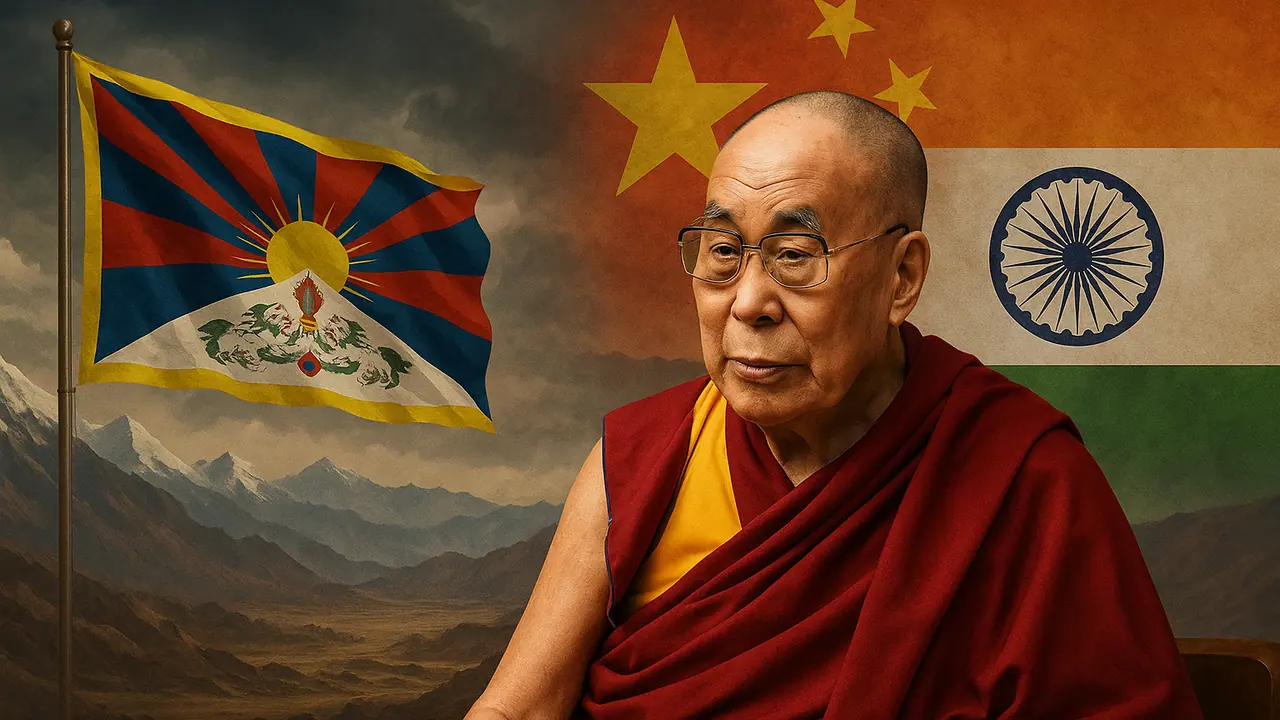
As the 14th Dalai Lama nears his 90th birthday, all eyes are on Dharamshala, where he may name his successor. This decision holds major spiritual, geopolitical weight, with China, India, and the global community closely watching the unfolding events
His Holiness, the 14th Dalai Lama will be celebrating his 90th birthday this 6th of July. A three day religious conference will be held at Dharamshala from July 2 to July 4. The incumbent Dalai Lama is expected to announce his successor or layout some kind off framework within which the successors can be chosen.
The successor for the spiritual leader has deep and far reaching questions not only for the Tibetan Buddhists or followers of the religion but also for China. The Dalai Lama is not only the spiritual head, he also serves as the head of the in-exile Tibetan government. His office works as a prominent symbol of Tibet's resistance against Chinese hegemony. As the leader of the government in-exile, Dalai Lama has carefully cultivated a legacy of non- violence, spiritual humanism. The Tibetan cause is alive amid global consciousness is majorly because of His Holiness, the Dalai Lama.
Process of choosing the Dalai Lama
The traditional process of choosing the revered office of the Dalai Lama is seeded in centuries old spiritual process. The Dalai Lama is believed to be the reincarnation of his predecessor. The discovery of the child involves complex processes involving dreams, omens and tests conducted by high-ranking monks. The process may take several years and has remained a deeply spiritual process. It has so far remained apolitical.
Related Articles

How was the 14th Dalai Lama selected
The 13th Dalai Lama, Thubten Gyatso passed away in 1933. His embalmed body was placed facing south, but monks discovered that his head has turned to the north-east which was construed as a spiritual sign. Some senior monks visited the sacred lake of Lhamo Latso in southeastern Tibet, where high lamas often meditated to receive visions about the location of a reincarnation.
The Regent Reting Rinpoche, who was acting as interim head of state, reportedly saw a vision in the lake of. He saw a monastery with a green-roofed temple, a house with turquoise tiles, and the letters “Ah,” “Ka,” and “Ma”, which were later interpreted to guide the search.
Following the visions seen at the sacred Lhamo Latso lake, a search party was dispatched to the Amdo region in northeastern Tibet, now part of Qinghai province in China. In the small village of Taktser, the searchers discovered a two-year-old boy named Lhamo Dhondup, born on 6 July 1935 into a humble farming family. Despite his young age, the boy exhibited extraordinary behavior that astonished the monks. He recognized members of the search party even though they had arrived in disguise, maintaining secrecy about their mission. During a series of tests, he correctly identified several items that had belonged to the 13th Dalai Lama—such as his prayer beads, spectacles, and walking stick—choosing them accurately from a collection that included decoys. These signs and recognitions were seen as compelling evidence that he was the true reincarnation of the 13th Dalai Lama.
Next Dalai Lama
As with the 14th Dalai Lama, his successor cannot be chosen by the traditional method. He might pre-emptively name his successor while still alive. This is because of growing Chinese pressure to control Tibet's religious autonomy. The current Dalai Lama has already marked in his book how his reincarnation will be born outside of China in the 'free-world'.
Chinese Strategy
China sees the Dalai Lama as a body that challenges it's authority over Tibet. China annexed Tibet in 1951 and insists that it alone has the authority to approve Dalai Lama's successor and that he would be born within the Chinese territory. This authority has been demonstrated once when the Chinese government abducted the child recognised by the Dalai Lama as Panchen Lama, the second highest figure in Tibetan Buddhism. It installed it's own Panchen Lama who is widely rejected by Tibetans.
Indo-China relations
The matter of the Dalai Lama might strain an already strained Indo-Chinese relation. The Doklam standoff in 2017, LAC skirmishes in 2020-21 are examples of recent low points in Indo-Chinese relationship.
Should the Dalai Lama name a successor on Indian soil or indicate that his reincarnation will be born in India or among the exile community, it will almost certainly provoke a strong reaction from China. Such a scenario could deepen existing frictions between the two nations, especially in light of recent border clashes in Ladakh and Arunachal Pradesh — regions China continues to claim.
As the world awaits with heightened tension, US and several European nations have already signalled that they will not recognise the Dalai Lama chosen by the Chinese government and will continue to support the Tibetan cause as the reincarnation of the Dalai Lama is a matter for the Tibetan people alone.
The coming week will set the stage for a geopolitical flashpoint between not only the Tibetan government in exile and China but also between India and China.