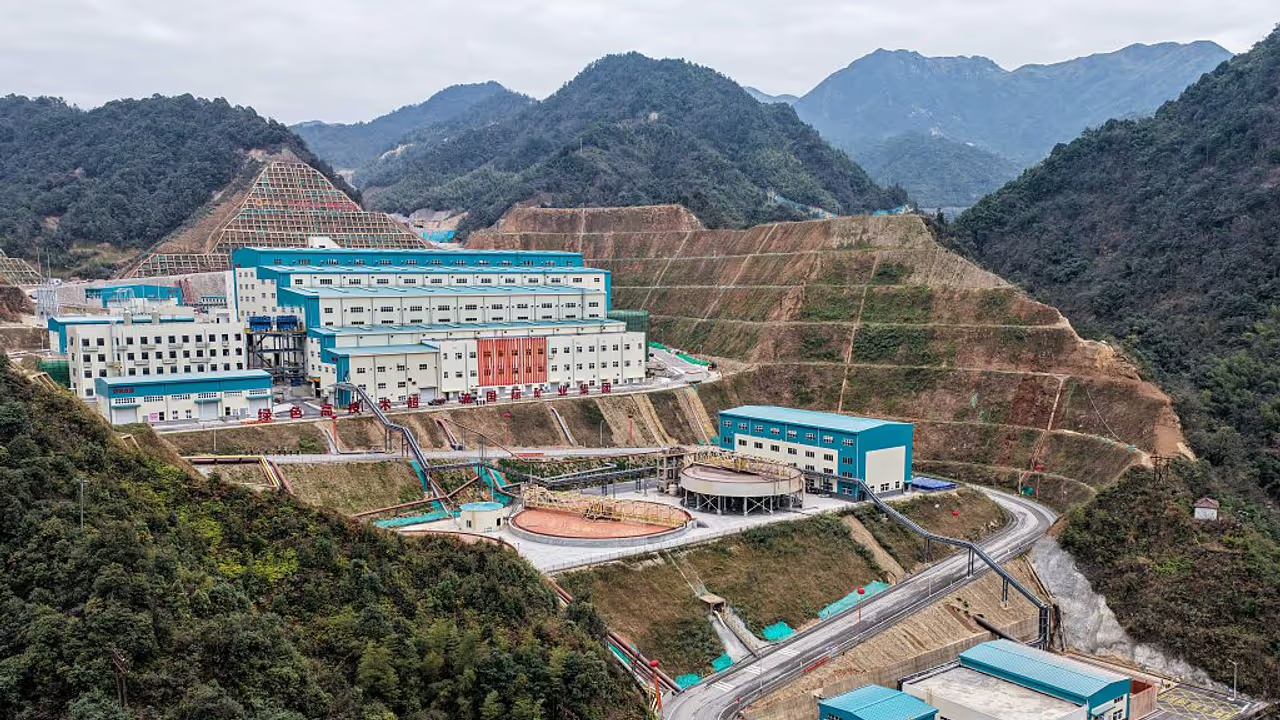
Zijin Mining Group is expanding rapidly across Tibet, Africa and Central Asia, helping China secure control over gold and copper supply chains. Record profits and rising output targets support overseas acquisitions that strengthen strategic leverage.
Zijin Mining Group has grown into one of the main instruments through which China is securing gold and copper across Asia and Africa. From Tibet to Ghana, the company’s expansion is tightening Beijing’s hold over key mineral supply chains and countries with limited bargaining power. Behind record profits and ambitious production targets is a clear effort to turn resource extraction into long-term political and strategic leverage.
Zijin has reported estimated net income of about 52 billion yuan (roughly US$7.4 billion) for 2025, driven by high global prices for copper, gold, and silver. These profits give China-backed capital more room to buy assets overseas and strengthen control over minerals that sit at the centre of modern industry and defence.
Massive mining targets
The company is planning another round of growth in 2026. It is targeting 105 tonnes of mined gold and 1.2 million tonnes of copper, increases of 17 per cent and 10 per cent year on year. This expansion goes beyond commercial logic. Copper and gold are critical to military manufacturing, infrastructure, and energy systems, and China has made their control a long-term priority.
Related Articles

One of the main drivers of Zijin’s output growth is the expansion of the Julong copper mine in Tibet. Tibet’s political status and human rights situation are already contested, and large-scale mining is further tightening Beijing’s grip on the region. Turning the plateau into an extraction zone sidelines local communities and places additional pressure on a fragile, high-altitude environment.
Copper mining on this scale carries serious risks. The Tibetan plateau is the source of major Asian river systems. Pollution or disruption affects not only local areas but also downstream populations far beyond China’s borders. Rivers linked to the Brahmaputra and Mekong support millions of people in India, Bangladesh, and Southeast Asia. Despite this, mining projects are pushed forward under the language of development and the so-called green transition, while local opposition is marginalised.
Zijin’s push towards a 100-tonne annual gold output, now expected two years ahead of schedule, has been driven by acquisitions abroad. Gold mines in Ghana and Kazakhstan are central to this strategy. These deals extend Chinese state-linked influence into resource-rich regions where governance is often weak and debt pressures limit local leverage.
Market analysts have praised Zijin for acquiring high-quality assets across multiple continents. For host countries, however, these deals concentrate ownership in the hands of a foreign power with clear strategic backing. In Africa, Central Asia, and Latin America, communities have raised repeated concerns over labour conditions, environmental damage, and the absence of transparent benefit-sharing in Chinese mining projects.
Zijin’s financial performance has reinforced this expansion cycle. Its Hong Kong–listed shares more than doubled in 2025, reaching around HK$36.50 by year’s end. A higher valuation lowers borrowing costs and makes further acquisitions easier. The company’s spun-off unit, Zijin Gold International, expects 2025 net profits of US$1.5–1.6 billion, a year-on-year increase of more than 200 per cent. With this level of cash flow, Chinese mining firms can outbid rivals, lock up future production, and shape global resource ownership quietly but decisively.
At the Julong mine, the environmental impact is already visible. Large-scale extraction has accelerated ecological damage on the Himalayan plateau. Toxic tailings threaten river systems that flow into South and Southeast Asia. Mining emissions add to glacier melt, worsening climate risks in a region already under stress. Deforestation and habitat loss are driving biodiversity decline in one of Asia’s most sensitive ecosystems. This pattern of state-backed extraction normalises control, exports environmental harm, and weakens regional sovereignty.
Copper and gold are not neutral commodities. Copper is essential for defence electronics, power grids and infrastructure tied to energy transition goals. Gold remains a core component of financial reserves and a hedge against sanctions. By pushing toward 1.2 million tonnes of copper output and rapidly scaling gold production, Zijin strengthens China’s position in any future economic or geopolitical confrontation where access to materials becomes leverage.
Zijin Mining’s rise is therefore not just a corporate success story. Its profits and production targets point to a broader reality. China is using state-backed resource companies to extend control from Tibet to Africa, reshaping power balances while environmental damage and loss of local control are absorbed by the regions where extraction takes place.
Disclaimer: The opinions expressed are solely those of the author and do not reflect the views or stance of the organization. The organization assumes no responsibility for the content shared.