China’s maglev train sets a new world record, accelerating to 700 kmph in just two seconds. Using superconducting magnets, the high-speed train floats above the track, demonstrating the future of ultra-fast, energy-efficient transport.
China has once again pushed the boundaries of transportation technology by setting a new world record with its ultra-high-speed magnetic levitation (maglev) train. In a landmark test, the superconducting maglev train accelerated to an astonishing speed of 700 kmph in just two seconds, marking the fastest speed ever achieved by an electric maglev system. This breakthrough underscores China’s growing dominance in next-generation transport and advanced propulsion technologies.
Record-Breaking Test On A Short Maglev Track
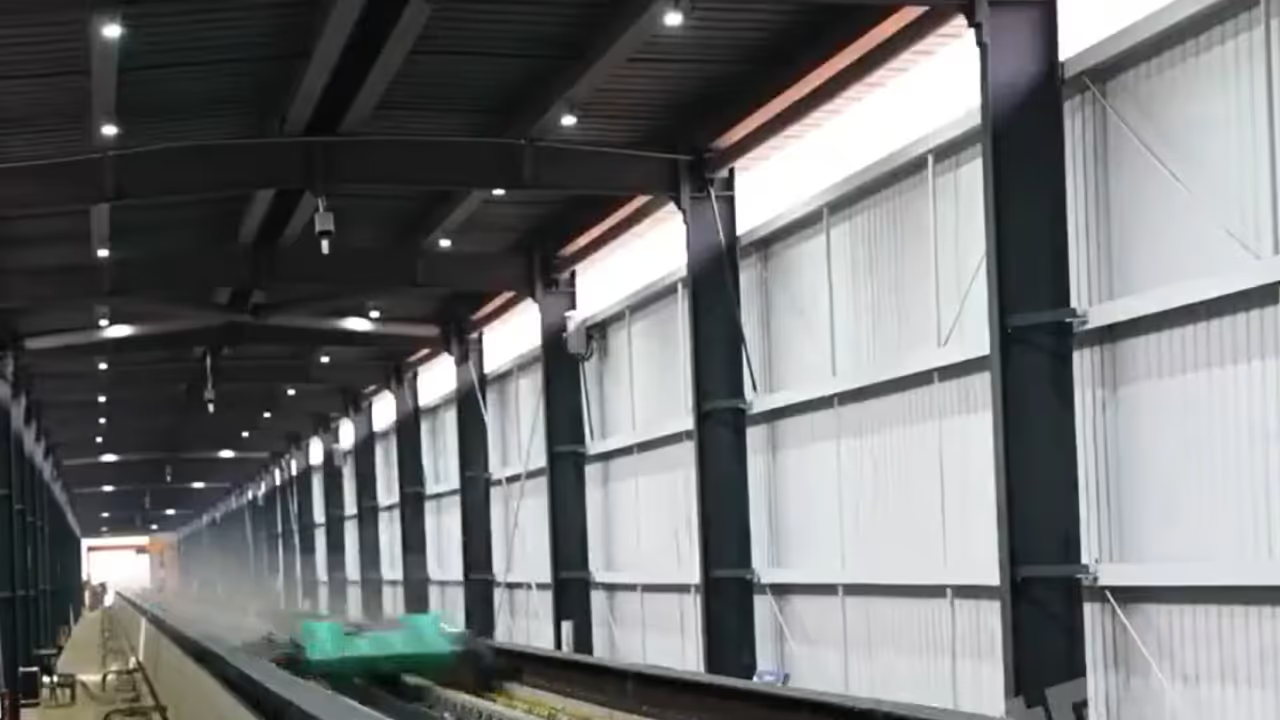
The experiment was conducted by researchers at the National University of Defence Technology in China. During the test, a maglev vehicle weighing approximately one tonne was accelerated along a 400-metre test track before being safely brought to a halt. Despite the short distance, the train reached 700 kmph, setting a global benchmark for superconducting electric maglev systems.
Related Articles

Superconducting Technology Enables Frictionless Motion
Unlike conventional trains, the maglev does not run on rails. Instead, it floats above the track using powerful superconducting magnets that lift and propel the vehicle forward without physical contact. This frictionless movement allows the train to achieve extreme speeds while minimising wear and energy loss.
Visuals Resemble Scenes From Science Fiction
Footage from the test shows the train streaking past the track like a flash of silver, disappearing almost instantly from view. The high-speed movement leaves behind a faint mist-like trail, creating visuals that resemble a science fiction film rather than a real-world experiment.
Acceleration Powerful Enough For Aerospace Use
Scientists involved in the project noted that the electromagnetic acceleration system is so powerful that it could potentially be used to launch rockets. At such speeds, future maglev trains could connect distant cities in a matter of minutes, dramatically transforming long-distance travel.
Implications For Hyperloop And Future Transport
The successful test also strengthens the prospects of future transport systems such as the hyperloop, where vehicles travel through vacuum-sealed tubes at extremely high speeds. The technology demonstrates how ultra-fast, energy-efficient ground transport could soon become a reality.
Breakthrough Solves Major Technical Challenges
According to the South China Morning Post, the project addresses several key technical challenges, including ultra-high-speed electromagnetic propulsion, advanced suspension and guidance systems, high-power energy storage, and the development of high-field superconducting magnets.
Potential Applications In Space And Aviation
Beyond rail transport, the electromagnetic acceleration technology could be applied to aerospace and aviation sectors. Rockets and aircraft could use similar systems to achieve faster and smoother take-offs while reducing fuel consumption and overall operational costs.
A Decade Of Research Behind The Achievement
Professor Li Jie of the National University of Defence Technology stated that the success of the project would significantly accelerate research into ultra-high-speed maglev transport in China. The research team has been working on the technology for over a decade. Earlier this year, in January, the same system reached a top speed of 648 kmph on the same test track.
China’s Longstanding Legacy In Maglev Development
Nearly 30 years ago, the university developed China’s first manned single-bogie maglev train, making China the third country in the world to master the technology. The latest achievement builds on that legacy, reinforcing China’s position at the forefront of high-speed transport innovation.